A neural network that counts light in ice ✛
Context
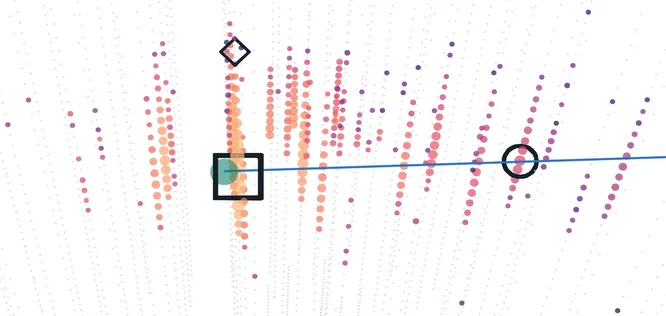
IceCube detects neutrinos via Cherenkov light left by charged particles in a cubic kilometer of glacial ice at the South Pole. To understand what neutrino arrived, one must simulate how light propagates from the particle cascade to each of the 5160 photosensors. The ice is inhomogeneous: dust layers, depth, and scattering anisotropy alter photon paths. Direct Monte Carlo simulation tracks each photon individually and requires enormous computational resources: one 2019 campaign consumed about 100,000 GPU-hours. Moreover, the flux of background atmospheric muons exceeds that of astrophysical neutrinos by six orders of magnitude, so estimating backgrounds requires huge sets of simulated events. This work stands apart: its nearest neighbors in the archive deal with neutrino signals from supernovae, dark matter, or radio methods, but not with accelerating photon transport. candela has no direct predecessors, although the need to speed up light simulation in neutrino telescopes has been long overdue.
Methods
The authors decomposed an event into point-like light sources: a muon traveling through ice loses energy continuously and stochastically, and each such local energy deposit produces a Cherenkov cascade. For each source and each sensor, the network receives a query: relative position in cylindrical coordinates along the source direction, absolute coordinates of source and receiver, and source energy. The SIREN network with six layers of 512 neurons outputs two numbers: expected photon yield per unit energy and arrival-time distribution represented as a mixture of eight inverse Gaussian distributions. Training used 65,536 configurations of isolated electromagnetic cascades generated by the reference simulator PPC. The loss function is a Poisson likelihood over arrival-time histograms. The full event is assembled by linear superposition of all source responses: light from each cascade propagates independently, so responses add up.
Results
On independent neutrino events with energies from 100 GeV to 1 PeV, candela reproduces the reference simulator PPC within statistical uncertainty. The median ratio of predicted photon yield to reference stays within 2% of unity across the entire sensor brightness range. Arrival-time distributions match the reference by Kolmogorov–Smirnov distance over six orders of magnitude of expected photon count. Discrepancies appear only at brightness close to photomultiplier saturation, where the detector response itself becomes nonlinear and unreliable. Event generation speed on an NVIDIA RTX 5090 GPU is 10–20 ms versus about a second for PPC at low energies, and at high energies the gap widens: PPC becomes more expensive with photon count, while candela is nearly energy-independent. Speedup reaches 50–100 times. An additional aggregation scheme inspired by the Lightcuts algorithm further reduces cost for complex events.
Implications
This work differs from its archive neighbors in that it addresses not a physics question about neutrino nature but a computational problem of fast and accurate light transport in a complex medium. Nearby works use neutrino signals for astrophysics or dark matter searches, but no one has built a differentiable surrogate for photon transport in IceCube. candela shows for the first time that a single neural network can replace direct Monte Carlo for the entire detector, including directional sources, embedded sensors, and an inhomogeneous anisotropic medium. This is not just acceleration: differentiability opens the way to gradient-based event reconstruction and calibration of ice optical properties, which currently dominate the telescope's systematic errors.
Future development
The next natural step is to use candela's differentiability for event reconstruction: gradients with respect to source position, direction, and energy would allow fitting neutrino parameters directly, without expensive numerical methods. Another direction is to add optical medium parameters to the network so the model can adapt to different types of ice or water, not just the specific IceCube glacier. In the long run, such an approach applies to any detector where light propagates in a scattering medium, from future neutrino telescopes to medical tomographs.
Impact
Speeding up simulations by 50–100 times reduces computational costs for generating background events, directly increasing the statistical power of astrophysical neutrino searches. candela's differentiability could change the approach to reconstruction and calibration in IceCube and other Cherenkov experiments.
Next steps
The immediate task is to integrate candela into the IceCube production pipeline for mass background event generation. In parallel, gradient-based reconstruction should be tested on real data and compared with existing methods.
Key open problems
In neutrino physics, the main unsolved problem is the origin of ultra-high-energy astrophysical neutrinos. Constraints on sources are limited by detector systematic uncertainties, which largely relate to ice optical properties. candela opens a path to direct calibration of these properties through differentiable modeling, potentially reducing systematics and bringing us closer to answering the source question.
The knowledge machine's view
This section is addressed to the author of the paper and their colleagues. Neighbouring works were found by meaning-based search across our archive, not by word overlap. We do not review: we show the field around the work.
What the work does
The authors have developed candela, a differentiable neural network that approximates the Green's function for photon propagation in Antarctic ice. The network is trained on 65,536 configurations of isolated electromagnetic cascades generated by the PPC simulator, and it reproduces reference results on independent events within statistical uncertainty. The event generation speed increases by one and a half to two orders of magnitude compared to direct simulation.
Where its strength is
The differentiability of the network opens up the possibility of gradient-based event reconstruction and calibration of the ice's optical properties, which directly addresses the dominant systematic uncertainties of IceCube. The SIREN architecture, with arrival times represented as a mixture of inverse Gaussian distributions, efficiently encodes the complex optics of the medium.
Where it could go next
- It might be interesting to look at applying candela in the context of atmospheric neutrino and background event analysis, where the high generation speed will allow increasing simulation statistics. In the archive nearby there is an analysis of a paper on neutrino tomography of the Earth, which also requires a large volume of simulations for accurate reconstruction.based on: The Earth’s Neutrino Confession: IceCube Reads the Planet in the Language of Weak Interactions arXiv:2607.02644
- The differentiability of candela can be used for gradient-based calibration of the ice's optical properties, which may be related to the methods described in the review on dark matter searches in neutrino telescopes, where systematic uncertainties play a key role.based on: Symphony of Shadows: Neutrino Telescopes Catch the Whisper of Dark Matter arXiv:2607.05335v1
- Perhaps it is worth considering transferring the approach to other neutrino telescopes or experiments that require fast calculation of Cherenkov light. In the archive there is a quick review of neural network methods for particle energy estimation, which may point to related applications.based on: Neural Network by Ear: How to Capture a Particle's Energy arXiv:2510.11469
Worth trying
- Test whether candela can be used for gradient-based event reconstruction by minimizing the discrepancy between predicted and observed light.
- Assess the possibility of using the network for calibrating scattering anisotropy, leveraging differentiability with respect to ice parameters.
- Investigate transfer learning to other detectors, such as KM3NeT, with adaptation to different geometry and optics.
Why this may matter
Speeding up light simulation in neutrino telescopes by orders of magnitude could significantly expand the analysis capabilities of IceCube, reducing computational costs and opening new avenues for accounting for systematic effects.
Nearby works in our archive
- The Earth’s Neutrino Confession: IceCube Reads the Planet in the Language of Weak Interactionssimilarity 0.51
- Catching the Neutrino Wind: Why the Faintest Breeze in the Universe Demands the Impossiblesimilarity 0.51
- Symphony of Shadows: Neutrino Telescopes Catch the Whisper of Dark Mattersimilarity 0.51
- Neural Network by Ear: How to Capture a Particle's Energysimilarity 0.50
- Polar Flip: How Neural Networks Catch Invisible Clumps of Dark Mattersimilarity 0.49
- A Universal Physicist from a Foreign Experimentsimilarity 0.49
The archive is sparse around this work: the closest review is only 0.51, against a usual 0.64. It looks like few have drilled nearby.
IceCube ice at depths of 1.5–2.5 km is so transparent that photons can travel hundreds of meters, scattering off bubbles and dust. The candela network learns exactly this 'memory' of the ice: it predicts not only how much light will arrive but also when, with nanosecond precision.
Key numbers
- speedup: 50–100 times
- detector volume: 1 cubic kilometer
- number of training configurations: 65,536
- event generation time: 10–20 ms
- photon yield accuracy: within 2%