A Neural Network That Counts Light in Ice ✛
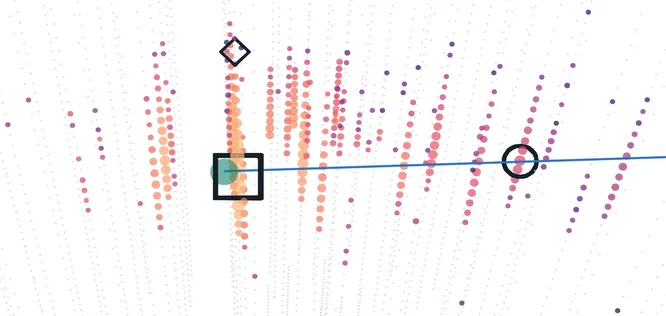
Imagine an interpreter at a meeting where everyone speaks a language they don't know. At first, they have to listen to every word, write it down verbatim, and then check against the original. That's how simulations for the IceCube neutrino telescope work: they track every photon born in the Antarctic ice, traveling hundreds of meters to hit a sensor. One campaign takes about 100,000 hours of powerful GPU time, because the ice is heterogeneous, layers of dust and bubbles bend the path of light, and each photon has to be tracked individually.
The neural network candela, developed at Harvard and MIT, behaves differently. It learns the very language of the ice: given the source and sensor coordinates, it instantly outputs how much light will arrive and with what spread in time. Inside, the network has six layers of 512 neurons, and it was trained on 65,536 configurations of isolated cascades generated by the reference simulator. Instead of running billions of photons, the network sums responses from all sources, much like an interpreter assembles the meaning of a sentence from familiar words.
Accuracy does not suffer. On independent neutrino events with energies from 100 GeV to 1 PeV, the predicted photon yield matches the reference within 2%, and the arrival time distribution matches the reference over six orders of magnitude in expected photon count. Discrepancies appear only where the sensor itself becomes nonlinear, that is, at brightness close to saturation.
Previously, light simulation was the most expensive step in IceCube data analysis. Now that the interpreter has learned the language, you can not only compute backgrounds faster but also solve the inverse problem: fit neutrino parameters directly using the network's gradients. This paves the way for calibrating the optical properties of the ice, which today contribute the largest systematic uncertainties for the telescope.
The interpreter, who used to get distracted by every rustle in the room, now summarizes the meeting in seconds. The Antarctic ice, which stores the traces of cosmic neutrinos, becomes more understandable.
IceCube ice at depths of 1.5–2.5 km is so transparent that photons can travel hundreds of meters, scattering off bubbles and dust. The candela network learns exactly this 'memory' of the ice: it predicts not only how much light will arrive but also when, with nanosecond precision.