Weak Field, Strong Current: The Nernst Effect in Multilayer Graphene ✛
An ordinary piece of graphite grown from gas is not suitable for converting heat into electricity. Inside it there are two types of charges: electrons and holes. They move in opposite directions and cancel each other out, so there is no current. But if you place this piece in a magnetic field and heat it from one side, the charges start moving in one direction. It is like a crowd of people that a traffic controller directs toward a single exit. This phenomenon is called the Nernst effect. Previously, it was thought that in cheap carbon films this effect is too weak.
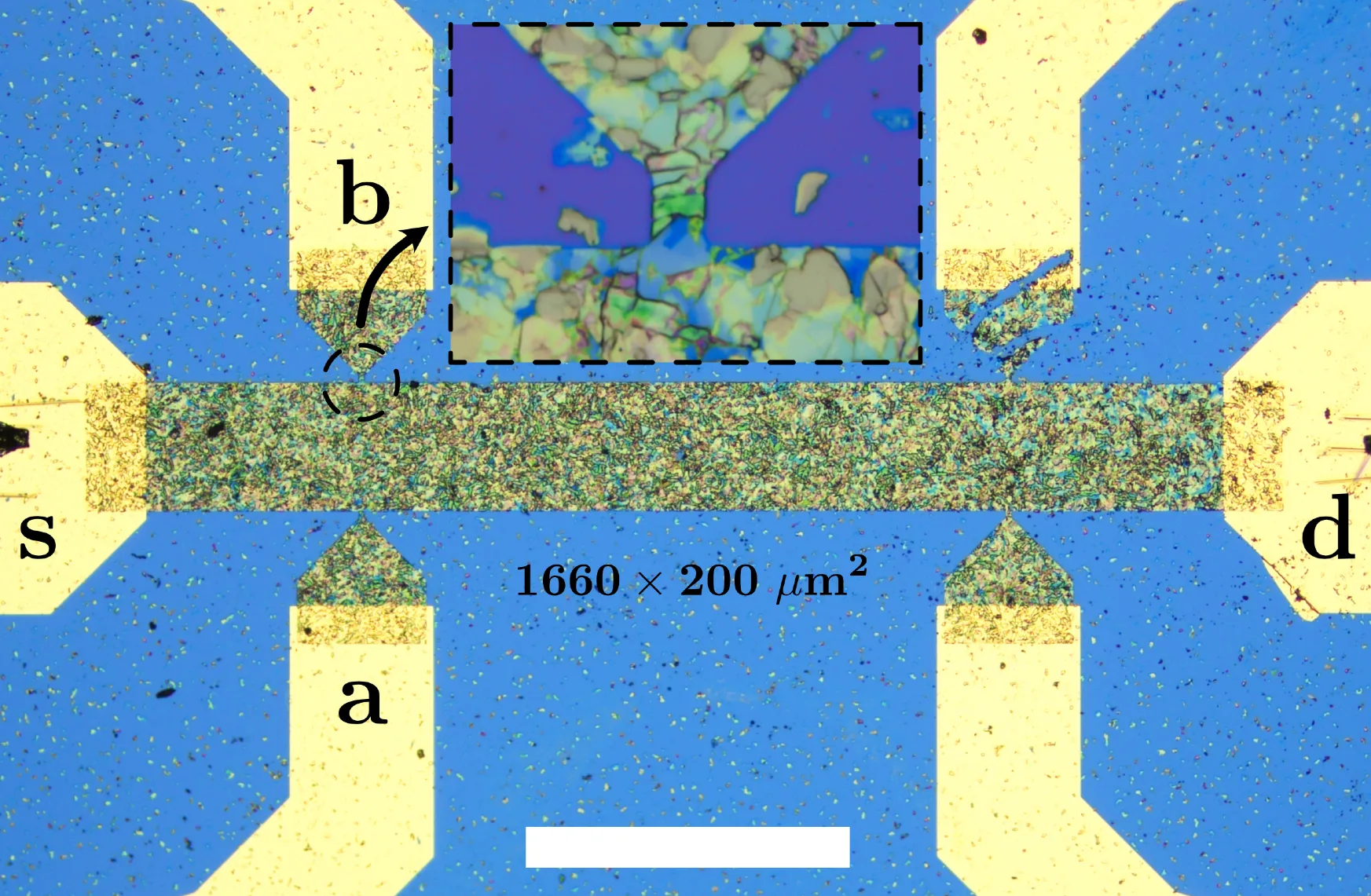
The scientists grew a multilayer graphene film with a thickness between 20 and 100 nanometers. It is like a stack of very thin carbon sheets. The film was heated with a laser, and the magnetic field was created by small permanent magnets. It turned out that even a weak field makes the charges move in one direction, and a voltage appears. At a field of 315 millitesla (similar to a refrigerator magnet), the voltage reached 270 microvolts per kelvin. This is several times larger than in the best semiconductors.
Previously, it was believed that cheap graphene could not produce a strong Nernst effect. Now it turns out that it can. This means that cheap devices can be made that harvest waste heat and convert it into electricity. For example, from the warmth of a palm or an exhaust pipe. The magnetic field, acting like a traffic controller, made the charges move in one direction, and the piece of graphite became useful.
A magnetic field of just 4 mT, produced by a small permanent magnet, is already enough to make the transverse voltage in a graphene film equal to the longitudinal one. This field is hundreds of times weaker than that of a typical refrigerator magnet.