Weak Field, Strong Signal: The Nernst Effect in Multilayer Graphene ✛
Context
This work stands apart from its neighbors on the archive: nearby studies cover graphene, superconductivity, and quantum models, but no one has measured the thermoelectric voltage in a magnetic field for chemically grown multilayer films. Neighboring articles investigate superconductivity in graphene and graphyne, heat transport in layers, and magnetoresistance. All touch on quantum or collective phenomena in thin layers, but the thermoelectric response in a weak field remained a blank spot. This work shows for the first time that cheap CVD graphene can produce a large transverse thermoelectric signal at room temperature.
Methods
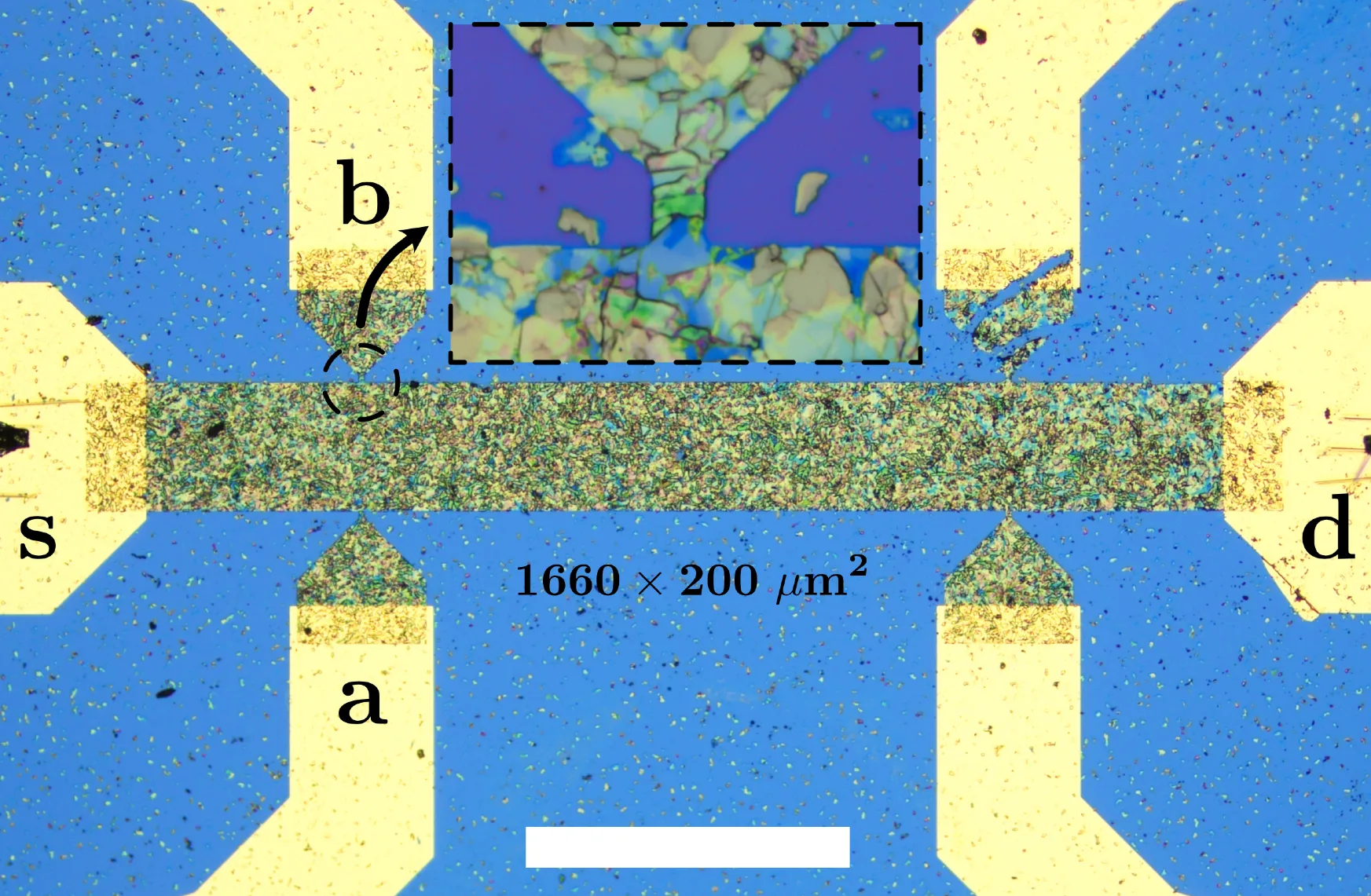
A multilayer graphene film grown by chemical vapor deposition was patterned into a Hall bridge 1660 µm long and 200 µm wide. The film thickness fluctuates strongly from 20 to 100 nm, and grains are about 10 µm in size. To create a local temperature gradient, the film was heated with a focused infrared laser beam (wavelength 8.1 µm, power 4 mW), with a spot size of about 20 µm. The magnetic field was produced by permanent magnets of various sizes, and its magnitude was determined from a calibration curve of magnetoresistance. Voltage was measured between source and drain, as well as between Hall probes, while scanning the laser across the entire sample area.
Results
At zero magnetic field, the photothermoelectric voltage map shows random patches of positive and negative sign with a characteristic size of 5 µm, indicating electron-hole puddles. Near metal contacts, the sign is fixed by doping, and the longitudinal thermoelectric voltage is about 10 µV/K. When the field is turned on, at just 4 mT the transverse voltage at the edges matches the longitudinal one at the contact, and the sign becomes consistent. At the maximum field of 315 mT, the transverse thermoelectric voltage reaches 270 µV/K, corresponding to a Nernst coefficient of 800 µV/(K·T). For comparison, indium antimonide, a benchmark high-mobility semiconductor, has a Nernst coefficient around 100 µV/(K·T). The film's magnetoresistance at 1 T was 100%, and fitting the quadratic part gave a mobility of (3–5)×$10^4$ cm²/(V·s), higher than that of ordinary graphite, due to twisted layers.
Implications
This work stands out from its archive neighbors by being the first to demonstrate a large Nernst effect in chemically grown multilayer graphene at room temperature and in millitesla fields. Neighboring articles explore superconductivity, quantum models, or heat transport, but none have measured the transverse thermoelectric voltage in such disordered films. The key point is the high mobility arising from layer decoupling due to random rotations, which allows carriers to be efficiently deflected by the magnetic field. This challenges earlier assumptions that CVD graphene is unsuitable for thermoelectrics because of low mobility.
Future development
The topic could evolve toward a theoretical description of the Nernst effect in inhomogeneous films with thickness and doping fluctuations. Existing models for magnetoresistance and the Hall effect in such media do not cover the transverse thermoelectric voltage. Experimentally, it would be interesting to test whether the large effect persists in films without twisted layers, and also to use selective Joule heating with an on-chip thermometer for more precise temperature measurements.
Impact
The results will influence the development of graphite-based thermoelectric generators, especially for harvesting low-grade heat. They are also important for understanding transport in disordered layered materials.
Next steps
Measure the Nernst effect in films with controlled twist angles and in samples without twisting. Build a theoretical model linking mobility and the Nernst coefficient in inhomogeneous thin films.
Key open problems
This work directly addresses the problem of thermoelectric efficiency in compensated semimetals, where the longitudinal thermoelectric voltage is suppressed by electron-hole symmetry. It shows that the transverse Nernst effect can bypass this limitation even in cheap polycrystalline films. The role of disorder and grain boundaries in enhancing or weakening thermomagnetic phenomena remains an open question.
The knowledge machine's view
This section is addressed to the author of the paper and their colleagues. Neighbouring works were found by meaning-based search across our archive, not by word overlap. We do not review: we show the field around the work.
What the work does
This work measures the transverse thermoelectric response (the Nernst effect) in a film of multilayer graphene grown by CVD. Local laser heating and a weak magnetic field (up to 315 mT) yielded a Nernst coefficient of up to 800 µV/(K·T), far higher than in conventional materials. The high carrier mobility, linked to the random twist angles between layers, explains the observed effect.
Where its strength is
Demonstrating a large Nernst effect in disordered CVD graphene at room temperature and in millitesla fields opens the door to cheap thermoelectric devices. Using random layer misorientation to boost mobility is an original move that could be carried over to other layered materials.
Where it could go next
- It may be interesting to compare the observed effect with the behavior of carriers at graphene edges: the archive has an analysis devoted to edge states in two-dimensional carbon. This would help clarify how edges and defects affect transverse transport in your films.based on: The Edge of Graphene: How the Rim of Two-Dimensional Carbon Behaves arXiv:2602.17906
- There is a nearby paper on turning on superconductivity with a magnetic field in graphene. Perhaps studying the competition or cooperation between superconducting fluctuations and the Nernst effect in multilayer systems will reveal new regimes of thermoelectric response.based on: Magnetic field switches on superconductivity in graphene arXiv:2607.06520
- The archive has an analysis of heat transport in iron and silicon films. Comparing the mechanisms that generate thermoelectric voltage in different disordered systems could reveal general patterns and help optimize composition and morphology for thermoelectric applications.based on: Turning Heat into Electricity: An Iron-Silicon Film arXiv:2602.09460
Worth trying
- Measure the Nernst effect in the same films at lower temperatures to separate the contributions of diffusion and phonon drag.
- Try varying the degree of layer misorientation (for example, by annealing or mechanical treatment) and track the correlation with mobility and the Nernst coefficient.
- Compare the response for films of different thickness and grain size to find the optimal parameters for the strongest transverse signal.
Why this may matter
If the effect reproduces in industrially grown films, it could lead to inexpensive thermoelectric generators that operate at room temperature and in weak fields, which matters for harvesting waste heat.
Nearby works in our archive
- The Edge of Graphene: How the Rim of Two-Dimensional Carbon Behavessimilarity 0.57
- Graphene Sandwich Accelerates Electronssimilarity 0.54
- Cosmic Kneading: Turbulent Amplification of Magnetic Fields in Newborn Neutron Starssimilarity 0.53
- Magnetic field switches on superconductivity in graphenesimilarity 0.53
- Superconductivity in Graphene: Magnetic Field Reveals the Secretsimilarity 0.52
- Superconductivity Without Wires: How to Catch a Persistent Currentsimilarity 0.51
- Turning Heat into Electricity: An Iron-Silicon Filmsimilarity 0.51
The archive is sparse around this work: the closest review is only 0.57, against a usual 0.64. It looks like few have drilled nearby.
A magnetic field of just 4 mT, produced by a small permanent magnet, is already enough to make the transverse voltage in a graphene film equal to the longitudinal one. This field is hundreds of times weaker than that of a typical refrigerator magnet.
Key numbers
- transverse thermoelectric voltage at 315 mT: 270 µV/K
- Nernst coefficient: 800 µV/(K·T)
- magnetoresistance at 1 T: 100%
- carrier mobility: (3–5)×104 cm²/(V·s)
- characteristic size of electron-hole puddles: 5 µm