Weak Field, Strong Current: The Nernst Effect in Multilayer Graphene ✛
On the lab bench lies a piece of graphite grown from gas, like a deposit on the wall of a reactor. Usually, such material is not suitable for converting heat into electricity: inside it, electrons and holes run in opposite directions and cancel each other out. But if you place this piece in a magnetic field and heat it from one edge, the charges start moving in one direction, like a crowd that a traffic controller directs to a single exit. This effect, discovered over a hundred years ago, is called the Nernst effect. Until now, it was considered too weak in cheap carbon films to be of practical use.
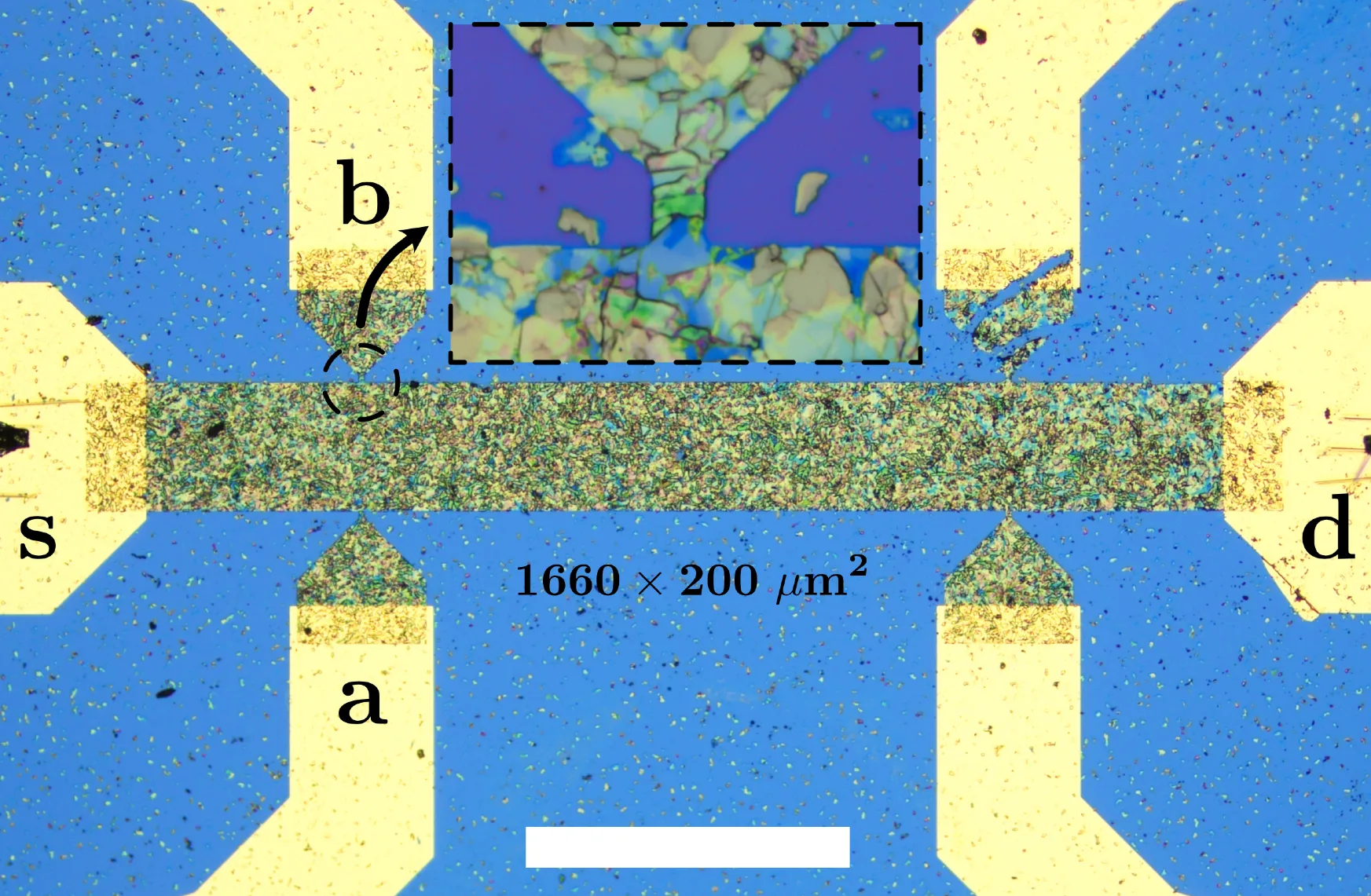
The researchers grew a multilayer graphene film using chemical vapor deposition. The film thickness varied from 20 to 100 nanometers, and the grains were about 10 micrometers in size. The film was heated with a focused infrared laser with a wavelength of 8.1 micrometers and a power of 4 milliwatts; the spot size was about 20 micrometers. The magnetic field was created by permanent magnets, and its magnitude was determined from the calibration curve of magnetoresistance. Voltage was measured between source and drain, as well as between Hall probes, while scanning the laser across the entire sample area.
When a field of just 4 millitesla was applied, the transverse voltage at the edges matched the longitudinal one at the contact, and the sign became consistent. At the maximum field of 315 millitesla, the transverse thermopower reached 270 microvolts per kelvin. This corresponds to a Nernst coefficient of 800 microvolts per kelvin-tesla. For comparison, indium antimonide, a benchmark semiconductor with high mobility, has a Nernst coefficient of about 100 microvolts per kelvin-tesla. The film's magnetoresistance at 1 tesla was 100%, and fitting the quadratic part gave a mobility of (3–5)×$10^4$ square centimeters per volt-second, which is higher than that of ordinary graphite, due to twisted layers.
Previously, it was thought that chemically grown multilayer graphene had too low mobility to produce a noticeable Nernst effect at room temperature and in weak fields. It turns out that the mobility in such films reaches (3–5)×$10^4$ square centimeters per volt-second, and the transverse thermopower reaches 270 microvolts per kelvin already at 315 millitesla, which is several times higher than that of benchmark semiconductors. This opens the way to cheap thermoelectric generators based on graphite, especially for harvesting low-grade heat.
The magnetic field acted as a traffic controller, forcing electrons and holes to move in the same direction, and the cheap carbon film unexpectedly turned out to be a strong thermoelectric material. Today, we can already design devices that collect waste heat and convert it into electricity using graphite films and weak magnets. The same piece of graphite that sat on the bench now promises to become the basis for generators that run on the heat of a palm or an exhaust pipe.
A magnetic field of just 4 mT, produced by a small permanent magnet, is already enough to make the transverse voltage in a graphene film equal to the longitudinal one. This field is hundreds of times weaker than that of a typical refrigerator magnet.