Calibration by Decay: How Silicon-25 Reveals FRIB's Precision ✛
Context
Studying beta-delayed charged-particle emission in proton-rich nuclei provides direct access to the Gamow-Teller strength distribution, isospin symmetry breaking, and properties of highly excited unbound states. However, precise measurements of such decays have long been hampered by experimental limitations: beam contaminants, summing of beta-particle energies, and resolution degradation due to thick stopping targets. The new combination of the ARIS separator and the cryogenic gas stopper ACGS at FRIB addresses these issues, delivering clean low-energy beams of radioactive ions. This work aligns with research on fast radio bursts and neutron stars, where precise nuclear spectroscopy is needed to understand processes under extreme conditions.
Methods
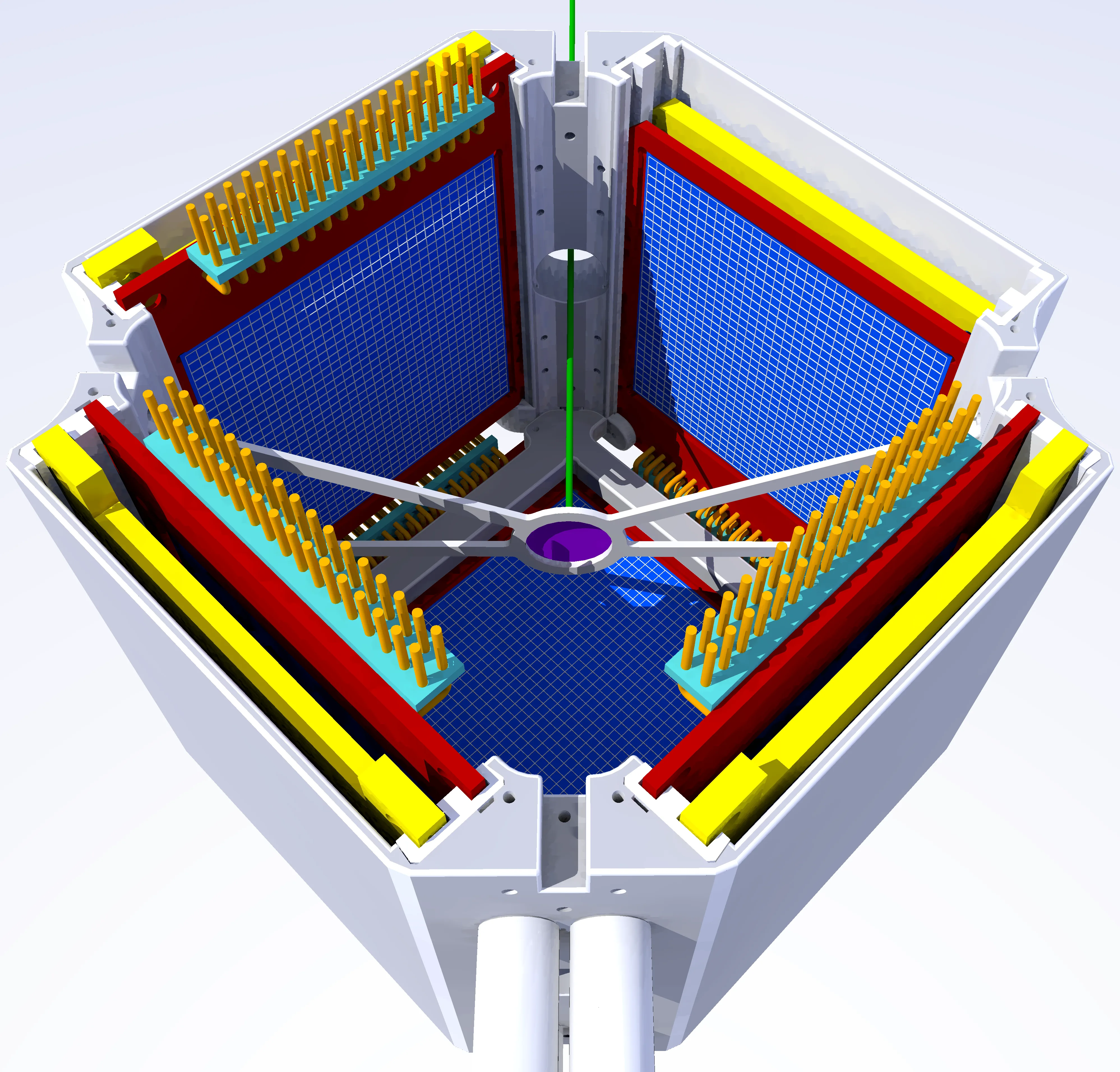
A beam of argon-36 was accelerated to 210 MeV/nucleon and directed onto a carbon target. The resulting silicon-25 nuclei were separated in the ARIS separator, slowed in the ACGS gas stopper, and implanted into a thin carbon foil 150 nanometers thick. Surrounding the foil were six silicon telescopes (a thin ΔE detector and a thick E detector) and two germanium detectors. Over four hours, 780 thousand protons were collected. Proton energies were reconstructed accounting for energy losses in the foil and detector dead layers, using SRIM tables. Calibration was performed using known proton lines from silicon-25 decay.
Results
A spectrum of beta-delayed protons was obtained with a resolution of about 3 keV, allowing previously unresolved transitions to be distinguished. New high-energy proton transitions were discovered, including a level at an excitation energy of 9008 keV in aluminum-25. The feeding of excited states in magnesium-24 was refined: transitions to the first 2+ excited state are more frequent than to the 0+ ground state. Interference patterns in proton lines provided reliable spins and parities for highly excited states in aluminum-25. The beta-strength distribution was extracted up to an energy of 10 MeV, close to the Q-value limit for electron capture. The experimental Gamow-Teller strength requires a quenching factor of 0.75, which is smaller than the standard 0.60.
Implications
This work demonstrates that a stopped beam at FRIB can achieve resolution and sensitivity previously unattainable for beta-delayed spectroscopy in this mass region. Unlike neighboring studies that focused on fast radio bursts or neutron star mergers, this is the first test of a precision charged-particle spectroscopy technique using a cryogenic gas stopper. This opens the way to studying nuclei near the proton drip line, such as proton-halo candidates aluminum-22 and phosphorus-26.
Future development
With increasing FRIB beam power and improved ion transport, it will become possible to calibrate thick E detectors with protons at higher statistics, improving accuracy. The technique can be extended to more exotic nuclei, including those expected to undergo direct two-proton emission. A detailed line-shape analysis is planned to extract the Gamow-Teller strength contribution to the isobaric analog resonance.
Impact
The technique is applicable for detector calibration and nuclear structure studies in experiments with stopped beams of radioactive ions. The beta-strength results are important for astrophysics, particularly for calculating reaction rates in stars.
Next steps
Perform beta-delayed proton measurements for aluminum-22 and phosphorus-26 using the same setup. Accumulate more statistics for analyzing the high-energy part of the spectrum and testing interference effects.
Key open problems
This work is directly related to the problem of Gamow-Teller quenching in proton-rich nuclei. The observed quenching factor of 0.75 instead of the standard 0.60 suggests a possible dependence of quenching on the distance from the valley of stability, warranting further investigation.
The knowledge machine's view
This section is addressed to the author of the paper and their colleagues. Neighbouring works were found by meaning-based search across our archive, not by word overlap. We do not review: we show the field around the work.
What the work does
The work at FRIB demonstrates, for the first time, precision spectroscopy of beta-delayed charged particles using a stopped beam. Using the decay of 25Si as a calibration source, the authors calibrated the detectors and refined the decay scheme, revealing new proton transitions and reliably determining the spins and parities of excited states in 25Al. They obtained a spectrum with a resolution of about 3 keV and extracted the Gamow-Teller strength distribution up to 10 MeV.
Where its strength is
The method combines the ARIS separator and the cryogenic gas stopper ACGS, providing clean low-energy beams and high resolution, which opens access to nuclei near the proton drip line. The achieved precision allows resolving closely spaced proton transitions and extracting spins and parities of highly excited states.
Where it could go next
- Extending the method to more exotic nuclei, such as proton-halo candidates 22Al and 26P, could be supported by similar approaches to nuclear decay studies described in a companion paper.based on: How Nuclear Decay Reveals the Universe's Secrets arXiv:2607.22983
- To improve the accuracy of charged-particle energy measurements, it may be worthwhile to look at beam control and detection techniques developed in the work on a crystalline undulator.based on: A Crystal Keeps an Eye on the Proton Beam arXiv:2601.14654
- The interpretation of the obtained spectroscopic data in the context of astrophysical processes, such as fast radio bursts, could be deepened using approaches from a study of magnetic field traces in distant explosions.based on: Gamma-Ray Burst Polarimetry: How Magnetic Fields Reveal the Secrets of Cosmic Catastrophes arXiv:2604.27480
Worth trying
- Test the method on the 22Al nucleus to search for a proton halo.
- Use thinner targets to further improve the energy resolution.
- Apply a similar detection scheme to other isotopes with beta-delayed proton emission.
Why this may matter
The development of precision spectroscopy of beta-delayed charged particles on stopped beams opens new avenues for testing models of the weak interaction and nuclear structure near the proton drip line, which is important both for fundamental physics and for astrophysical applications.
Nearby works in our archive
- How Nuclear Decay Reveals the Universe's Secretssimilarity 0.52
- A Crystal Keeps an Eye on the Proton Beamsimilarity 0.49
- Gamma-Ray Burst Polarimetry: How Magnetic Fields Reveal the Secrets of Cosmic Catastrophessimilarity 0.49
- A Sensitive Thermometer for X-rayssimilarity 0.48
- A Needle That Listens to Superconductorssimilarity 0.48
- How Photons Spin the Omegasimilarity 0.48
The archive is sparse around this work: the closest review is only 0.52, against a usual 0.64. It looks like few have drilled nearby.
Silicon-25, used as a calibration source, has a half-life of only 219 milliseconds, yet in four hours of measurements, 780 thousand protons were collected thanks to the high beam intensity.
Key numbers
- Half-life of silicon-25: 219.2 ms
- Number of registered protons: 7.8×10⁵
- Energy resolution: about 3 keV
- Carbon foil thickness: 150 nm
- Gamow-Teller quenching factor: 0.75