Calibration by Decay: How Silicon-25 Reveals FRIB's Precision ✛
Silicon-25 lives for just 219 milliseconds. In that time, it manages to emit a beta particle and, occasionally, a proton. These protons, ejected from the nucleus after beta decay, have become the calibration benchmark for a new microscope that physicists have assembled at the FRIB accelerator.
Previously, precise measurements of beta-delayed protons faced two problems: beam impurities and thick targets that smeared the energy resolution. Now, a beam of argon-36 is accelerated to 210 MeV per nucleon, hits a carbon target, and the resulting silicon-25 is separated in the ARIS magnetic separator. The ions are then slowed down in the cryogenic gas stopper ACGS and implanted into a carbon foil just 150 nanometers thick, thinner than the wall of a soap bubble.
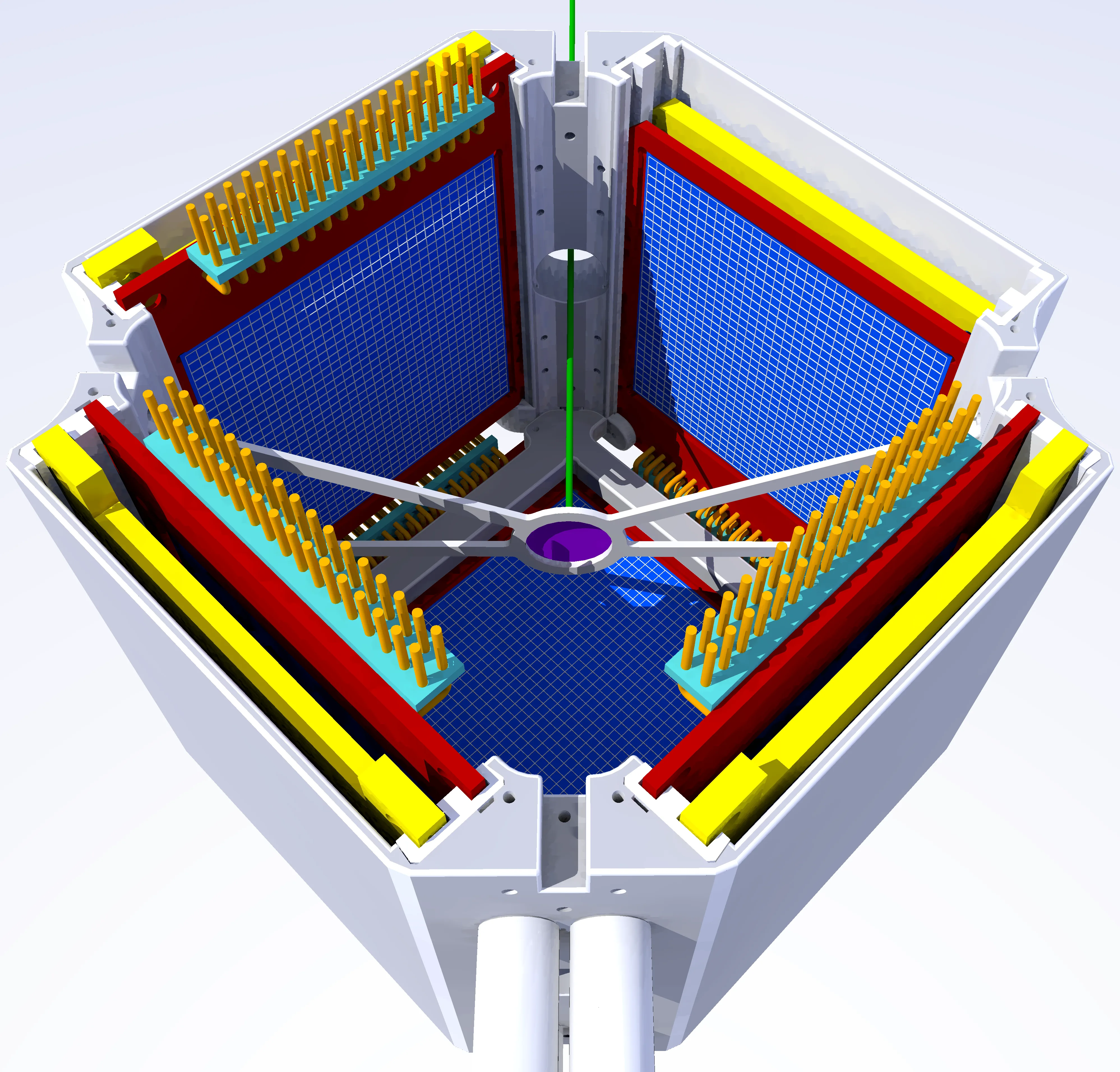
Around the foil sit six silicon telescopes and two germanium detectors. Over four hours, they collected 780 thousand protons. The energy of each proton was reconstructed, accounting for losses in the foil and detector dead layers, using SRIM tables. The result was a spectrum with a resolution of about 3 keV, which is like spotting individual hairs on a person's head from a kilometer away.
The new data showed that transitions to the first excited state of magnesium-24 occur more often than to the ground state. Interference patterns in the proton lines provided reliable spin-parity assignments for highly excited states of aluminum-25. The extracted beta strength up to 10 MeV required a quenching factor of 0.75 instead of the standard 0.60. This means that the quenching of the Gamow-Teller strength depends on how far the nucleus is from the line of stability.
The technique is ready for more exotic nuclei, such as aluminum-22 and phosphorus-26, which are suspected of having a proton halo. The same calibration benchmark that validated the new microscope will now reveal details that no one has seen before.
Silicon-25, used as a calibration source, has a half-life of only 219 milliseconds, yet in four hours of measurements, 780 thousand protons were collected thanks to the high beam intensity.