Angular resolution is the ability of an optical system — a telescope, microscope, or camera — to distinguish two closely spaced objects as separate rather than seeing them as a single blurred blob. It is fundamentally limited by the wave nature of light: when light passes through an aperture, it diffracts, creating a central bright spot (the Airy disk) surrounded by faint rings. If two point sources are closer than roughly the radius of that disk, their patterns merge and they become indistinguishable. The smaller the aperture or the longer the wavelength, the worse the resolution.
History
The diffraction limit was first quantified by Lord Rayleigh in 1879, building on earlier work by Airy on the diffraction pattern of a circular aperture.
How it works
The key formula is θ ≈ 1.22 λ / D, where θ is the smallest resolvable angle, λ is the wavelength of light, and D is the aperture diameter. This Rayleigh criterion sets a hard floor: no matter how perfect the optics, diffraction spreads each point source into a finite-sized pattern. To improve resolution, you either increase the aperture (build a bigger telescope) or use shorter wavelengths (e.g., X-rays instead of visible light). In practice, atmospheric turbulence often degrades resolution further, which is why space telescopes and adaptive optics are used.
In practice
Angular resolution determines the sharpness of astronomical images, the resolving power of microscopes, and the quality of satellite photography; it also sets the fundamental limit in X-ray microtomography, where the goal is to see tiny internal structures.
Fun fact
The Hubble Space Telescope's 2.4-meter mirror gives it an angular resolution of about 0.05 arcseconds — sharp enough to read a newspaper from 10 kilometers away, yet still limited by diffraction.
At night on a volcano summit, six telescopes stare at the same speck of light. Each catches its own copy of the wave, and if you combine their signals, you get an image that no single instrument could produce alone. But there's a catch: light captured by different stations cannot simply be added like photographs.
A camera looks at two distant sparks. They're so close together that they merge into a single fuzzy blob. It seems impossible to tell them apart — the classic limit of optical microscopy has been reached.
But quantum mechanics hints that the light field still holds a secret about where each spark sits.
Unlike regular cameras, event-based ones only record moments when light becomes brighter or dimmer. They don't produce snapshots; instead, they send an endless stream of such flashes. Scientists turned this stream into a sharp picture of the Earth while flying over it on a satellite. Each flash is like a piece of a mosaic; together they form a still image.
Imagine photographing a statue in dim light. You face a dilemma: take one bright shot or a series of dim frames from different angles. In the first case, quality is limited by photon noise, the graininess that arises from a lack of photons, while in the second, details overlap, making it harder to reconstruct the 3D structure.
The quantum many-body world is a jazz ensemble, where each electron improvises, continuously listening to all the others, and the overall wave function is born from this tense dialogue.
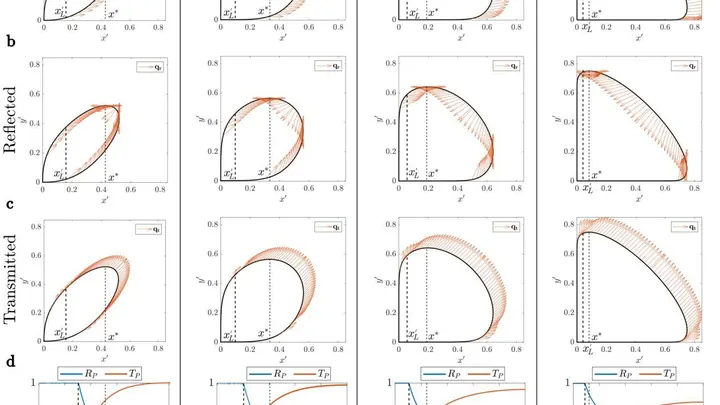
A river flows in one direction, but a wave on its surface travels in the opposite direction. The same splitting happens in hyperbolic materials: the energy of a light wave and its fronts diverge, preventing a sharp lens from being created.
Light from the star HD 163296 passes through the surrounding gas-and-dust disk like a flashlight beam through murky water. The disk's particles scatter the light, giving it a special property — polarization: the waves begin to oscillate in a single plane, like a rope shaken strictly up and down.