Three Cloud Layers of Jupiter express
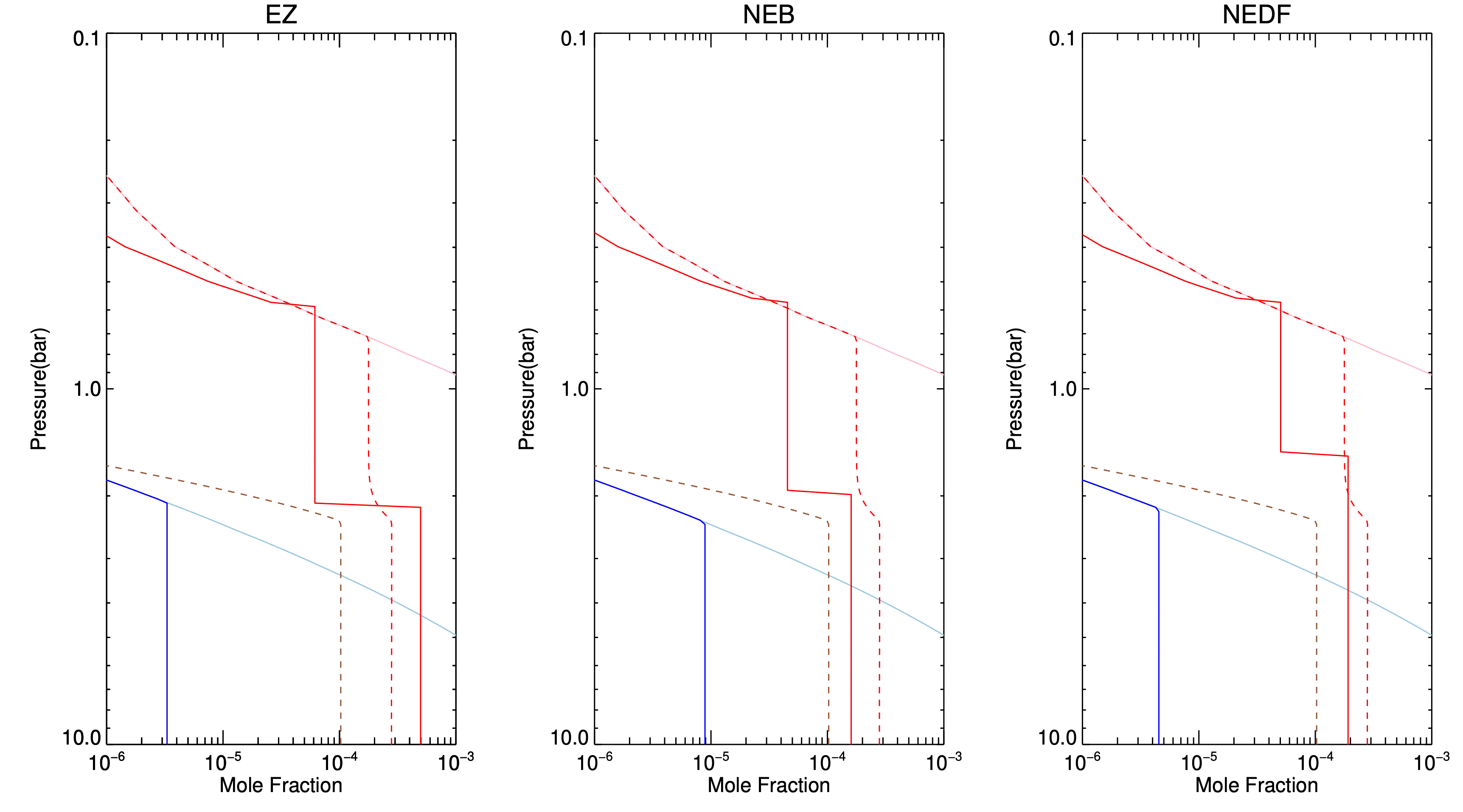
Jupiter's atmosphere resembles a layered cake, where each layer plays its role. Scientists took data from four instruments at once (VLT/MUSE, Cassini/VIMS, IRTF/SpeX, and Juno/JIRAM) and built a model of clouds and ammonia in the planet's equatorial zone, from 0.1 to 10 bar (pressure equivalent to hundreds of kilometers below Earth's oceans).
The model includes three components. The first is a dense lower cloud at depths of 1–2 bar, composed of large particles with a radius of about 10 μm. The second is a thin upper cloud at ~0.55 bar, made of particles of the same size. The third is a layer of blue-absorbing particles (radius ~0.2 μm) embedded right in the lower cloud. These tiny particles, like a blue filter, absorb blue light and give the clouds their familiar brownish-red hue.
The ammonia profile is closely linked to the clouds: the lower cloud coincides with the onset of decreasing ammonia concentration, while the upper cloud corresponds to its condensation level. The spectral properties of the particles hint at water ice in the lower layer and ammonia ice in the upper. Interestingly, the authors did without a separate photochemical haze: all observed features at methane absorption wavelengths are explained by variations in the opacity and vertical extent of the upper cloud. So the layered cake of Jupiter's atmosphere turned out to be simpler than previously thought.
Original abstract
as written by the authors arXiv:2607.25542
We present a combined cloud/ammonia model for Jupiter's equatorial atmosphere from 0.1 to 10 bar, consistent with observations made at a range of observation geometries from 0.35 to 5.15 $$\mu$$m by VLT/MUSE, Cassini/VIMS, IRTF/SpeX and Juno/JIRAM. Our cloud model has three components: 1) an optically-thick lower cloud (radius $$r$$$$\sim$$$$10$$ $$\mu$$m) at 1-2 bar; 2) an optically-thin upper cloud ($$r$$$$\sim$$$$10$$ $$\mu$$m) at $$\sim$$0.55 bar; and 3) a layer of blue-absorbing chromophore particles ($$r$$$$\sim$$$$0.2$$ $$\mu$$m) situated within the main lower cloud. The ammonia profile is intimately linked with the cloud profile with the lower cloud coinciding with an initial drop in ammonia abundance and the upper cloud coinciding with the ammonia condensation level. The large lower cloud particles are highly scattering at visible wavelengths, allowing sunlight to scatter through the clouds and be Rayleigh-scattered from the deep atmosphere. At 5 $$\mu$$m, the lower cloud particles are found to be more absorbing, with the belt/zone differences mostly accounted for by changes in the single-scattering albedo of these particles and secondarily by changes in the cloud opacity. The spectral properties of these lower cloud particles are possibly consistent with a component of water ice. The upper cloud particles need a distinct absorption band near 3 $$\mu$$m, possibly consistent with a component of ammonia ice. We note that we do not need a separate upper-level photochemical haze in our model. Instead, we find that the features seen at methane-absorbing wavelengths are caused by variations in the opacity and vertical extent of the upper cloud layer.
The particles that color Jupiter's clouds brown are a hundred times smaller than their transparent neighbors, like a grain of sand next to an apple.
Jupiter's layered clouds resemble the atmosphere of the planet Bespin from Star Wars, where a cloud city mined tibanna gas.