In 1913, German physicist Johannes Stark discovered that in a strong electric field, hydrogen lines split and shift. Unlike the Zeeman effect, where the magnetic field breaks rotational symmetry, the electric field directly polarizes the atom. Classical physics could not explain the magnitude of the splitting; success came with quantum theory, where for hydrogen the shift depends linearly on the field (linear Stark effect). In multi-electron atoms, the interaction is usually quadratic.
History
Johannes Stark discovered the effect in 1913 by observing the splitting of hydrogen Balmer series lines in a strong electric field. The quantum mechanical explanation was given by Paul Epstein and Karl Schwarzschild in 1916, using separation of variables in the Schrödinger equation in parabolic coordinates. Subsequently, the effect became an important tool for plasma diagnostics and the development of optoelectronic devices.
How it works
The effect is used for light modulation in electro-optic modulators, where applied voltage controls absorption in semiconductor structures (quantum-confined Stark effect). In spectroscopy, Stark broadening of lines determines the concentration of charged particles in plasma. Limits of applicability: in strong fields, ionization occurs (fields above 10⁸ V/m), in weak fields, the effect is masked by Doppler broadening.
In practice
Optical modulators, semiconductor research, quantum-confined structures, spectral analysis of electric fields in plasma.
Fun fact
Near high-voltage power lines, electric fields are so strong that they cause a measurable shift in the spectral lines of air glow — the Stark effect can be seen in the lab without touching the wires.
A laser hits an atom, and tears out an electron. The brighter the light, the stronger the kick, and the faster the electron flies away. That's how the familiar picture works, where light is a smooth wave. But what if the light isn't smooth but 'squeezed,' with quantum fluctuations, like the trembling of a string?
A superconductor pushes out a magnetic field like a sponge squeezing out water. This Meissner effect has been known for nearly a century, but it's usually calculated in a flat world — without gravity. In the strong field of a black hole or at enormous speeds, the picture changes.
A proton bunch flies into a plasma cloud, and leaves behind an invisible trail: an electric wave. This wave can pick up other particles and accelerate them to enormous energies. But controlling it is tricky: there are too many details in plasma behavior.
Building a quantum network node is like teaching a dancer to balance on a carbon thread over an abyss. One leg must spring lightly from the wire, hurling photon-messengers into the external world. The other must grip the rope tightly, guarding precious quantum information.
Every quantum particle has spin — an intrinsic magnetic property, like a tiny arrow. In an experiment, a beam of such particles passing through a magnet splits in two, like a coin that lands either heads or tails. That’s exactly how particles like a hydrogen atom behave.
A child on a swing: too strong a push and they fly off. Roughly this is how powerful light tears electrons out of an atom. It would seem that the stronger the push, the more certain the destruction. But in the quantum world it is different: when the field strength crosses a certain threshold, the atom suddenly freezes.
A palm hovering over a hot stove feels the heat even when the surrounding air seems cool. Something similar happens to electrons in the Aharonov–Bohm effect: the particle senses an electric voltage even though it enters a region where the field has already been switched off.
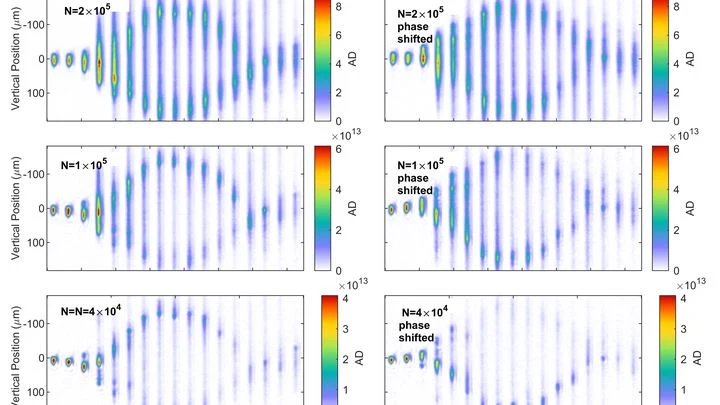
A fisherman casts a net into a quiet backwater. The longer the rope, the weaker he feels the faintest nibble — the wave fades along the way. But what if the signal didn't die out but grew stronger? That's roughly the trick described by the authors of a study on an ensemble of particles placed in a field with a special 'stepped' force gradient.
When two different materials are pressed together and then pulled apart, a spark jumps between them. Anyone who has pulled off a wool sweater in the dark or gotten a shock from a doorknob knows the feeling. For a long time, it was thought that charges simply hop from one surface to another due to differences in material properties.
Electrons in a conductor behave like a crowd on an escalator: each one moves on its own, but together they create a flow. If you make them circle around a ring, their angular momentum (a measure of rotation) can couple to a magnetic field, like gears in a clock.
Physicists built a chain of Rydberg atoms — atoms with electrons in enormous orbits, comparable to planetary paths. These giant atoms feel their neighbors intensely, turning the chain into a quantum analog of a string.
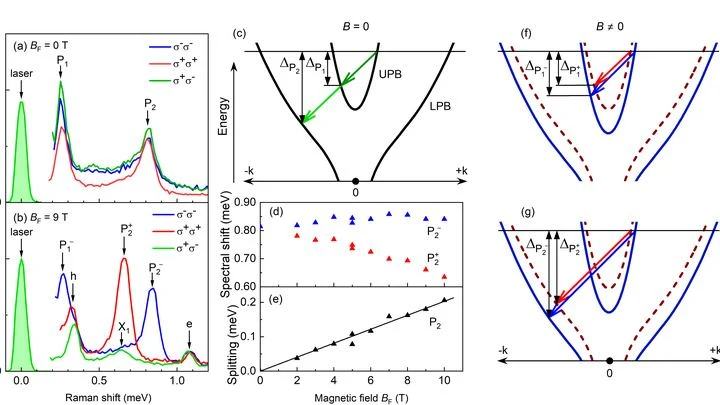
A laser beam hits a shiny crystal, and comes back different: slightly shifted in color, with a different polarization. In a magnetic field, this transformation of light becomes especially noticeable.
High above Antarctica, a balloon carried an instrument that caught electrons from space. These particles come from distant stellar explosions and other powerful events. The instrument measured their energy, like the force of an impact. And in one energy range, there were more impacts than calculations predicted.