Simple

Why the Light Sail Brakes Itself

Original: "Relativistic Lightsail Propulsion Dynamics"
· Chao Shen, Jiaze Li
arXiv:2606.04052v1 · 2026-06-02 · CC BY · ⏱ 1 min · Instrumentation
At 75% light speed, scattered light becomes a brake, not a helper.
Abstract

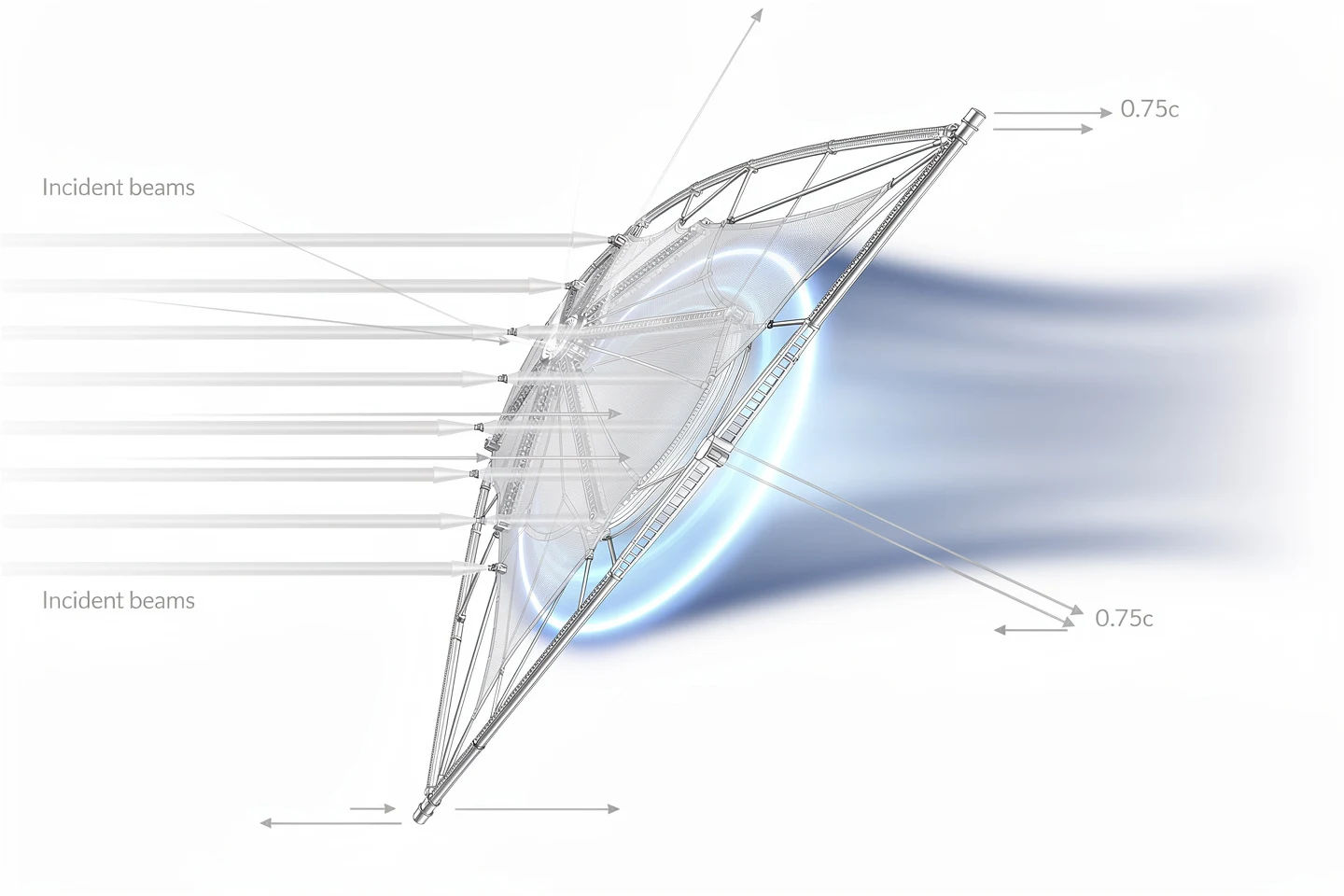
A light sail is like a sailboat, only propelled by light. Direct light gives the strongest push, reflected light is weaker, scattered light is the weakest. Because of the Doppler effect (light changes color), the push weakens as speed increases, and after a certain speed, scattered light even acts as a brake. But the sail still accelerates, and the main boost happens early in the journey. Can it race to the stars?

Links in the knowledge graph 1

To reach the stars, engineers came up with replacing fuel with light: a laser hits a mirror sail, and photons, like wind, push it forward. At low speeds, the light 'wind' blows straight at your back, but as you accelerate, the rules change.

Like a runner catching up with a tailwind, the sail feels less and less pressure—the light redshifts and weakens. This effect was foreseen by Maxwell, who discovered light pressure. The big surprise: if the sail scatters light like matte foil, then at 75% of light speed the scattered light becomes a headwind vortex. It’s as if your reflection overtakes you and hits you in the face.

Paradoxically: harmless scattering at launch becomes an optical anchor in relativistic flight.

Direct reflection still pulls forward, but now designers know: the sail must be perfectly smooth. These calculations will come in handy for a future sprint to Alpha Centauri. At near-light speeds, even a speck of dust will punch through the hull, time for the crew will slow down, and the laser is planned to be powered by the Sun. Brightness measurements will help refine the trajectory, and only near planets will spacetime curvature have an effect. Distant worlds await.

🎯 A sail a hundred atoms thick and the area of a football field, accelerated by a laser, would reach half light speed in a week. But at 75% light speed, its own scattered glow creates a braking pressure—as if it’s overtaking itself.

🎬 This idea recalls Arthur C. Clarke’s story ‘The Wind from the Sun’, where space yachts raced on solar sails. Modern laser sail projects seem to bring that fiction to life.

F = \frac{2 A s}{c} \cdot \frac{1 - v/c}{1 + v/c}
A is the sail area, s is the energy flux density of the incident radiation, v is the craft's speed, c is the speed of light. The fraction shows how quickly the force drops as v approaches c.
v_{\text{diff}} = \frac{3}{4}c
Above this speed, diffusely scattered light creates deceleration rather than thrust. The threshold is derived from analysis of the energy-momentum tensor for Lambertian scattering.
Scientists
Christian DopplerD. B. McLaughlinDidier QuelozMichel MayorR. A. RossiterAlbert Einstein
Tags
speed of light Time dilation exoplanet cosmic dust Sun spacetime curvature photometry
Laws
Doppler effectprinciple of constancy of the speed of lightKepler's third lawmass–energy equivalenceMaxwell's equationsLorentz transformations
Original: arXiv:2606.04052v1 · CC BY · bridge42worlds