Dance of Photons: When the Solar Sail Becomes Its Own Brake ✛ ✎ ✦
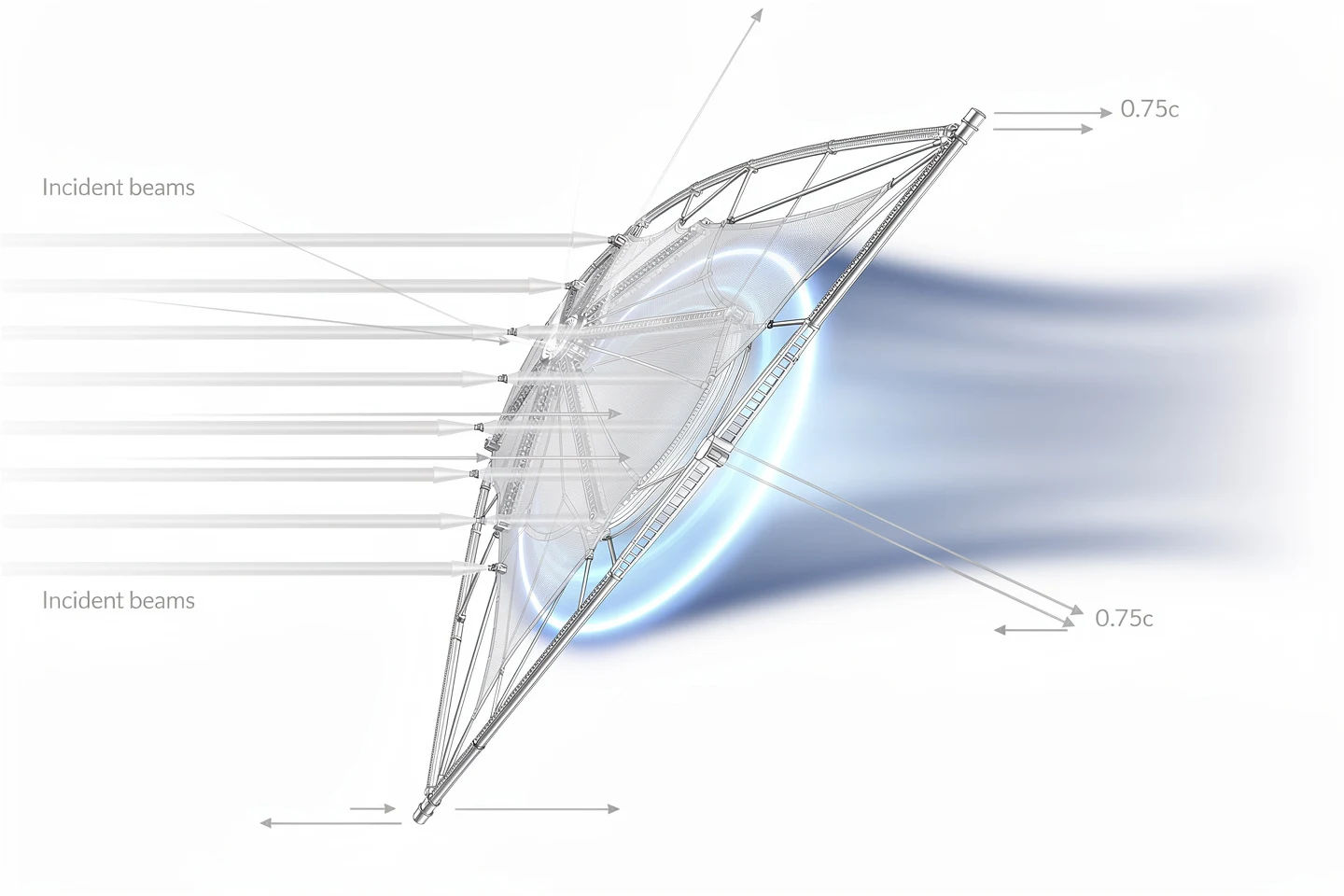
Imagine a three-faced dancer on the crest of a light wave. One face is a catcher, absorbing incoming photons. The second is a perfect mirror, throwing light back. The third is frosted glass, scattering rays in all directions. As long as speed is low, the dance is harmonious. But at near-light speeds, the choreography breaks.
This is like a surfer chasing a wave. At first, the water powerfully pushes forward. But as soon as they nearly match the crest's speed, the push weakens, and their own spray turns into a headwind. So too with the solar sail: as its speed approaches the speed of light, the Doppler effect and time dilation reshape the directions of forces. Incoming light reddens and dims, mirror thrust weakens, and diffuse glow — that very "foam" — unexpectedly changes roles: from accelerator to brake.
And here's an unexpected lesson: the threshold does not depend on laser power — it's pure kinematics. No matter how bright the beam, it only pushes the sail faster to the point where its own glow becomes an oncoming hurricane. Numerical integration is implacable: the main acceleration up to 0.75c takes just five characteristic times (a parameter depending on mass, area, and laser power). Afterwards, the speed curve flattens. For an ideal mirror, the thrust force decreases as (1 - v/c)/(1 + v/c) — an elegant signature of relativistic redshift. And the threshold of 3/4 c becomes a beacon that probe designers must either circumvent or incorporate into calculations.
The conclusion is stern: minimize diffuse scattering, aim for a perfect mirror. Every percent of scattered light at high speeds will sap momentum, heating the sail. But this work merely opens the door. Incorporating three-dimensional orientation, variable area, resistance from the interstellar medium (cosmic dust and gas) and even spacetime curvature will enable self-consistent trajectories. This knowledge will also be useful for solar sails near the Sun, where radiation flux is especially powerful. And from there, it's a short leap to exoplanets around other stars: probes to Alpha Centauri will require exactly this understanding not to become glowing meteors braking with their own photon shadow.
A featherlight sail the size of a football field, pushed by a megawatt laser, accelerates to 20% light speed in just days. But once it surpasses 0.75c, its own glow hits it in the face — as if the sail at full speed deployed a braking shield.
The idea of interstellar sailors harks back to Arthur C. Clarke's story "The Wind from the Sun" (1964), where heroes compete in solar sail races from Earth to the Moon. The modern Breakthrough Starshot project, using laser propulsion, turns this dream into an engineering calculation.