Relativistic dynamics of light sails: how specular and diffuse reflection govern acceleration to sub-light speeds ✛ ✎ ✦
Context
Humanity has long dreamed of interstellar travel. Light sails are one of the most promising technologies, having already undergone orbital tests (IKAROS, LightSail 2). However, when a probe accelerates to speeds comparable to the speed of light, relativistic effects kick in: time dilation and light aberration, which drastically change the dynamics. This is especially important for projects like Breakthrough Starshot, targeting the nearest exoplanets in the Alpha Centauri star system. Understanding how thrust behaves at near-light speeds is critically necessary for calculating realistic trajectories.
Methods
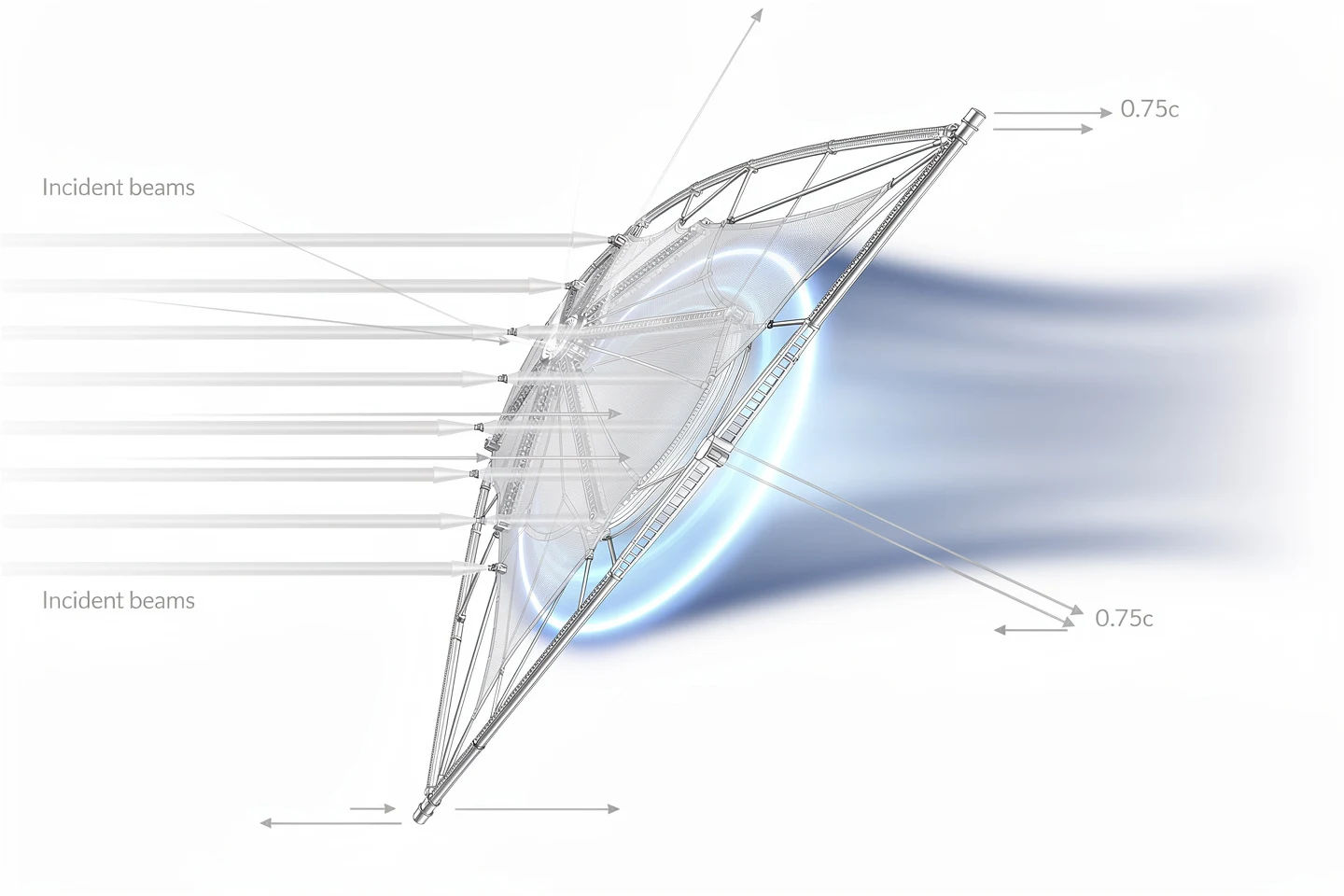
The authors applied the apparatus of radiation dynamics in flat spacetime, using the energy-momentum tensor of radiation and Lorentz transformations. Three components were modeled: incident light, specularly reflected (with reflection coefficient ξ), and diffusely scattered (one-sided Lambertian scattering model). The diffuse component was described by a tensor constructed via the 4-velocity and the normal to the sail surface. The equations of motion were solved numerically after introducing dimensionless time T (in units of characteristic acceleration time τ). For verification, analytical solutions were obtained in limiting cases (pure reflection and pure absorption). Maxwell predicted light pressure a century and a half ago, and now his theory serves as the basis for calculating forces at such speeds. The calculations took into account the relativistic photometric shift (change in energy flux density) and angular redistribution of photons.
Results
Main result: the thrust force from each component decreases monotonically with increasing speed due to relativistic redshift. For a perfectly reflecting sail (ξ=1), the thrust is proportional to (1-β)/(1+β), where β=v/c. Diffuse scattering gives an even weaker contribution, and at β > 0.75 it changes sign and starts to decelerate the craft — the effect of light aberration: scattered photons go forward along the course. Nevertheless, the total radiation force remains accelerating. Numerical integration showed that a speed of 0.75c is reached in 5τ (characteristic times), after which the acceleration rate sharply slows. For typical parameters of an interstellar probe with a powerful laser source, this could correspond to several hours or days. An important nuance: the role of cosmic dust and electromagnetic forces has not yet been taken into account, but in a real flight they may introduce disturbances.
Implications
Practical conclusion for designers: it is necessary to minimize diffuse scattering and strive for specular reflection with ξ→1. This reduces energy losses to heating and increases efficiency. Understanding the critical speed of 0.75c allows for more precise mission profiling: after this threshold, the diffuse glow of the sail turns into a parasitic brake. Theoretically, the inclusion of spacetime curvature (general relativity) may slightly correct the result, but the main features are correct in the flat approximation. The work also confirms that even with an ideal sail, acceleration to ultra-relativistic speeds requires exponentially growing energy expenditure — the speed of light remains an asymptotic limit.
Future development
Future research should include three-dimensional sail orientation, variable area, and complex scattering models (e.g., two-sided emission, blackbody). Accounting for gravity of massive bodies and resistance of the interstellar medium (dust, gas) will allow building fully self-consistent trajectories. It is also interesting to consider quantum effects at extreme photon densities. In the future, such calculations will form the basis of engineering design for probes to exoplanets and possibly to stars like the Sun for studying the heliosphere.
Impact
The results will directly impact interstellar mission projects (Breakthrough Starshot) and solar sails for deep space exploration. The developed formalism can be adapted for analyzing any photon engines, including stabilization and maneuvering.
Next steps
It is planned to generalize the model to the three-dimensional case with an arbitrary normal vector and variable area, as well as to include the effects of scattering on surface irregularities.
Key open problems
The fundamental problem of relativistic mechanics of bodies under radiation lies at the heart of creating interstellar probes. The work clarifies how different channels of light reflection limit maximum speed, and connects this with aberration and the Doppler effect — key to understanding momentum transfer at near-light speeds.
The knowledge machine's view
This section is addressed to the author of the paper and their colleagues. Neighbouring works were found by meaning-based search across our archive, not by word overlap. We do not review: we show the field around the work.
What the work does
The authors computed the relativistic dynamics of a light sail, separating the contributions of specular and diffuse reflection. They derived analytical expressions for thrust in limiting cases and numerical trajectories showing that 0.75c is reached within 5τ, with acceleration slowing beyond that threshold.
Where its strength is
The strength of the work lies in the explicit separation of reflection components and the identification of a threshold velocity beyond which diffuse scattering becomes a drag. This provides a clear benchmark for designing sails with maximal specular reflection.
Where it could go next
- Nearby is an analysis of ultrarelativistic spin in a blazar jet, discussing the role of polarization and angular distribution of radiation under extreme conditions. It might be interesting to see how accounting for polarization of the incident laser light and scattering anisotropy affects sail thrust at β>0.75.based on: Hidden Ultrarelativistic Spine in a Blazar Jet arXiv:2606.27430
- The archive contains a paper on a celestial velocity filter that examines the influence of aberration on observed properties of fast objects. It may be useful to apply their method for estimating aberration corrections to the calculation of the angular distribution of scattered light and refine the critical velocity for the diffuse component.based on: Speed Filter of the Skies: How Swift Visitors Elude Telescopes arXiv:2606.05344v1
Worth trying
- Test how the threshold velocity changes if diffuse scattering is not Lambertian but has a more forward-peaked indicatrix.
- Estimate the contribution of incident light polarization to thrust, using approaches from the blazar spin analysis.
- Apply the aberration correction method from the velocity filter paper to more accurately account for angular redistribution of photons at high β.
Nearby works in our archive
- Charged Layers in the Pulsar Windsimilarity 0.60
- Hidden Ultrarelativistic Spine in a Blazar Jetsimilarity 0.59
- The Universe Sings: Resonance of Dark and Ordinary Mattersimilarity 0.59
- The Spotlight That Turned Away: The Mystery of Transient AT 2019ijnsimilarity 0.58
- The Tidal Dance of Neutron Starssimilarity 0.58
- Light and Gravity Lag: The Key to Jet Birthsimilarity 0.58
- Speed Filter of the Skies: How Swift Visitors Elude Telescopessimilarity 0.58
The archive is sparse around this work: the closest review is only 0.60, against a usual 0.64. It looks like few have drilled nearby.
A solar sail the size of a football field and the mass of a postage stamp, illuminated by a megawatt laser, could accelerate to 20% of the speed of light in a matter of days. However, when its speed exceeds 75% of light, its own diffuse glow will start to 'blow' in the opposite direction.
The idea of interstellar sailcraft harks back to Arthur C. Clarke's story 'The Wind from the Sun' (1964), where heroes compete in solar sail races from Earth to the Moon. The modern Breakthrough Starshot project, using laser propulsion, embodies this fantasy on a technological level.
Key numbers
- critical speed for diffuse scattering: 0.75 c
- characteristic acceleration time τ: Mc/(2As)
- speed after 5τ: 0.75 c
- decrease in reflected light frequency at v=0.5c: by a factor of 3
- fraction of light speed gained in 5τ: 75%