Modern search for extraterrestrial intelligence looks beyond radio waves. Technosignatures encompass any observable manifestations of technology: from engineering megastructures like a swarm of satellites partially blocking a star's light, to spectral lines of artificial molecules in an exoplanet atmosphere. The key principle is inconsistency with natural astrophysical processes. Machine learning algorithms are trained to distinguish anomalies from interference. Thus the forest of space continues to listen and peer in search of alien intelligence.
History
Systematic searches began in 1960 with Frank Drake's Project Ozma. In the 1970s, NASA supported the SETI program, later funding was discontinued. Private initiatives (SETI Institute, Breakthrough Listen) resumed work. The discovery of thousands of exoplanets by the Kepler and TESS missions provided a list of targets. In recent years, the concept has expanded to technosignatures of any kind, including 'technomarkers' in atmospheres.
How it works
Search for radio technosignatures: narrowband spectroscopy in millions of frequency channels, fast Fourier transform algorithms and machine learning to identify repeating patterns. For atmospheric technosignatures: transmission spectroscopy during a planet's transit, search for unnaturally high concentrations of minor gases. For megastructures: anomalies in a star's light curve not explainable by planetary transits. Confirmation requires independent observations.
In practice
The search for technosignatures helps answer the question of whether we are alone in the Universe and stimulates the development of sensitive sensors and data analysis algorithms.
Fun fact
In 2015, Tabby's Star attracted attention with strange dips in brightness — as if something huge and irregularly shaped was orbiting it. The Dyson sphere hypothesis was not confirmed, but the excitement spurred new search methods.
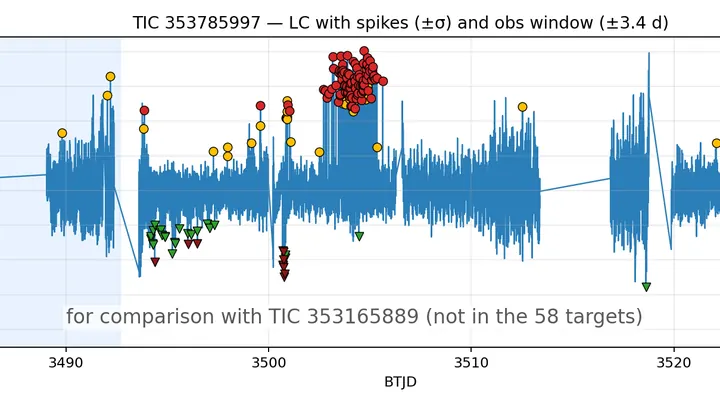
A telescope stares at a star for many nights in a row. Somewhere in the stream of light hides a tiny dip in brightness — an Earth-sized planet briefly blocking part of the star. Such a dip lasts a few hours and repeats once a year or less. Catching it is like hearing a single quiet click in a noisy hall.
Two hundred million stars. In the heart of the Galaxy, where the future survey by the Nancy Grace Roman telescope will aim, about 250 times during its mission the light of one of them will flicker at an invisible touch.
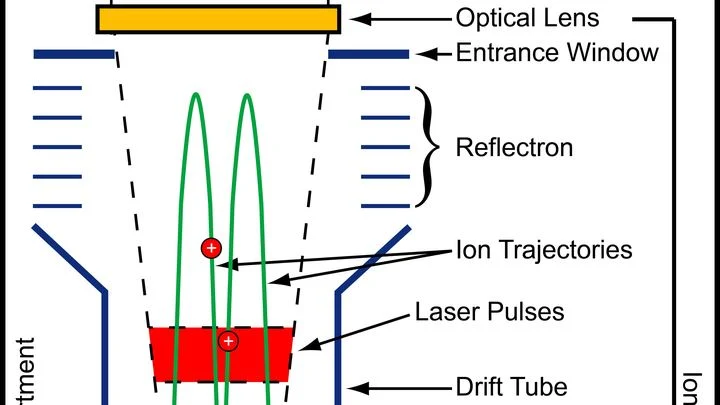
At nine in the morning, the DarkSide-50 detector, 1400 meters beneath Gran Sasso, records a weak ionization pulse. By eleven at night, the frequency of such events drops noticeably. This is not an electronics glitch or a seasonal background variation.
Assembling the puzzle of the Universe, astronomers are used to every new detail fitting perfectly into the already completed picture. But sometimes there are pieces that seem cut from another jigsaw. Twenty thousand active galactic nuclei, and eleven percent of them the neural network confidently rejects as alien.
Deep in the Amazon rainforest, beneath a multi-layered canopy of leaves, lie vast earthen figures — squares, rectangles, the occasional rhombus. For decades they teased archaeologists with their silent geometry, until a researcher armed with orbital optics saw them as an astronomical instrument.
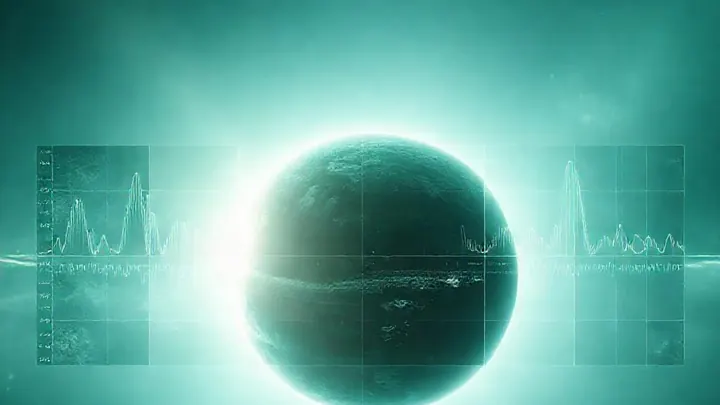
The light of a distant star carries within it the silent hum of the atmospheres of planets orbiting it. For a long time, capturing it was like trying to make out a whisper over a roaring waterfall. But with the advent of the 39-meter Extremely Large Telescope (ELT) and the ANDES spectrograph with a resolution of 100,000, this task is no longer hopeless.
In the silent ocean of the Galaxy, mature civilizations have likely long chosen an unexpected strategy: instead of loud beacons, they scatter quiet fireflies — autonomous interstellar laser beacons, drifting in the void and dropping microsecond flashes. These 'seeds of contact' are not tied to their home stars and do not drown in their glow.
Decades of radio astronomy have listened to space, hoping to catch narrowband radio transmissions — the technogenic 'voice' of distant exoplanets. But our own technological evolution reveals a paradox: loud analog signals, like 1960s TV broadcasts, are just a brief squawk of a newborn civilization.
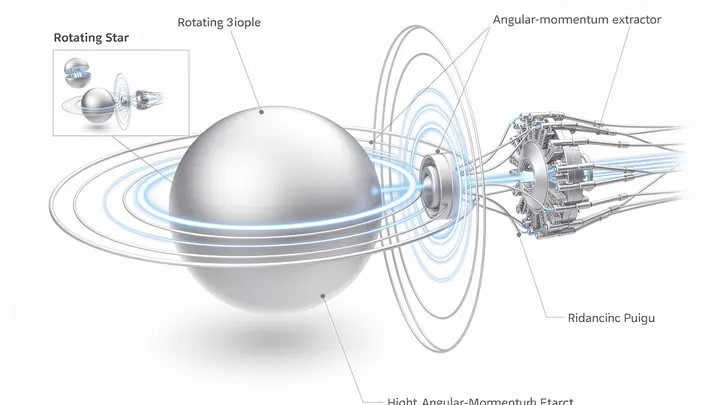
For decades, SETI has hunted for Dyson spheres — hypothetical shells that capture a star's light stars and re-radiate it in the infrared. But the cosmos remains silent. Perhaps an alien intelligence operates more elegantly: instead of collecting light, it tames the rotation of a sun, like a giant flywheel.
In 1960, the Tatel radio telescope spent weeks listening to emptiness around Tau Ceti and Epsilon Eridani. Project Ozma was searching for technosignatures — traces of another mind at work.
Gravitational signals from dying massive stars are whispers reaching us from the most violent laboratories in the Universe. Einstein predicted these gravitational waves over a century ago, but only today, with detectors like LIGO, are we beginning to hear them.
3I/ATLAS burst into the Solar System like an uninvited guest, a gift of fate for hunters of extraterrestrial intelligence. This comet-like wanderer from the depths of the Galaxy flew close enough to be heard in all its details — unlike distant exoplanets.
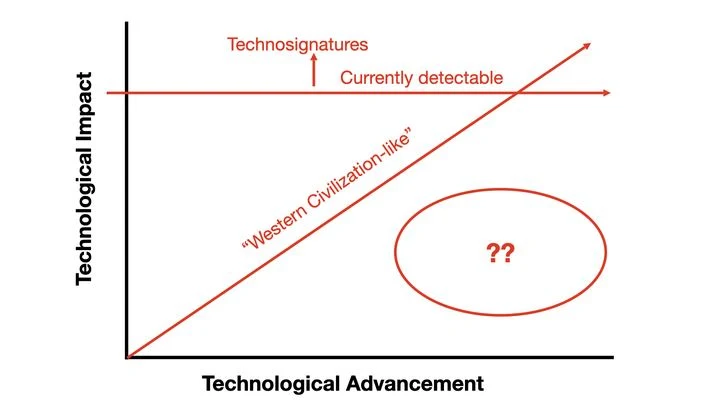
Studying distant exoplanets, scientists look for signs of life — for instance, water and carbon — and signs of technology: radio signals, megastructures. But between these clues there is a yawning gap. If intelligence hasn't created machines or they've vanished, we won't notice it.
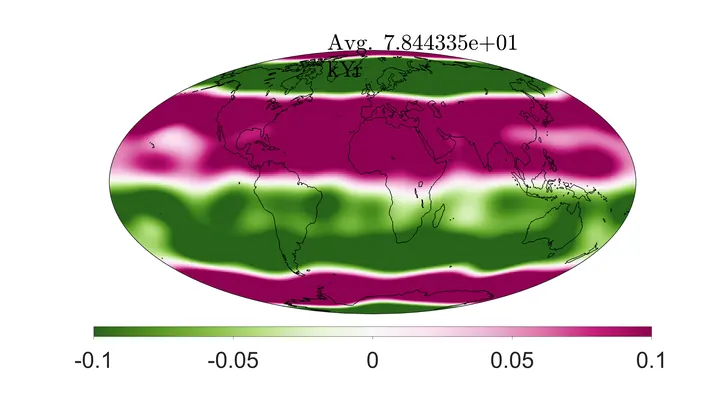
Earth's magnetic field is like an invisible shield that protects us from cosmic radiation. But if you look closely at its long-term averaged pattern, you'll notice that this shield isn't perfectly smooth: it has its own "seams" and "patches." New research using computer simulations of the geodynamo shows that…
The Drake Equation is an attempt to guess the number of intelligent civilizations in our Galaxy. It’s like counting finished cakes in an unknown bakery: you know the ovens (stars), the baking sheets (planets), and the baking time. But were eggs added to the batter? Western science, relying on a single earthly recipe, considers them a rare ingredient.
The Moon is a natural archive that has been collecting cosmic dust for billions of years. Among the microscopic grains that arrived from distant stars, there could be techno-specks — particles created by alien civilizations.
The cosmological principle, the axiom that the Universe looks the same in all directions on large scales, is like a quiet bass hum that sets the tone for the entire symphony of structures.
Civilizations in the Universe are separated not just by distance, but by the vast gulf of time. Hunting for their traces is like archaeology: instead of palace ruins, we find clouds of cosmic dust.
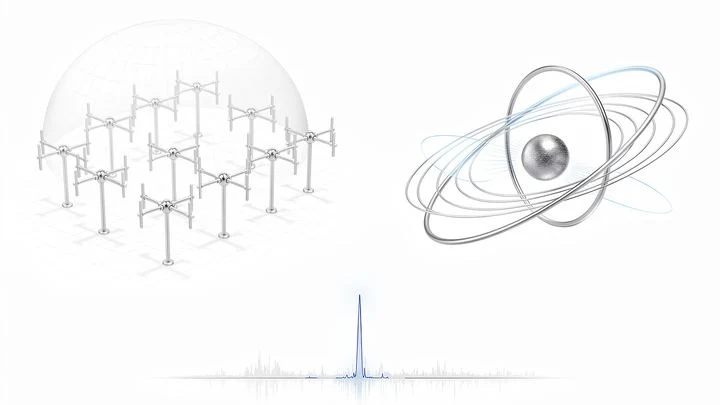
Listening to the cosmos requires patience and a finely tuned ear. Astronomers chose the most sensitive low-frequency instrument for this: the OVRO–LWA antenna array — 352 dipole antennas scattered across two and a half kilometers of California desert.
Listening to the cosmos requires patience and a finely tuned ear. Astronomers chose the most sensitive low-frequency instrument for this: the OVRO–LWA antenna array — 352 dipole antennas scattered across two and a half kilometers of California desert.
A rock concert blares at full volume, and you're trying to catch your friend's whisper. That's roughly how radio detectors feel when they pick up signals from cosmic dust particles. A particle slams into the atmosphere and spawns an air shower, a cascade of millions of secondary particles, and this shower emits a short radio pulse.
A fundamental string plucked at the moment of the Big Bang doesn't just hum a single note — waves run along it, and occasionally tiny loops peel off. These loops, like tuning forks, begin to ring at their own frequency, producing a very high-pitched sound.
For decades, the search for extraterrestrial intelligence has waited for quiet, coherent signals from space — a kind of 'whistle' in the radio silence. However, our own technosphere has created a continuous radio background — the hum of a vast metropolis, emitted by all communications, radars, and broadcasting stations.
Searching for extraterrestrial signals is like trying to hear a whisper at a roaring stadium. The Green Bank Telescope listened to 70,000 stars, but 100 million bursts turned out to be earthly noise — from phones, satellites, microwave ovens.
The hunt for life on distant planets is like diagnosing a rare disease with a test of unknown accuracy. A single positive result means nothing: maybe it's a glitch? We search the atmospheres of exoplanets (worlds around other stars) for traces of water and other compounds, but any signal could be a false alarm.
A swarm of mirrors and antennas envelops a black hole like bees around a hive. But instead of honey, this structure collects energy enough to power a consciousness the size of a galaxy. These very 'Dyson minds' were the topic of a recent meeting at MIT. The idea traces back to [scientist:F. J.
The fate of a civilization isn't just a matter of luck or disasters. Scientists simulated a thousand years of history under ten different scenarios, accounting for resource consumption, governance, and random shocks. The key metric turned out to be the 'activity coefficient' – the fraction of time when a civilization is technologically alive. At best, this fraction nears 100%; at worst, it drops to 38%.
In a distant galaxy, at a distance that light takes 11 billion years to cross, something flashed. The Einstein Probe X-ray telescope caught a brief, needle-prick-like burst: it lasted only a few dozen seconds.
Imagine you and your friends are in a dark room. You agree that after a common flash, each of you will turn on a flashlight ten seconds later, but with a correction for the light delay — since the light from the flash reaches each of you with a slight lag.
To spot a dim star above a brightly lit city, astronomers subtract one image from another — removing the glare of streetlights. They do the same with living neurons: their faint flashes drown in noise, but if you subtract everything unchanging, only they remain.
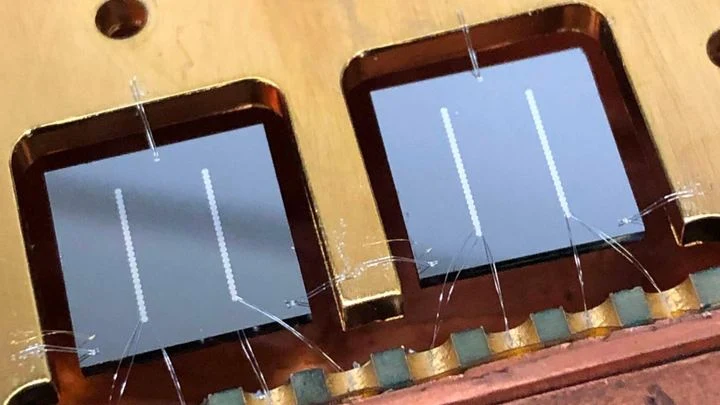
A dark matter detector is like a super-sensitive microphone listening for silence. It picks up tiny heat jolts, phonons, that occur when a particle grazes a crystal. But instead of silence, the instruments have been hearing noise for years: a slew of weak signals below a few hundred electronvolts.
The night sky is no longer as quiet as it used to be. Thousands of satellites are whizzing overhead, and each one can accidentally emit radio waves, interfering with astronomers trying to listen to distant galaxies. To make sense of this noise, scientists pointed the 21CMA radio telescope in China at Starlink satellite passes.
Imagine the hum of a crowded square (that's what the gravitational wave background of the Universe sounds like, as detected by a network of pulsars) neutron stars that emit regular radio pulses with the precision of atomic clocks.
The night sky in a telescope image looks like a photo taken through a fogged-up window: bright stars are visible, but everything faint drowns in a murky haze. That haze is noise — random interference from electronics, heat, and the atmosphere itself.
Hidden in the heart of the Alps is the Large Hadron Collider. From time to time its detectors register sudden bursts — scientists call them UFOs (Unidentified Falling Objects). According to one theory, these are not equipment malfunctions at all, but traces of dark matter.
Cosmic particles with energies millions of times greater than anything our accelerators can produce slam into the atmosphere and create a shower of secondary particles. This shower emits radio waves that antennas on the ground pick up. But the signal is weak: it's swamped by the radio noise of our galaxy and the receivers' own noise.
Scientists built a model of Earth with all living organisms removed — from bacteria to trees. Over billions of years, this 'empty house' didn't turn into an icy desert. Volcanoes, like a furnace, release carbon dioxide, and rock weathering, like a thermostat, absorbs it.
Neutrinos are ghost particles: predicted by the Standard Model, they barely interact with matter. Catching them is like trying to hear a whisper in the roar of a waterfall.