Degrees of freedom are the independent parameters that fully specify the state of a physical system. For a single particle moving in three-dimensional space, there are three degrees of freedom — its x, y, and z coordinates. For a system of N particles, there are 3N degrees of freedom, unless constraints (like rigid bonds) reduce them. The concept extends beyond positions: a spinning top has rotational degrees of freedom, a vibrating molecule has vibrational ones, and a field has infinitely many, one for each point in space.
History
The concept was formalized in the 19th century by James Clerk Maxwell and Ludwig Boltzmann in the context of kinetic theory and statistical mechanics, though the term itself evolved from Lagrangian mechanics, where Joseph-Louis Lagrange used generalized coordinates in the 18th century.
How it works
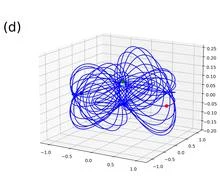
The number of degrees of freedom determines how much information is needed to describe a system and how it evolves. In statistical mechanics, the equipartition theoremstates that each quadratic degree of freedom contributes (1/2)kT to the average energy, which explains heat capacities. In chaos theory, the dimension of the phase space (the space of all possible states) equals the number of degrees of freedom; a system with few degrees of freedom can still exhibit chaotic behavior, as seen in the titles about distinguishing chaos from order by particle traces.
In practice
Degrees of freedom are used in robotics to design manipulator arms, in computational physics to reduce model complexity, and in quantum computing to estimate the resources needed to simulate a system.
Fun fact
A single photon has two polarization degrees of freedom, but when it is entangled with another photon, the combined system has four degrees of freedom, yet the individual photons cannot be described independently — a key insight in quantum information.
An engineering blueprint of a skyscraper always includes a number: the maximum load on the foundation — say, 500 kilopascals. Einstein's field equations in curved spacetime impose a similar limit on the 'force load' inside stars, planets, and any other clumps of matter.
Traditionally, machine learning algorithms operate in a static environment, like water flowing along a pre-cut channel without changing its shape. The new method flips this paradigm: it lets an agent simultaneously master actions and deliberately modify the very environment it inhabits.
Any measuring device is spoiled by quantum noise — the chaotic jitters of elementary particles. To tame it, physicists used a trick on calcium fluoride molecules, much like squeezing a balloon: press in one spot, and it bulges in another.
In 2015, the LIGO detectors caught the first burst of gravitational waves — astronomers heard two black holes colliding far out in space. That ripple in spacetime reached us with its signal shape intact: like the sound of a bell traveling billions of years without distortion.
Three bodies attracting each other by universal gravitation: a problem that has stumped mathematics for three centuries. After Poincaré, it became clear that no general solution exists and trajectories are chaotic. But within this chaos there are islands of order: periodic orbits where motion repeats.