Popular

Faraday effecteffect

24 Related articles
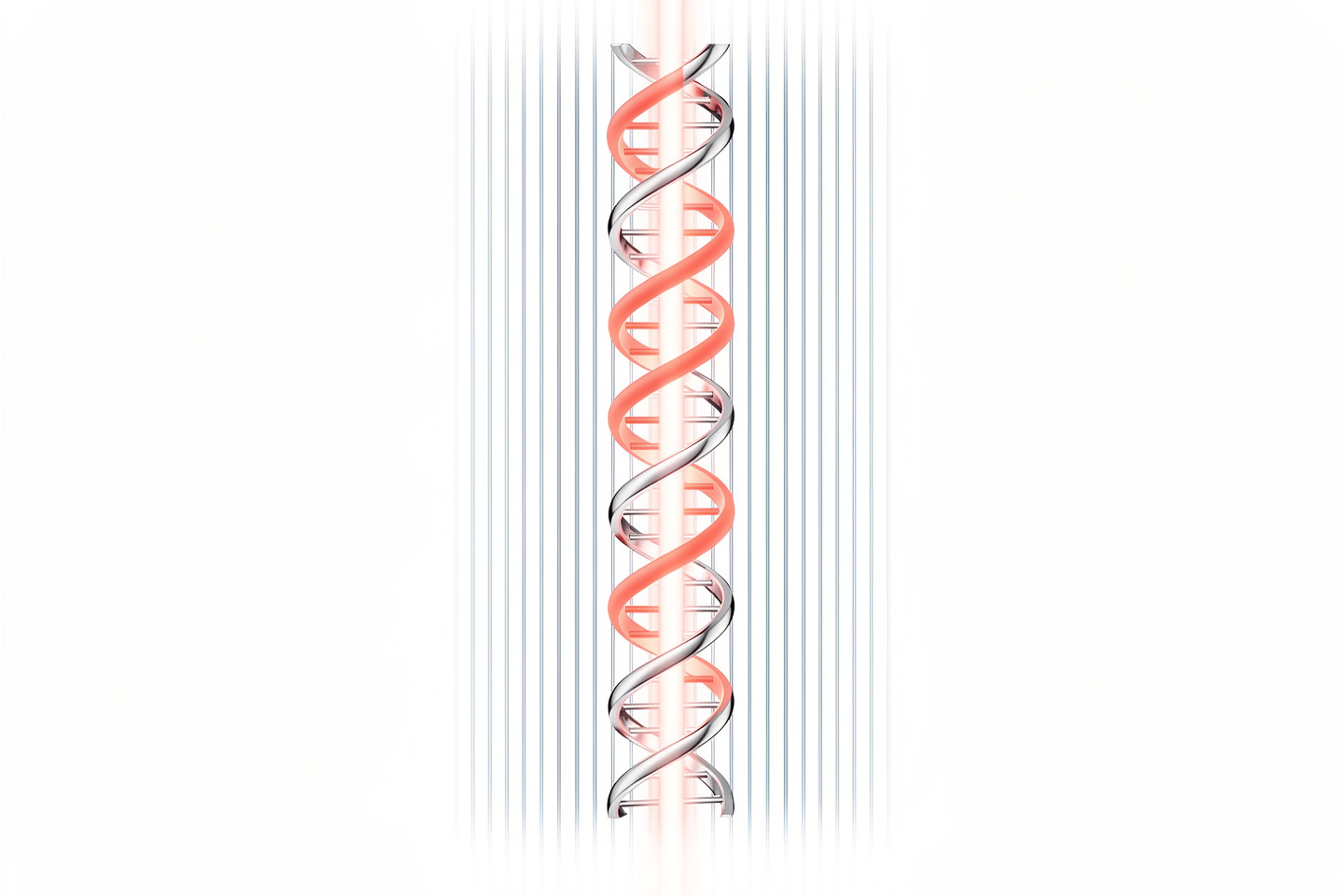
In 1845, Michael Faraday sought a connection between light and magnetism and discovered that heavy glass placed in a strong magnetic field changes the polarization of transmitted light. This became the first proof of the unity of electromagnetism. Essentially, the magnetic field makes the medium anisotropic for light — as if light were forced to go up a spiral staircase where one turn is steeper than the other.

How it works

It is encountered in fiber optics with magnetic sensors, and in astrophysics for measuring magnetic fields of galaxies.

💡 Faraday had been trying to find the effect for several years unsuccessfully until he took super-transparent lead glass from a chandelier. It turned out that ordinary glass gave too weak a rotation.
\theta = V B L
θ — rotation angle of polarization plane (rad), V — Verdet constant (rad/(T·m)), characterizing magneto-optical activity of the substance, B — magnetic induction (T), L — light path length in the medium (m).
Links in the knowledge graph 1
Discovered by
Michael Faraday
Related concepts
electromagnetismfast radio burstinterstellar mediumpolarimetrypolarizationradio astronomy
Related laws
Maxwell's equationsZeeman effect

Related articles

The Skyrmion Dance: How a Magnetic Vortex Conducts the Quantum Orchestra

A hybrid quantum system has been proposed, combining long-lived spin memory, a fast superconducting processor, and a topologically protected mediator — a magnetic skyrmion. Its oscillations bridge the atomic world of defects with macroscopic circuits, overcoming the scale chasm. Calculations promise
arXiv:2505.00266v1 · 2025-05-01

Cosmic Tango: How Spins Dance with Dark Matter

Armed with a quantum magnetometer that reads nuclear spins with incredible precision, scientists hunted for exotic forces that break mirror symmetry. A tandem of rotating lead masses and a cloud of neon atoms improved previous constraints by a thousandfold. The setup works like a miniature gravitati
arXiv:2505.00483v1 · 2025-05-01

Dance of the Octopus Electron: What Quantum Tunneling Says About the Nature of Reality

Quantum tunneling is not just a trick that lets electrons seep through impassable barriers. It’s a window into the deepest mysteries of reality. It turns out that an electron behaves not as a point, but as a distributed entity—something like an octopus squeezing its tentacles through a crack. This v
arXiv:2505.00872v4 · 2025-05-01

Quantum Symphony from Noise: How Spontaneous Emission Gives Birth to Entanglement

Contrary to the entrenched view of spontaneous emission as an incoherent process that destroys quantum entanglement, a team of physicists has theoretically demonstrated the possibility of generating near-perfect bipartite entanglement between two bright light fields. The scheme is based on a four-le
arXiv:2505.00919v1 · 2025-05-01

The Rydberg Waltz: How a Dance of Losses Amplifies Quantum Sensitivity

Quantum sensors based on Rydberg atoms can detect minuscule electromagnetic fields, but optical readout usually destroys almost all signal photons. Physicists from Warsaw went against the grain and deliberately enhanced nonlinear losses through dipole-dipole collisions of excitations. This paradoxic
arXiv:2505.01506v2 · 2025-05-02

Radical Dance, Frozen by Chirality: How Birds See the Magnetic Field

The work shows how chirality—the property of a molecule not coinciding with its mirror image—turns a weak magnetic signal into a reliable compass. Chirality does not merely create quantum coherence, but induces spin polarization, forcing the system to endlessly 'freeze' in one state. This amplificat
arXiv:2505.01519v1 · 2025-05-02

Seven Lives of a Photon: Exceptional Points Control Spontaneous Emission

By combining lithium niobate and gallium arsenide, scientists created a chip. In it, quantum dots interact with microresonator modes, and electro-optic tuning of the feedback phase drives the system to an exceptional point. At this singularity, two modes coalesce, and the spectral density of states
arXiv:2505.05490v1 · 2025-05-02

Quantum Internet: How Entanglement Became a Data Packet

Superconducting qubits and optical photons are separated by a five-order-of-magnitude frequency gap. Direct qubit translation is an engineering dead end, but an architectural trick inspired by packet switching turns weak transducers into entanglement generators. Thus the quantum internet transforms
arXiv:2505.02057v4 · 2025-05-04

The Black Hole's Spin Signature: Polarization Ripples on Its Shadow

New research reveals a subtle mechanism: polarization doesn't just illuminate a black hole's shadow — it deforms it. The effect, predicted for rotating holes, is vanishingly small but fundamental: polarimetry transforms from a passive spectator into an active probe of extreme gravity. In a static sc
arXiv:2605.02136v2 · 2026-05-04

Breath of the Abyss: How a Black Hole's Horizon Pulsates to the Rhythm of Accretion

Analog gravity doesn’t freeze in weak perturbations. When gas roars onto a black hole, it gives birth to a living acoustic spacetime—a horizon that oscillates and shifts. Using an equation of state for ultrahot plasma with a variable adiabatic index, the authors showed that the horizon radius dances
arXiv:2605.04158v2 · 2026-05-05

Cosmic Hourglass: The Flickering Shadow of a Wormhole

Numerical simulations revealed how plasma gets stuck in the throat of a rotating wormhole, painting a thin luminous rim on its shadow and making it flicker with a period set by mass and spin. These signatures, observable by the Event Horizon Telescope at 230 GHz, turn active galactic nuclei into nat
arXiv:2605.04631v1 · 2026-05-06

Stellar Mimicry: Boson Stars Pretend to Be Black Holes

The heart of the Milky Way, the object Sagittarius A*, might turn out not to be a black hole, but its perfect cosmic counterfeit — a boson star. Data from the infrared interferometer GRAVITY were compared with models of twelve such stars — giant scalar clumps — and the Bayesian verdict could not tel
arXiv:2605.09521v1 · 2026-05-10

Universes in Wine Glasses: How Wormholes Reconciled the Irreconcilable

The study unites two poles of quantum cosmology: tunneling from existing space and the no-boundary Hartle–Hawking state. Numerical solutions of Einstein's equations with an axion (or magnetic) charge and a scalar field revealed a family of Euclidean wormholes—their scale-factor profile shaped like a
arXiv:2605.10548v1 · 2026-05-11

Astrons: Electric Leviathans That Defy Cosmology

Astrons — hypothetical relics of the early Universe with a mass on the order of 10¹² solar masses and a gigantic electric charge — could explain dark energy. However, rigorous analysis crushes the simple hopes: ordinary accretion does not yield the required charge, and phenomenologically interesting
arXiv:2605.10587v1 · 2026-05-11

Cosmic Crystal: How Vacuum Defects Twist Light

The cosmic microwave background not only brings a map of the early universe but also a subtle twist in polarization—just a few thousandths of a radian. For a long time, it was attributed to ultralight axions, but they clash with experiments. A new explanation is more elegant: the rotation arises whe
arXiv:2605.11065v1 · 2026-05-11

Polarization Echo: Light Catches the Gravitational Ringing of a Black Hole

A covariant approach has been developed, showing that light in the gravitational "storm" of merging black holes alters its polarization, tracing the damped melody of the ringdown. Numerical simulations based on Kerr perturbation theory confirm: an achromatic rotation of ~10 degrees is a direct impri
arXiv:2605.11499v1 · 2026-05-12

The Silent String of Gravity: Hunting for κ

The weak equivalence principle has been tested with fantastic precision, but always with grounded samples — as if one string of the gravitational violin is deliberately muted. The κ parameter quantifies whether acceleration depends on electric charge: it is the ratio of the difference in acceleratio
arXiv:2605.12246v2 · 2026-05-12

Black Holes: The Perfect Mask of the Abyss

All the headline discoveries — from mergers detected by LIGO to the image of M87*’s shadow — are interpreted as direct proof of black holes’ existence. But a careful analysis shows that the same signatures arise from any ultracompact horizonless object, if its radius differs from the gravitational r
arXiv:2605.13901v1 · 2026-05-12

Gravitational Radio Forest: How a Hydrogen Quantum Detector Reveals Dark Matter

Astrophysicists have proposed a new method for hunting dark matter — not searching for the black holes themselves, but listening to the quantum echo of gravity. In regions of ionized hydrogen, tidal forces from primordial black holes split the atomic level 2P₃/₂, turning a single 9.9 GHz absorption
arXiv:2605.13042v1 · 2026-05-13

Graviton Laser: Translating Gravity into the Language of Light

The main obstacle for a graviton laser is that gravitational waves cannot be reflected: they pass through any substance. The solution lies in the Gertsenshtein effect. Under a powerful magnetic field, gravity particles temporarily become photons, which are easily reflected by ordinary mirrors. The r
arXiv:2605.14050v1 · 2026-05-13

Long-Throat Wormholes: How Doppler Notes Give Them Away

New research shows: wormholes with a precisely tuned throat length can cast a shadow indistinguishable from that of a Schwarzschild black hole. But numerical simulations expose a critical flaw in the disguise—the wormhole's accretion disk emits far more energetic radiation thanks to Doppler boosting
arXiv:2605.16413v2 · 2026-05-13

Cosmic Forge: Cygnus X-3 and the Birth of a Gamma-Ray Bubble

The LHAASO observatory detected an extended gamma-ray source — the Cygnus Bubble — and new calculations show that it was spawned by the microquasar Cygnus X-3. Particles accelerated in the jets to tens of PeV diffuse into the surrounding medium and, upon colliding with gas, produce gamma-ray photons
arXiv:2607.07100 · 2026-07-08

Cosmic Calligraphy: A General-Purpose Neural Network Catches Fast Radio Bursts

Fast radio bursts—ultra-short but colossally powerful radio flashes from distant galaxies—leave an elegant curved trace on spectrograms, resembling a calligraphic flourish. For decades they were hunted with heavy algorithms and narrow neural networks, until the most unexpected tool was tried: a mult
arXiv:2607.07382 · 2026-07-08

Cosmic Flash: Why Advanced Civilizations Vanish from the Ether

A model based on exponential technological growth shows: the faster a civilization develops, the shorter the period during which it emits technosignatures we can detect. At rates comparable to Earth's after the emergence of AI, this window could be less than twenty years. Traditional narrowband sear
arXiv:2607.07413 · 2026-07-08