The Black Hole's Spin Signature: Polarization Ripples on Its Shadow ✛ ✦
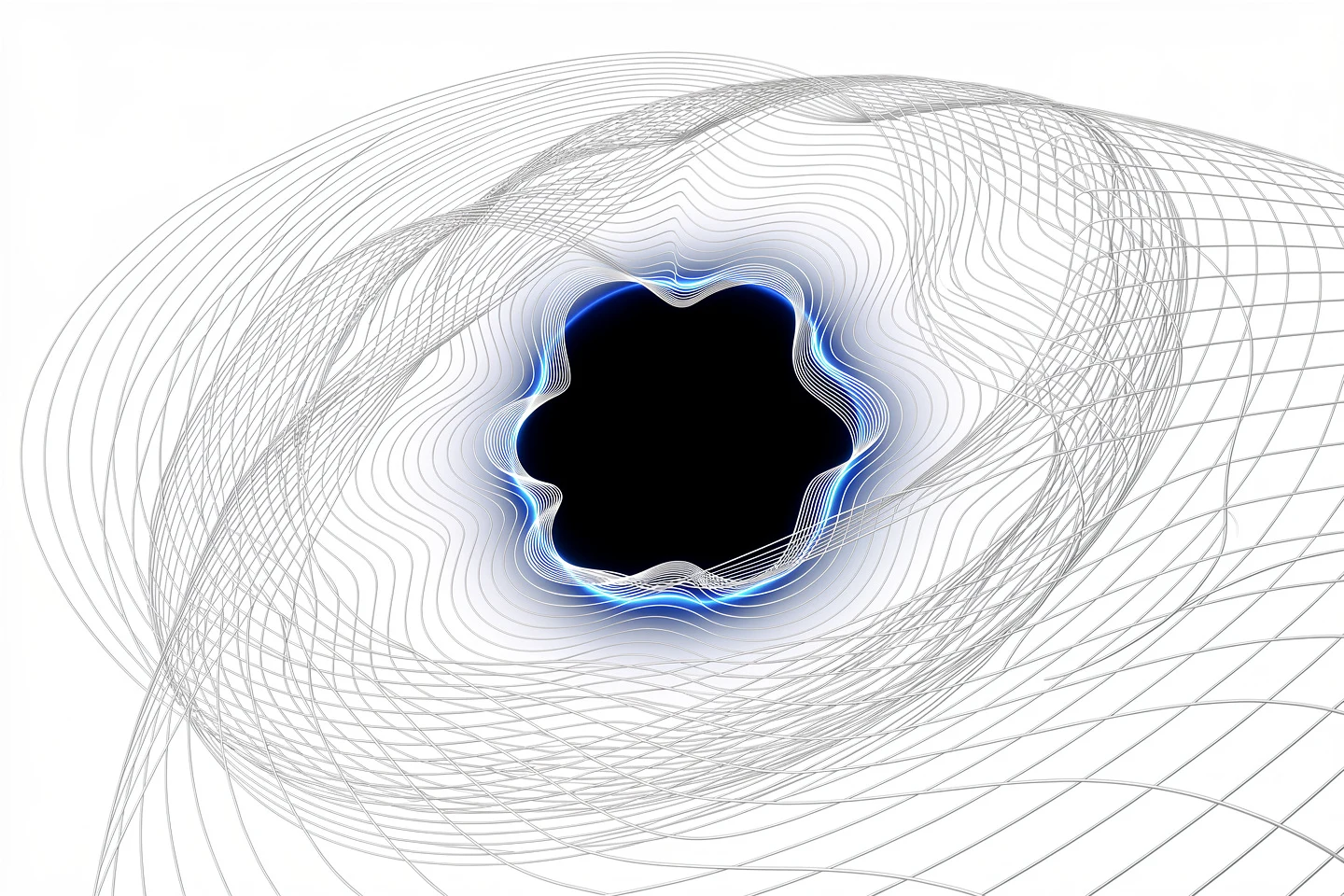
The black hole shadow is an icon of astrophysics — but look closer: its velvet edge quivers in time with the light's polarization. This is no optical illusion, but a gravitational spin-Hall effect: a rotating black hole becomes a polarization prism, sorting photons by the rotation direction of their electric field. Left- and right-handed light fall into the abyss at slightly different distances — and the shadow's edge splits.
Imagine a cosmic conductor: the black hole waves the baton of its spin, and the warped spacetime around it begins to vibrate, setting a different rhythm for each polarization. In a static Schwarzschild universe, where symmetry reigns supreme, left and right light go hand in hand — the shadow remains perfectly round. But start the rotation — and the symphony stratifies: each photon hears its own note, and the shadow acquires a delicate polarization pattern.
Analytical and numerical calculations confirm: the relative change in the shadow radius for opposite polarizations forms a dipole ripple — it peaks where the spin 'blows' across the line of sight. For moderate spin, the amplitude is a measly few hundredths of a percent, but on the rapidly rotating side, the sign of the effect flips. Add electric charge (the Kerr–Newman model) — and it acts like a horn, amplifying the splitting: in the extreme case, almost quadrupling it! For the familiar supermassive black holes in galactic nuclei — M87* or Sgr A* — this whisper is still lost in the noise of ground-based VLBI stations, but it will ring clear for future receivers.
This discovery flips the role of polarimetry in strong gravity. It no longer just colors the picture, but actively participates in shaping it: the shadow becomes not a dark blotch, but a polarization code. Revisiting Event Horizon Telescope data through the lens of spin-optics will refine mass and spin estimates, and also offer a chance to test alternative theories of gravity, where the asymmetry could be orders of magnitude brighter. And then, perhaps, next-generation radio interferometers, inspired by the ideas of Kip Thorne, will catch these ripples — and the event horizon will no longer be mute. It will speak the language of polarization, and perhaps tell us not only about spin, but also about the quantum foam of spacetime hidden beneath the smooth horizon.
This gravitational spin-Hall effect is a cosmic echo of the lab version: in optics, a beam shifts by nanometers, but here the black hole's shadow edge ripples over hundreds of kilometers.
As in 'Interstellar,' where Gargantua's shadow was calculated accounting for spin, polarization adds a hidden layer of reality: the faintest ripple on the shadow, like a pulse betraying the abyss's spin.