Красные глаза: космическая линза показала пару чёрных дыр экспресс
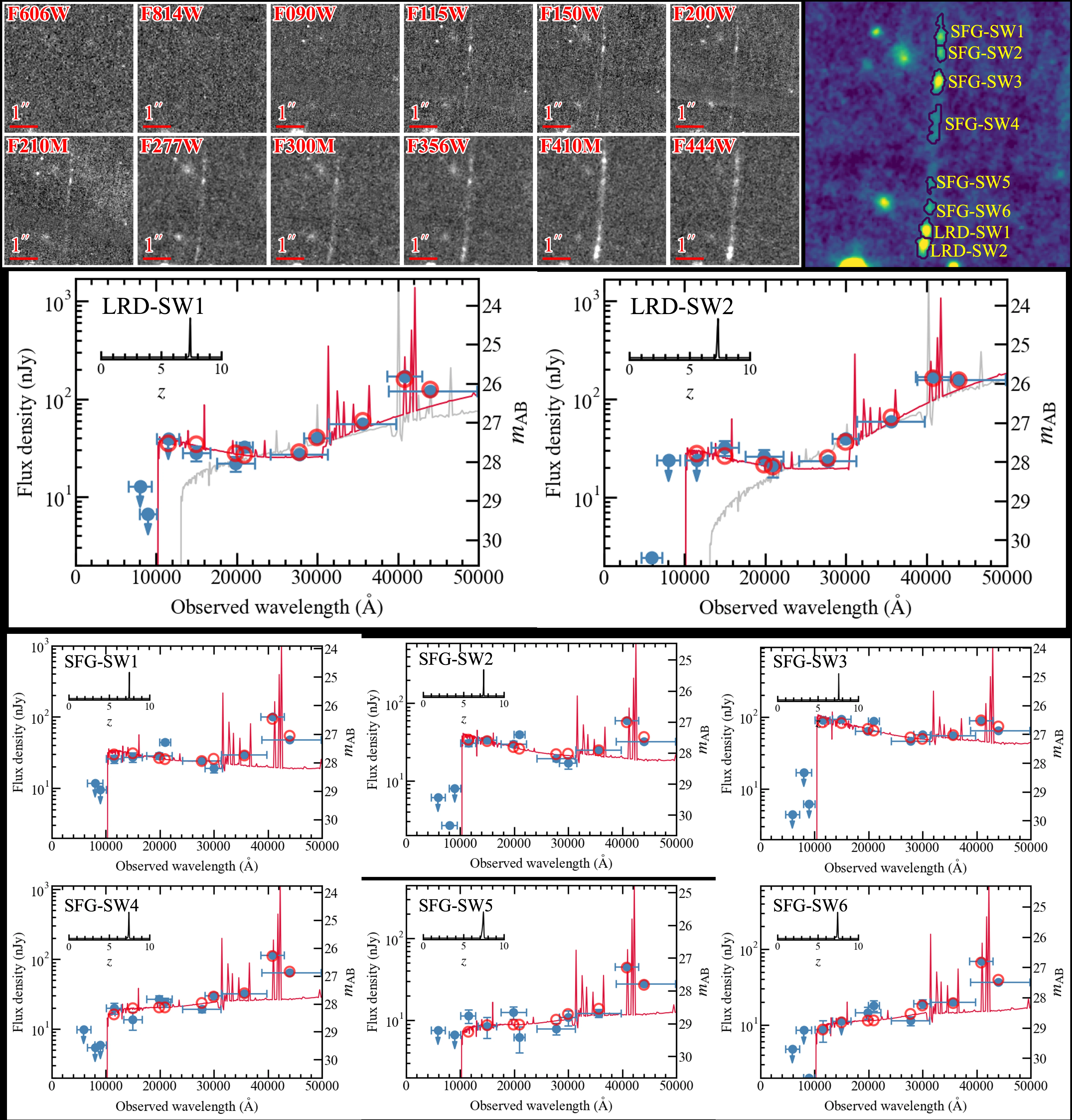
Благодаря гравитационной линзе — эффекту, предсказанному Фрицем Цвикки, когда скопление галактик работает как увеличительное стекло, — телескоп Джеймса Уэбба заметил две красные точки в галактике возрастом 800 миллионов лет после Большого взрыва. Эти объекты, названные Красными Глазами, оказались не в центре, как можно было ожидать, а на самой окраине — словно пара светящихся зрачков, вглядывающихся в пустоту.
Каждый глаз — чёрная дыра средней массы, окружённая раскалённым газом. Их разделяет всего 70 парсек — по космическим меркам это теснее, чем расстояние от нас до центра Млечного Пути. Находка переворачивает представление о росте чёрных дыр: возможно, сверхмассивные монстры в ядрах галактик собраны из множества таких блуждающих «зрачков», которые сливались и пожирали вещество на окраинах. Иными словами, каждый гигант начинался с пары красных глаз.
Оригинальная аннотация
как её написали авторы, на английском arXiv:2601.06015v1
We report the identification of a pair of faint little red dots (LRDs), dubbed Red Eyes, in a strongly-lensed galaxy at $$z\sim7$$ behind the PLCKG004.5-10.5 cluster, identified from the JWST Treasury program VENUS. Red Eyes are spatially resolved on the image plane with distinct colors, while the critical curve lies far north of Red Eyes, clearly requiring two different LRDs rather than a single LRD. Red Eyes is an extremely close pair of LRDs separated by $$\sim70\,\mathrm{pc}$$ in the source plane with a magnification of $$\mu\sim20$$, which consistently explains another counter-image detected to the north-west. Red Eyes is hosted in a typical star-forming galaxy with $$M_{\mathrm{UV,int}}\sim -19$$, but its own UV emission is very faint ($$M_{\mathrm{UV,int}} \gtrsim -16$$). Moreover, Red Eyes does not reside at the galaxy center but lies at an offset position of approximately one effective radius $$R_{\mathrm{e}}$$ away from the galaxy center. If observed without lensing, Red Eyes would appear as a typical star-forming galaxy at $$z\sim 7$$ with $$M_{\mathrm{UV}}\sim -19$$, showing no apparent LRD signatures in either morphology or SED. These results suggest that multiple off-center LRDs, similar to Red Eyes, may be commonly hidden in a typical high-$$z$$ star-forming galaxy. In this case, various plausible scenarios may emerge, one of which is that intermediate-mass black holes (IMBHs) with $$M_\mathrm{BH}\sim10^{4\text{--}6}\,M_\odot$$ may form in star clusters on a stellar disk and contribute to the growth of the central supermassive black hole via mergers, with some IMBHs detectable as luminous LRDs in a sufficiently active and massive phase.
Пара Красных Глаз разделена дистанцией в 70 парсек — почти в 30 раз меньше, чем от нас до центра Галактики. Для чёрных дыр это предельно тесное соседство.