Seiji Fujimoto

10 articles · 30 co-authors · latest: 2026-08-13
298 citations · h-index 10 · 77 papersData: Semantic Scholar

We have retold 10 papers by this author. 1 of them with a full read. most often about: galactic evolution, Reionization, galaxy merger. 30 co-authors across our retellings.

Links in the knowledge graph
Galaxies2025-12-021 minarXiv:2512.03154express
High Energy2026-01-071 minarXiv:2601.04156express
Galaxies2026-01-091 minarXiv:2601.06015express
Galaxies2026-02-051 minarXiv:2602.06024express
Cold Water Trail in the Red Dots of Space
A distant red object usually means one thing: we're seeing a dust veil over a scorching disk falling into a black hole. But when the James Webb split its light into shades, a shadow appeared inside — just like steam from boiling water intercepts rays.
Galaxies2026-02-122 minarXiv:2602.12325express
Cosmic Sprinter: Black Hole and Its Galaxy Grow in a Race
Imagine a city where a skyscraper and a huge park are being built at the same time. The skyscraper grows upward, and the park expands outward. Both processes are fast and get in each other's way, but in the end they are meant to become a single whole. That's the situation in galaxy GNz7q: a black hole grows at the center while new stars burst to life around it.
Galaxies2026-02-231 minarXiv:2602.20241express
Chemistry Around Galaxies: What Their Outskirts Breathe
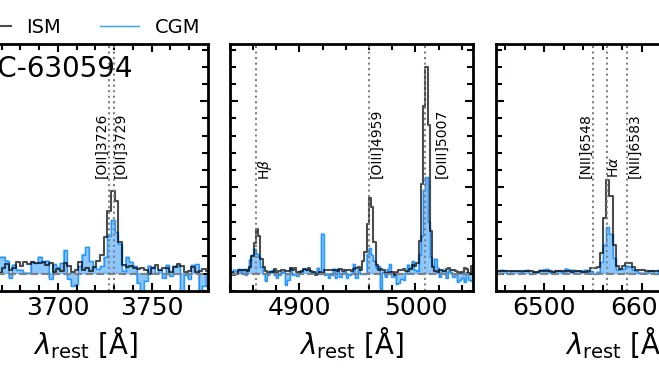
The kitchen of a distant galaxy isn't limited to its bright disk. Around every star system, there's an invisible cloud of gas, like steam above a pot of soup. Astronomers peeked into this steam around galaxies that appear as they were just one and a half billion years after the Big Bang.
Galaxies2026-04-092 minarXiv:2604.08687express
Galaxy Exhales a Dusty Wind
A fountain shoots from the center of the city at a speed thousands of times faster than a courier bike. Such a 'fountain'—a stream of gas accelerated to 5500 kilometers per second — has been spotted by astronomers in the galaxy GLIMPSED-329380.
Galaxies2026-04-242 minarXiv:2604.22702express
More Than a Hundred Distant Stars in a Single Galaxy
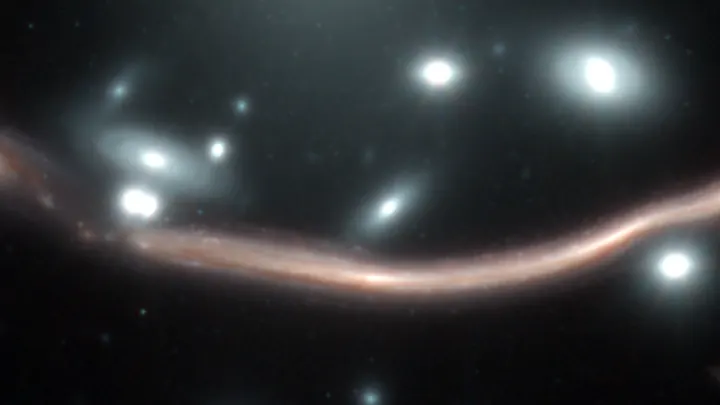
Light from the distant Dragon Galaxy has been traveling toward us for more than seven billion years. On its way, it passes by a huge galaxy cluster whose gravity bends the path of light like a lens. As a result, the galaxy appears brighter and larger than it really is, just as a magnifying glass enlarges fine print.
Galaxies2026-07-023 minarXiv:2607.02666
Cosmic Cocoons: MEOW's Infrared Hunt Reveals the Secret Growth of Black Holes
The Universe is less than a billion years old, yet at its centers already sit black holes with masses of a billion suns. According to the conventional picture, they grew by voraciously devouring matter, but calculations show that 'feeding' must have been almost continuous, while visible quasar flares last only a few million years. So where does all the accreting fuel go?
Galaxies2026-08-132 minarXiv:2608.12708express
A Distant Galaxy Was Actually Much Closer
The night sky is full of deceptive lights. Astronomers were searching for galaxies that ignited in the first few hundred million years after the Big Bang: their light has traveled to us for nearly 13 billion years. Six faint smudges were selected from images taken by the Hubble and Spitzer space telescopes.