Three Pendulums on a Single String: Why El Niño Is So Diverse
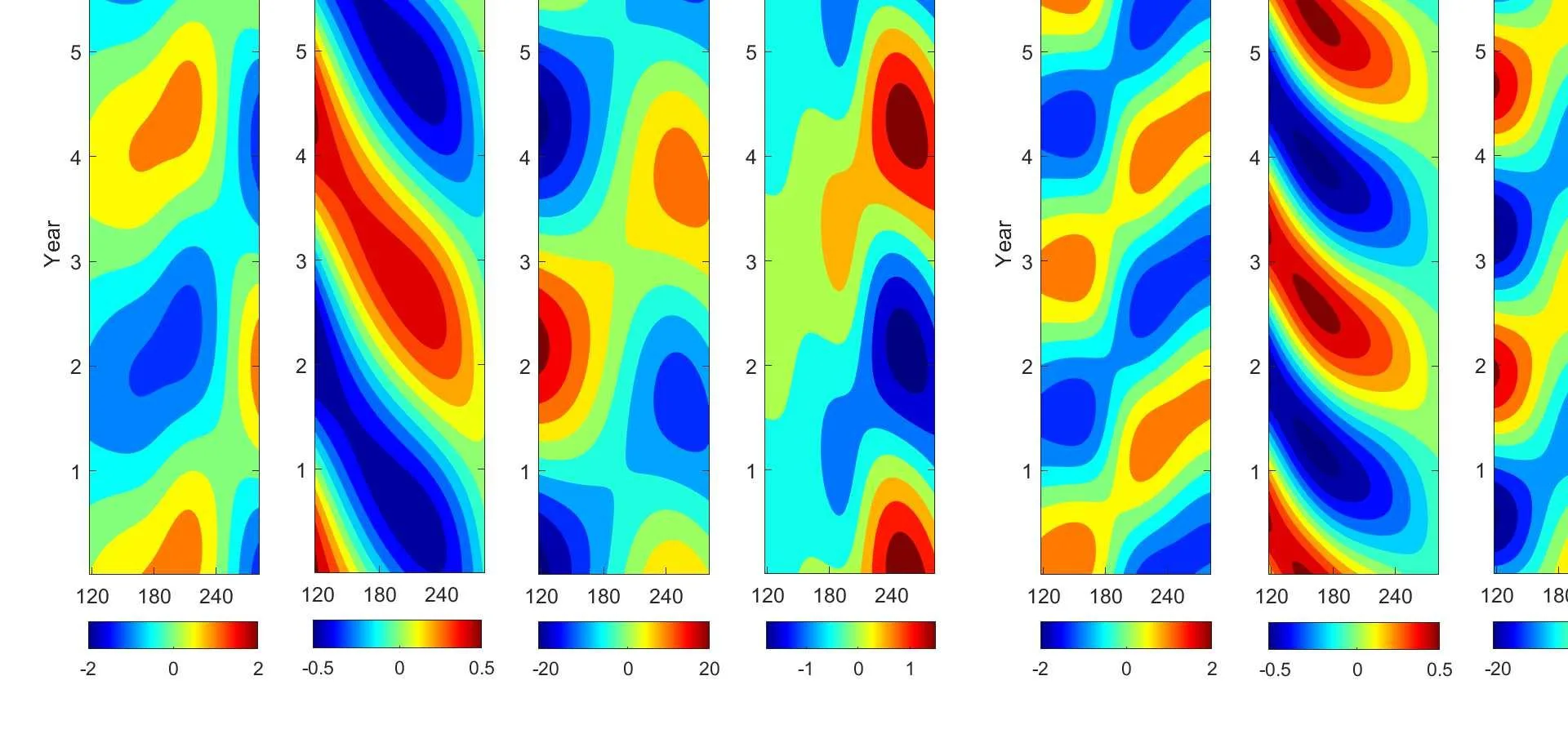
Three pendulums hang from a single string. One swings fast, another slow, and the third sometimes freezes and then lurches. The string is shared, so every jerk is transmitted to the others. The climate of the tropical Pacific works the same way: fast wind bursts, the interannual El Niño cycle, and slow changes in background circulation are coupled into one system.
El Niño is a warm patch on the ocean surface. It appears every few years and changes weather across the planet: it causes droughts in Australia, floods in Peru, and influences Atlantic hurricanes. But the patch does not always appear in the same place. Sometimes it sits near the coast of South America, sometimes in the central Pacific. Scientists call this the diversity of El Niño.
The model couples three processes. The first is fast wind bursts that last weeks and act as random kicks. Their strength depends on water temperature: the warmer the water, the stronger the bursts can be. The second is the El Niño cycle itself, which develops over one to two years. The third is slow changes in background circulation that last decades and determine which type of El Niño is more likely. All are connected, like pendulums on a shared string.
The model was run for 3500 years of virtual time and compared with 70 years of real observations. It reproduced the shape of temperature distributions: in the eastern ocean, strong warm anomalies are more common, while in the central ocean, strong cold anomalies are. This matches reality. Now it is clear that slow changes in background circulation switch the system between eastern and central types, while random wind bursts generate extreme events. Three pendulums on a shared string is a working scheme for forecasting.
The model reproduced the delayed super El Niño of 2014–2015, including the characteristic sequence of westerly, easterly, and again westerly wind bursts that first triggered, then suppressed, and then re-triggered the event.