El Niño at Three Scales: A Simple Model of a Complex Phenomenon
Context
ENSO is a central problem in modern meteorology. From 1980 to 2000, sea surface temperature anomalies were concentrated in the eastern equatorial Pacific, but after 2000 they shifted toward the center. This diversity of El Niño (eastern and central types) alters global atmospheric teleconnections and complicates forecasting. Existing general circulation models often shift the cold tongue too far west and poorly reproduce the sea surface temperature gradient, which distorts the zonal advective feedback. Alongside this work in the archive are studies of El Niño predictability and the role of randomness in its evolution, but this paper stands apart: it proposes a minimal model that links different time scales to reproduce complexity.
Methods
The starting point is a deterministic linear coupled system of atmosphere, ocean, and sea surface temperature. After meridional projection onto parabolic cylinder functions and spatial discretization (128 points in the atmosphere, 56 in the ocean), two dominant linear modes emerge: the eastern Pacific and central Pacific modes. Two stochastic processes are added: one describes intraseasonal wind bursts with amplitude dependent on sea surface temperature (multiplicative noise), and the other captures decadal variability of the background Walker circulation, which modulates the strength of the zonal advective feedback. Seasonal synchronization is introduced via sinusoidal functions, and cubic nonlinear damping in the central Pacific parameterizes the coupling between subsurface temperature and thermocline depth. The model is integrated numerically with a time step of 0.5 days, and statistics are computed over 3500 model years.
Results
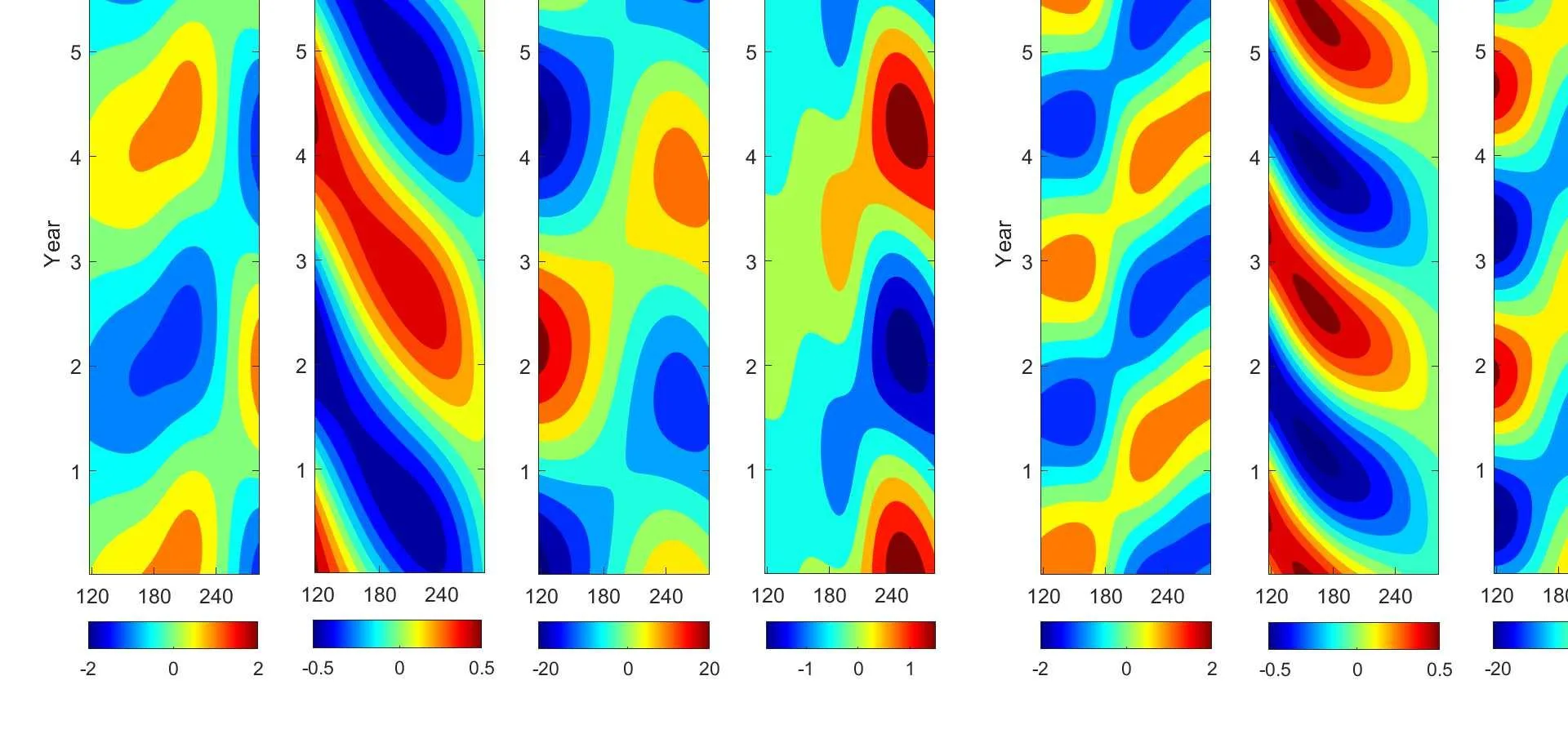
The model reproduces the spatiotemporal evolution of different ENSO types: eastern, central, mixed events, extreme El Niño, and multi-year La Niña. It almost perfectly recovers the strongly non-Gaussian probability density functions of sea surface temperature anomalies in all three Niño regions: positive skewness and a heavy tail in Niño 3, negative skewness and a light tail in Niño 4. Seasonal synchronization (peak in winter) and power spectra (2–4 years for Niño 4, 2–7 years for Niño 3) also match observations well. Composite sea surface temperature anomalies for different events and the two-dimensional 'strength–location' distribution of maxima are nearly identical to data. Event frequencies over 70 years: eastern El Niño 18.2 (observed 14), central 14.7 (10), La Niña 26.1 (24), extreme El Niño 3.1 ± 2.3 (4).
Implications
This work differs from neighboring studies by combining three time scales in a single minimal model and reproducing not only mean characteristics but also full non-Gaussian distributions. It shows that decadal variability of the Walker circulation drives the switching between eastern and central regimes, while multiplicative noise generates extreme events. This provides a theoretical basis for understanding the mechanisms of ENSO complexity and for building more accurate statistical forecasts.
Future development
The model can be extended by including spatially distributed intraseasonal dynamics (e.g., Madden–Julian waves) and additional meridional basis functions to account for asymmetry. A promising direction is coupling with conceptual models for multi-model data assimilation and forecasting different El Niño types.
Impact
The model could improve forecasts of ENSO and associated climate impacts, including droughts, floods, and hurricanes. It is also useful for assessing the influence of climate change on the frequency of extreme El Niño events.
Next steps
The next step is to develop a spatially distributed stochastic model of intraseasonal wind bursts and Madden–Julian waves, as well as to incorporate asymmetric meridional structures.
Key open problems
Connection to unsolved problems in meteorology: how to predict ENSO diversity (eastern/central types) and how to reproduce the non-Gaussian statistics of sea surface temperature, which general circulation models often miss.
The model reproduced the delayed super El Niño of 2014–2015, including the characteristic sequence of westerly, easterly, and again westerly wind bursts that first triggered, then suppressed, and then re-triggered the event.
Key numbers
- Number of model years: 3500
- Frequency of eastern El Niño (model/observed): 18.2 / 14 per 70 years
- Frequency of central El Niño (model/observed): 14.7 / 10 per 70 years
- Frequency of extreme El Niño (model/observed): 3.1 ± 2.3 / 4 per 70 years
- Grid spacing: 312.5 km