Nan Chen

11 articles · 14 co-authors · latest: 2025-07-18

We have retold 11 papers by this author. 11 of them with a full read. most often about: el_nino_southern_oscillation, enso_predictability, enso. 14 co-authors across our retellings.

Links in the knowledge graph
Neural Network Learns from a Draft: How a Crude Model Helps Predict El Niño
An interpreter at an important negotiation keeps a draft of their speech at hand but checks against the live conversation as they go: if what is said diverges from the prepared text, they adjust the translation on the fly.
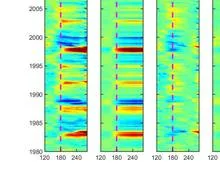
Three Rhythms of El Niño: A Model of Complexity
An orchestra of three conductors governs the Pacific climate. The first conductor is intraseasonal wind bursts, blowing now from the west, now from the east, like random plucks on strings. The second is the interannual ocean dynamics, slowly rocking warm and cold waves.
A Flashlight in the Pacific Fog: Each El Niño Has Its Own Predictability Limit
A flashlight beam in fog reaches some objects and fades before touching others. So it is with El Niño forecasts: for events in the central Pacific, the light reaches almost two years ahead, but for eastern events it gets lost in random wind gusts within six months.
Three Pendulums on a Shared Spring: How a Simple Model Explains El Niño's Whims
Three pendulums hang from a long rope attached to the ceiling. One swings fast, another slow, and the third sometimes freezes and then lurches. But the rope is shared, so each jerk of one is felt in the motion of the others.
How Order Emerges from Chaos: A Rigorous Derivation of El Niño Models
Every few years, warm Pacific waters rise to the surface off the coast of Peru, and the planet's weather goes off its usual schedule. This is El Niño, an irregular phenomenon that recurs every 3–7 years but still eludes precise forecasting.
A Compass for Climate Currents: Finding the Hidden Levers of El Niño
In the tropical Pacific Ocean lives a giant pendulum: warm water swings from Australia to South America and back, and each swing changes weather across the entire planet. This pendulum is called El Niño–Southern Oscillation, and its behavior resembles a capricious conductor: sometimes it waves the baton sharply, sometimes slowly, and sometimes it freezes, confusing forecasters.
A Sieve for El Niño: How an Algorithm Finds the Minimal Model of a Fickle Climate
Every few years, a huge pool of warm water in the western Pacific Ocean shifts eastward, like water in a bathtub when you tilt it sharply to one side. That is El Niño. But each tilt is different: sometimes the water sloshes against the shores of Peru, sometimes it stalls in the middle, sometimes it pours out in a powerful surge, and sometimes it barely creeps.
The interpreter that learned chaos's dialect
An interpreter at a conference hears the noise of the hall but keeps translating. They don't repeat every word; instead, they find an intermediate language where complex phrases become simple, yet meaning is preserved.
A Bridge Between Ocean and Atmosphere Rhythms
The tropical Pacific breathes in two rhythms. One lasts several years: the water off the coast of Peru warms and cools, which fishermen call El Niño. The second rhythm is fast: every month or two, a giant cloud wave is born over the warm waters of the Indian and Pacific Oceans, creeping eastward at a runner's pace and dying out near South America.
The Two-Core El Niño Model: An Orchestra Where the Soloist Sets the Tempo
A warm patch off the coast of Peru does not appear every year, but when it does, deserts are drenched with rain and Australia is plagued by wildfires. This is El Niño, a phenomenon that climate models struggle to reproduce. Simple models do well at estimating how often it occurs but lose spatial details.
A Bridge Between Typhoon and Current: How El Niño Is Born
The tropical Pacific Ocean lives in two rhythms. The first is fast: a wave of thunderstorms born over the Indian Ocean races eastward and dies out off the coast of the Americas within a month or two. The second is slow: every few years, the ocean surface warms enough to alter weather across the entire planet. That is El Niño. Between these rhythms lies a bridge, and building it took climatologists decades.