How River Interlinking Changes the Monsoon
In 2019, 16,000 villages in the Indian state of Maharashtra ran dry, and authorities began distributing water by ration coupons. In response to such crises, the government plans to transfer water from water-rich river basins to arid ones through a network of canals stretching 15,000 kilometers. The project rests on a simple logic: if one place has too much water and another too little, connect them with a pipe. But river basins are not isolated buckets; they are linked by an invisible atmospheric pipe, and pouring from one bucket into another can change where rain falls.
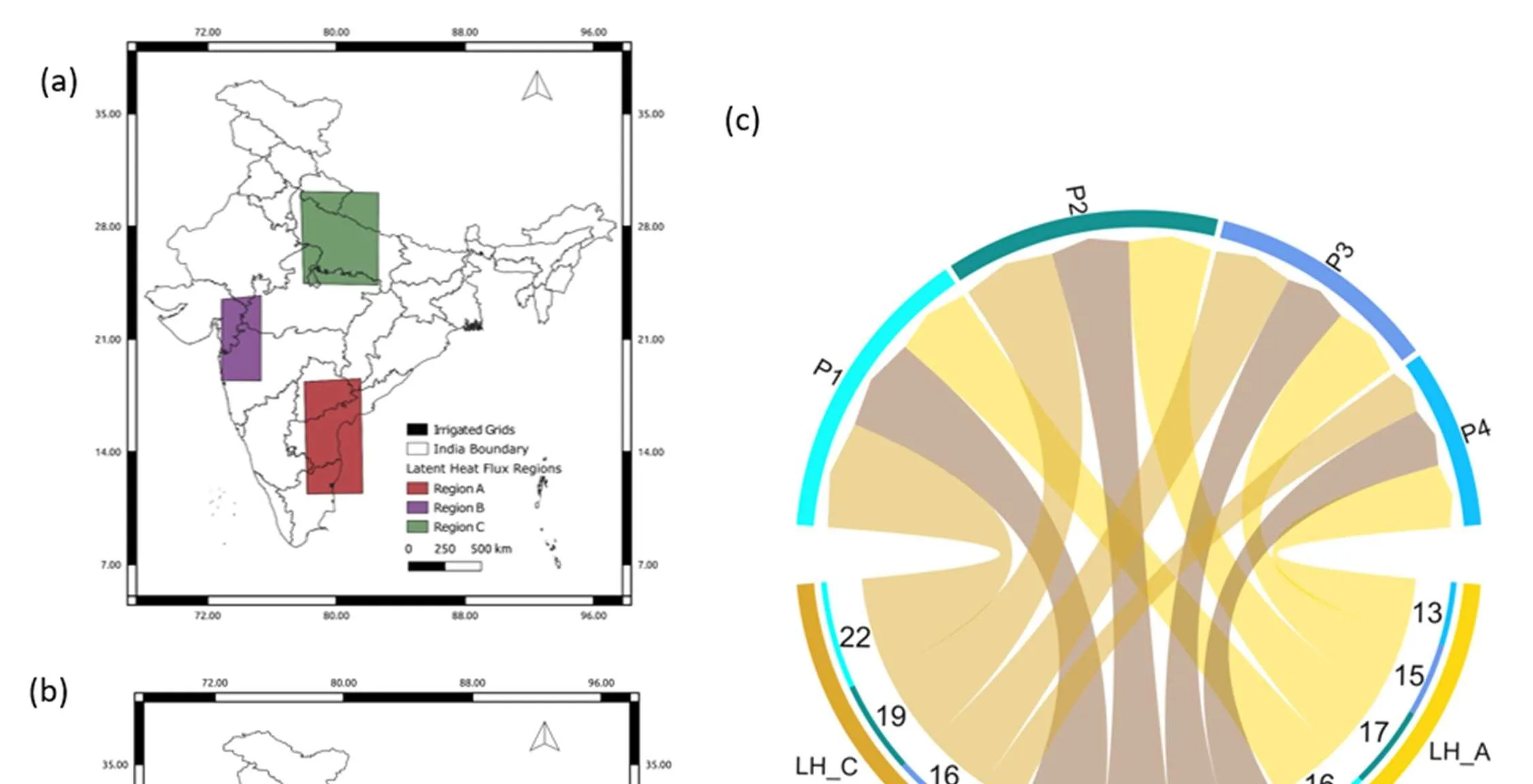
Scientists tested this connection using 40 years of data with methods that seek causal chains in complex systems. They found persistent pathways of information transfer from land variables in one basin to atmospheric variables in another. Then they ran a regional climate model at 25 km resolution and conducted two numerical experiments: a control run with current irrigation and an experiment with additional irrigation simulating water transfer. The model covered monsoon seasons from 1991 to 2012.
The results were alarming. Additional irrigation leads to a statistically significant reduction in September precipitation of up to 12% in central and western India, including the arid regions of Rajasthan and Gujarat. In individual years, the reduction reached 20% in Odisha and Uttarakhand and up to 50% in Gujarat. The precipitation decline was accompanied by an increase in maximum temperature of up to 1°C and a decrease in soil moisture of about 15 mm. The effect was stronger during La Niña years than during El Niño years.
This is the first quantitative evidence that large-scale hydrological projects can alter regional climate through a land-atmosphere feedback. Traditional water resource planning has ignored atmospheric connections, treating basins as independent. Now that assumption collapses: if one basin receives more water, a neighboring one may be left without rain. The results call for a reassessment of impact assessments for such projects worldwide, from China to Africa.
In 2019, villages in Maharashtra stood in line for water, while in other states rivers overflowed their banks. River interlinking seemed an obvious solution, but now it is clear that water poured from one bucket into another can evaporate and fall as rain in a third place. The atmospheric pipe connecting basins works like communicating vessels, and the level in one bucket depends on the level in another. When planning interbasin transfers, we must consider not only the land but also the sky.
The planned canal network in India is about 15,000 km long, which is greater than the distance from Delhi to Sydney. The project aims to transfer 174 billion cubic meters of water per year, equivalent to the annual flow of the Nile River.
In Kim Stanley Robinson's novel "The Ministry for the Future," large-scale geoengineering projects that alter the climate are described, echoing the unintended consequences of river interlinking shown in this work.