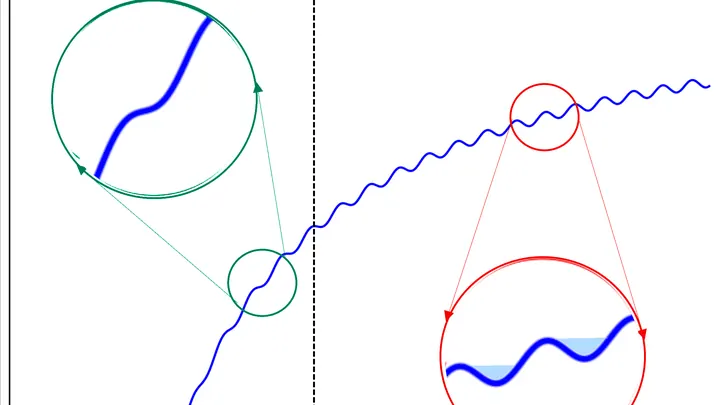
The bottleneck effect is a sharp reduction in population size, leading to an impoverishment of the gene pool (the total set of all genes). Unlike the founder effect, where a small group separates voluntarily, here the reduction is forced and catastrophic. The survivors are a random sample, not reflecting the former diversity. When the population recovers, it is genetically homogeneous, which increases the risk of extinction from diseases or environmental changes. A famous example is cheetahs: DNA analysis shows that all modern cheetahs are so closely related that they can accept skin grafts from each other without rejection.
History
The term entered scientific usage in the mid-20th century with the development of population genetics. One of the first to describe it in detail was Sewall Wright in the context of his theory of genetic drift. Classic studies of cheetah genetics in the 1980s, conducted by Stephen O'Brien and colleagues, showed extremely low diversity, explained by a Pleistocene bottleneck. Later, genetic data confirmed bottlenecks in many species, including humans, the northern elephant seal, and bison.
How it works
During a sharp population decline, alleles are lost randomly, regardless of their adaptive value. Genetic drift in a small population rapidly fixes some alleles and eliminates others. After population recovery, the population bears the imprint of this random process: many loci (DNA regions) are monomorphic, and harmful recessive alleles can reach high frequencies. The effect is especially noticeable in species with low mutation rates, as new mutations cannot replenish the lost diversity quickly enough.
In practice
Helps understand why cheetahs are so similar to each other and vulnerable to diseases — their population underwent a sharp decline about 10,000 years ago.
Fun fact
Humanity also passed through a bottleneck: about 70,000 years ago, after the eruption of the Toba supervolcano, the population of our ancestors may have dropped to a few thousand individuals.
In a psychologist's quiet office, a fourteen-year-old fills out a questionnaire about childhood. The scores climb, and on the MRI scans the amygdala climbs with them: a small node deep in the brain that teaches us to fear and to remember danger. In a rat held in a narrow tube for three hours a day, the same structure grows faster than in its calm counterparts.
Imagine a large orchestra without a conductor. Each musician hears everyone else and adjusts to the collective hum. If every instrument amplifies its neighbors, the sound builds to a screech; if some occasionally dampen it, the orchestra may fall into silence or break into cacophony.
Cosmic rays are particles that race across our Galaxy at enormous speeds. Their energies can be millions of times higher than those of particles in the most powerful accelerator on Earth. But the higher the energy, the fewer such particles there are: the plot of their numbers shows a noticeable kink, which is called the knee.
Rare species in a large community are like thin branches on a tree: a random gust can easily snap them. Even if conditions are stable, a small population simply lacks enough individuals to survive a bad season. In a new study, scientists added this factor to an ecosystem model and watched the community clean itself out.
Rare species in a large community are like thin branches on a tree: a random gust can easily snap them. Even if conditions are stable, a small population simply lacks enough individuals to survive a bad season. In a new study, scientists added this factor to an ecosystem model and watched the community clean itself out.
A vast hall with a thousand doors, and only one leads to the stars. The rest are locked, and the keys aren't just hidden: they're wrapped in other keys and tangled into a knot. That's the Great Filter in a new reading: not a chain of failures but a tangled hierarchy where each step depends on the previous one nonlinearly.
A landscape cut by roads or rivers into isolated patches resembles a shared apartment after partitions are installed: residents no longer bump into each other in the common hallway. Species that once competed for the same food or space now live apart. Competition weakens, and those that would have lost to pushier neighbors in a continuous landscape now survive.
The Sun constantly emits a stream of charged particles — the solar wind. Among them are many electrons, some of which fly back toward the Sun. But observations show that fewer electrons return than expected.
Genetic diagnostics is like comparing two photos taken with different cameras. If one camera slightly shifts the colors, the image will show "defects" that don't exist in reality.
In 2019, 16,000 villages in the Indian state of Maharashtra ran dry, and authorities began distributing water by ration coupons. In response to such crises, the government plans to transfer water from water-rich river basins to arid ones through a network of canals stretching 15,000 kilometers.
In spring 2020, Earth's atmosphere seemed to hold its breath. Transport ground to a halt, factories fell silent, and carbon dioxide emissions from burning fuel dropped by nearly eight percent. But spotting this "carbon echo" on a global scale proved tricky: the atmosphere is constantly mixing, forests and oceans breathe, and weather adds its own noise.