How River Interlinking Changes the Monsoon
Context
India's river basins face growing stress from climate change, population growth, and pollution. In response, the government plans to transfer water from surplus basins to deficit ones via a network of canals and reservoirs. Until now, such projects have relied on the assumption that basins are hydrologically independent, since water does not cross their boundaries on land. However, in India, where land-atmosphere feedbacks are particularly strong, this assumption may not hold. This work aligns with studies on collective behavior of climate systems and stochastic modeling, but differs by being the first to test atmospheric connectivity between basins for planned projects.
Methods
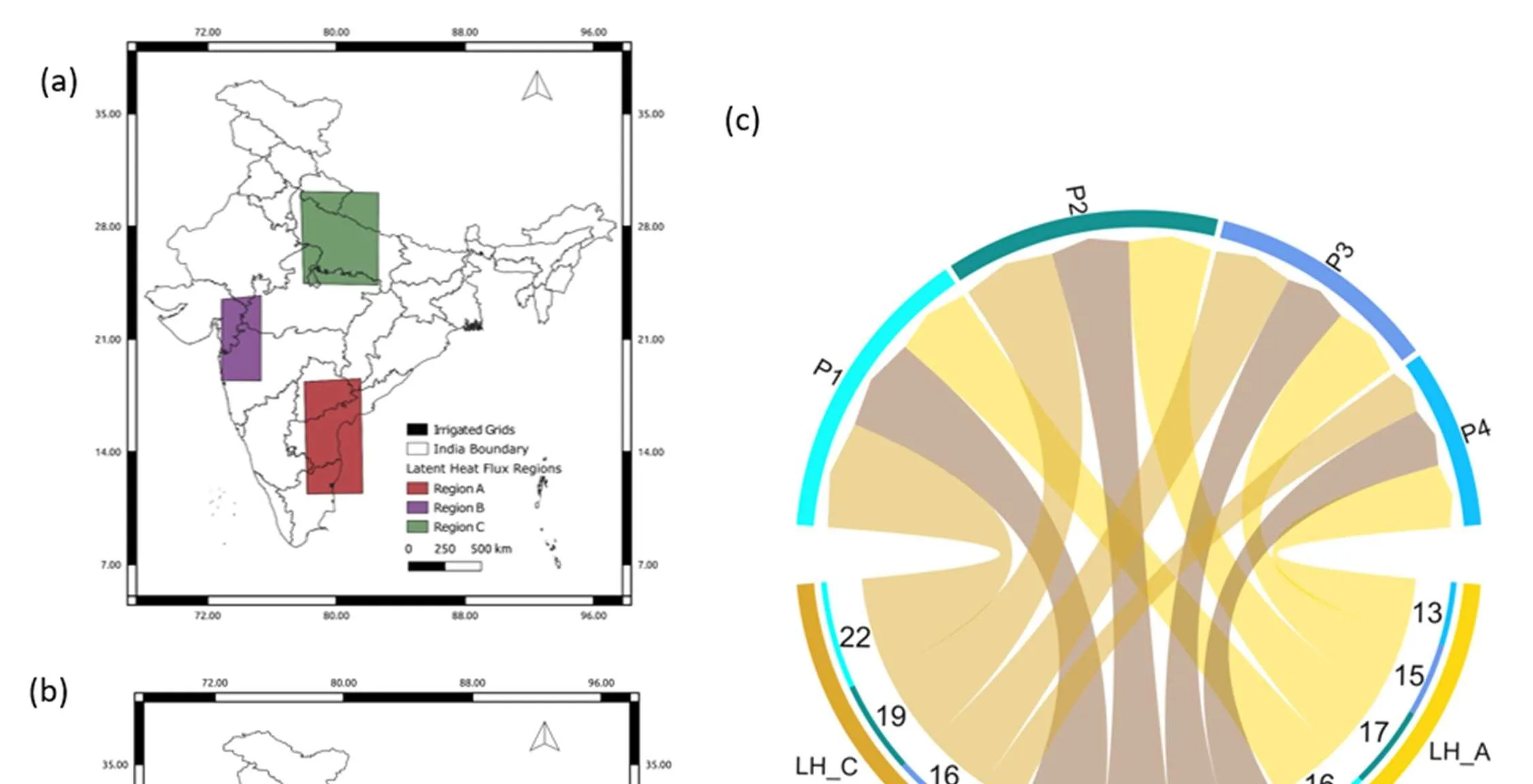
The researchers used two causal analysis methods: transfer entropy and the PCMCI algorithm, applied to 40 years of daily data from the ERA-5 and MERRA-2 reanalyses. They examined eight variables (soil moisture, heat fluxes, precipitation, humidity, wind, radiation, temperature) across six major Indian basins. Then, using the regional climate model WRF-CLM4, they ran two numerical experiments: a control with current irrigation and an experiment with additional irrigation simulating water transfer. The model had a resolution of 25 km and covered monsoon seasons from 1991 to 2012.
Results
Causal analysis revealed consistent pathways of information transfer from land variables in one basin to atmospheric variables in another, challenging the notion of basin independence. Model experiments showed that additional irrigation leads to a statistically significant reduction in September rainfall of up to 12% in central and western India, including arid regions of Rajasthan and Gujarat. In individual years, the reduction reached 20% in Odisha and Uttarakhand and up to 50% in Gujarat. The rainfall decline was accompanied by an increase in maximum temperature of up to 1°C and a decrease in soil moisture of about 15 mm. The effect was stronger during La Niña years than during El Niño years.
Implications
This work is the first to quantitatively show that large-scale hydrological projects can alter regional climate through land-atmosphere feedback. Unlike neighboring studies that examine natural variability or local effects, here a mechanism is demonstrated whereby anthropogenic intervention in one basin affects rainfall in others. This challenges traditional water resource planning that ignores atmospheric connections. The results call for a reassessment of impact assessment approaches for such projects worldwide.
Future development
The topic could evolve toward more detailed modeling that includes runoff feedback to the ocean, which also influences the monsoon. Incorporating climate change scenarios and more accurate land-use data is possible. Applying causal analysis methods to other regions with planned river interlinking, such as China or Africa, is promising. It is also important to study long-term effects on ecosystems and agriculture.
Impact
The results will influence water resource planning in India and other countries with monsoon climates. They are also important for climate modeling and assessments of agricultural vulnerability to rainfall changes.
Next steps
The next step could be conducting ensemble simulations with different climate models to test the robustness of the results. It is also necessary to investigate the impact of water transfer on runoff to the ocean and its feedback to the monsoon.
Key open problems
This work directly addresses the unresolved problem of hydrological connectivity of basins, which is traditionally ignored in water management planning. It also touches on how anthropogenic changes in land surface affect regional climate, remaining one of the main uncertainties in hydrology and climatology.
The planned canal network in India is about 15,000 km long, which is greater than the distance from Delhi to Sydney. The project aims to transfer 174 billion cubic meters of water per year, equivalent to the annual flow of the Nile River.
In Kim Stanley Robinson's novel "The Ministry for the Future," large-scale geoengineering projects that alter the climate are described, echoing the unintended consequences of river interlinking shown in this work.
Key numbers
- September rainfall reduction: up to 12%
- Temperature increase: up to 1°C
- Soil moisture decrease: about 15 mm
- Additional irrigated area: 30 million hectares
- Canal length: 15,000 km