A Network That Rings Before the Lurch
A fisherman pulls on his net and listens to it ring. Each strand quivers in its own way, but before a strong tug, all the strands begin to vibrate in unison. So it is with complex systems: before a sharp state jump, the individual parts suddenly start to oscillate in concert, and that synchrony betrays the coming jump.
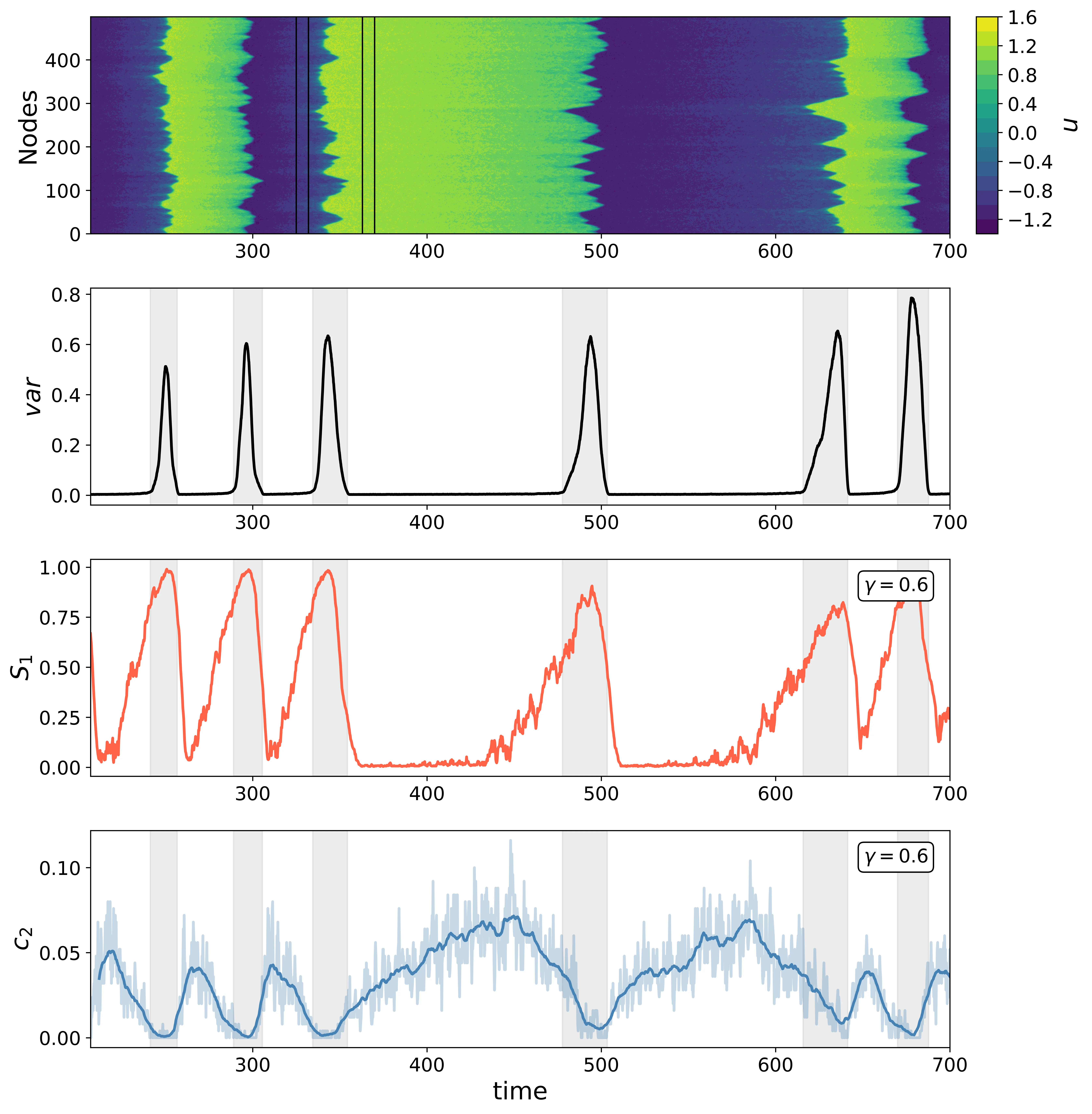
Scientists built a model of 500 coupled FitzHugh–Nagumo oscillators arranged on a ring. These are mathematical pendulums that can abruptly flip the sign of a fast variable, like a neuron that suddenly fires. Between oscillators, they placed links whose strength depended on how synchronously the oscillators moved. The result is a network: nodes are points in space, and links are statistical dependencies between their oscillations.
It turns out that the size of the largest cluster grows well before the jump and reaches its maximum at the moment of transition. Even earlier, a peak appears in the probability that a random node belongs to a cluster of size two. It is as if small groups of people in a square first pair up, then merge into a single crowd. Spatial variance does not provide such an early warning.
A test on real sea-surface temperature data from the NINO3.4 region showed that the peak in the probability of a size-two cluster precedes El Niño and La Niña by 79–214 days. But after detrending, the signal vanished. So in the ocean, the network rings not because of slowing local dynamics, but because of an overall large-scale temperature trend. The fisherman hears the net ring, but now he knows it can be caused by different things.
The peak in the probability that a node belongs to a component of size two (c2) arises because small clusters first grow and then merge with the giant component, as if separate groups of people in a square first formed pairs and then merged into a single crowd.