A Network That Hears a Jump Coming
Context
This work sits somewhat apart: its nearest neighbors in the archive deal with predicting climate shifts and synchronization, but here the focus shifts to the mechanism of percolation precursors in irregular oscillatory systems. Around it, there are studies where neural networks warn of droughts or El Niño, and work on how networks themselves decide when to stop. This paper does not merely apply network analysis; it uncovers why it works, separating the contribution of a global trend from that of fluctuation synchronization.
Methods
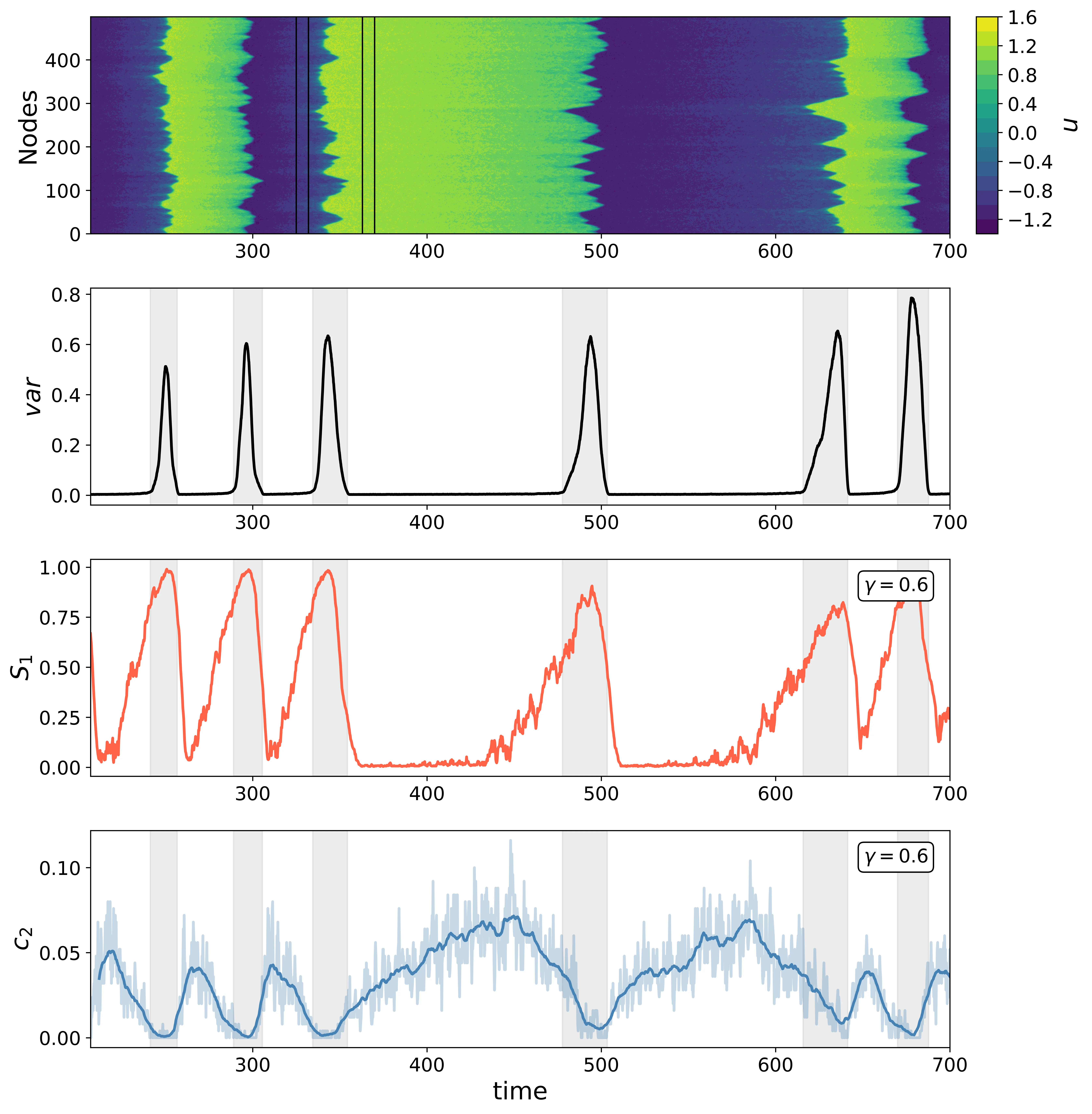
A time sequence of functional networks is constructed: nodes are spatial points, links are Pearson correlations above a threshold. For a model of 500 diffusively coupled noisy FitzHugh–Nagumo oscillators on a ring, percolation measures are computed: the relative size of the largest component S1 and the probability c2 that a node belongs to a component of size two. The time series are then detrended with a Gaussian kernel to remove the overall trend and test whether the precursor remains due to critical slowing down. The same approach is applied to sea surface temperature anomalies in the NINO3.4 region for 1979–2019.
Results
In the FitzHugh–Nagumo model, percolation precedes every sharp switch in the sign of the fast variable: S1 starts growing well before the jump, reaches a maximum at the transition, and drops quickly; c2 peaks even earlier. Spatial variance of this lead does not provide a signal. Detrending barely weakens the precursor, meaning critical slowing down works on its own. On real El Niño and La Niña data, the c2 peak leads the event by 79–214 days, but after trend removal the signal disappears: here percolation is caused by the overall large-scale temperature trend, not by slowing of local dynamics.
Implications
The paper shows that percolation precursors apply not only to bifurcation-induced transitions (B-tipping) but also to irregular oscillations where parameters do not change. This broadens the class of systems for which early warnings can be built. Compared with neighboring works where neural networks predict events, here the physical mechanism is revealed: the growth of correlations before a jump is explained either by an overall trend or by critical slowing down, and these contributions can be separated by detrending.
Future development
The method could be extended to other types of sudden transitions: N-tipping (noise-induced), R-tipping (rapid parameter change), and transitions in systems with two time scales. Combining it with lagged correlations and information measures is promising for capturing delays and nonlinear couplings. In climatology, it would be interesting to test whether the separation of trend and slowing works at larger spatial scales where teleconnections arise.
Impact
The results matter for climatology, neuroscience, seismology, and ecology, where anticipating abrupt regime shifts is crucial. In practice, this could improve early warning systems for El Niño and La Niña.
Next steps
Test percolation precursors on other climate indices and on models with different coupling topologies. Develop automatic selection of the correlation threshold and window width for real-time monitoring.
Key open problems
In complex systems theory, the existence of universal early warnings for transitions not related to bifurcations remains an open question. This work shows that percolation of functional networks can serve as such a warning for irregular oscillations, but the mechanism depends on the nature of the system: trend or critical slowing down. This links the problem to the broader challenge of distinguishing tipping types and finding reliable indicators for each.
The peak in the probability that a node belongs to a component of size two (c2) arises because small clusters first grow and then merge with the giant component, as if separate groups of people in a square first formed pairs and then merged into a single crowd.
Key numbers
- Number of oscillators in the model: 500
- Correlation threshold for the model: 0.6
- Correlation threshold for SST: 0.998–0.999
- Lead of c2 for El Niño/La Niña: 79–214 days
- Window width for SST: 200 days