Climate, Harvest, and Post-Harvest Conflict
On an African field, maize has just been harvested. The grain sits in sacks, and for armed groups it's a lure: something to take from farmers. But if the harvest fails, the lure disappears, and attacks become fewer. That's exactly what happens when El Niño (the warm current in the Pacific Ocean that alters weather worldwide) brings drought to Africa's farming regions.
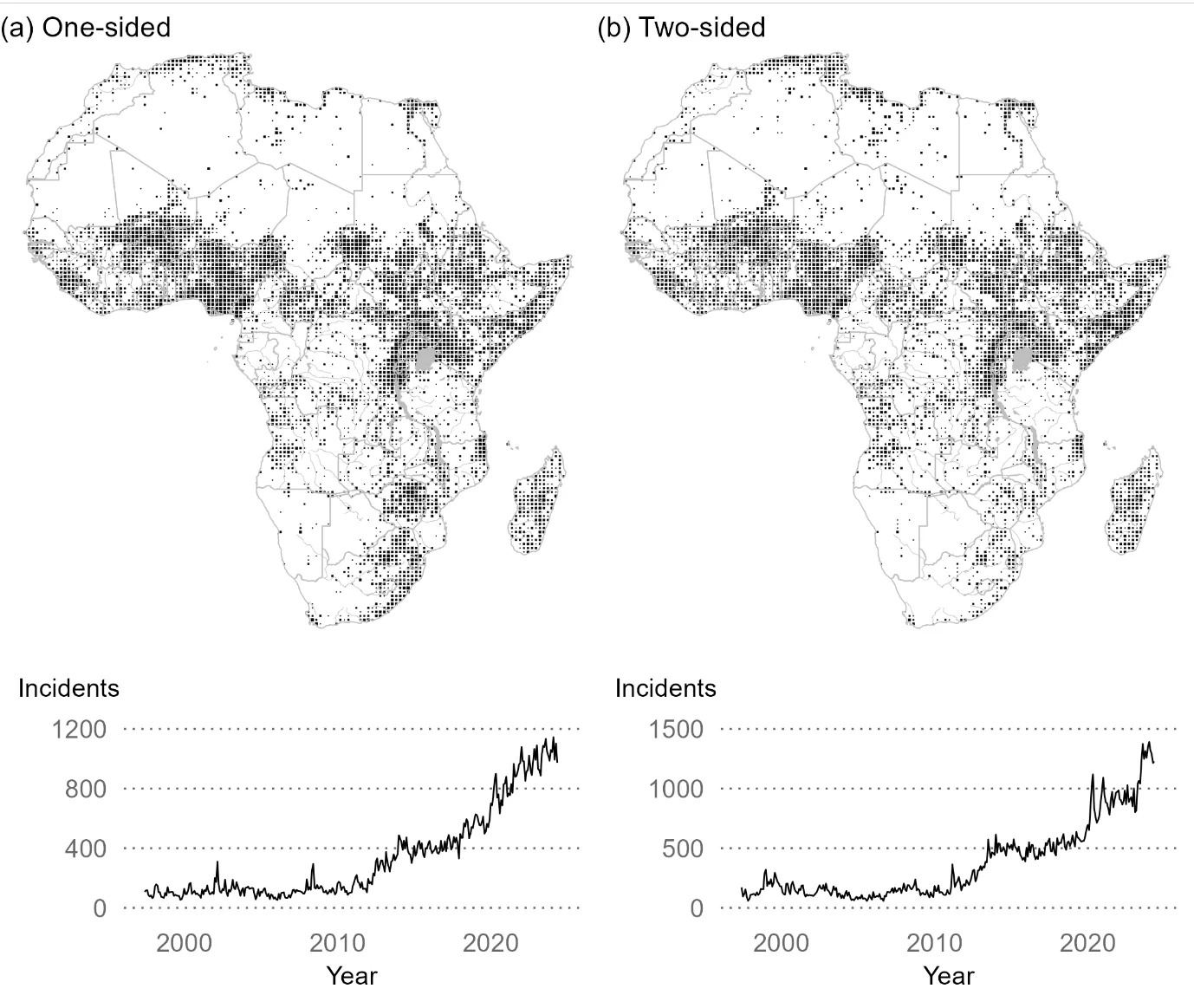
The researchers examined 10,223 half-degree grid cells across Africa from June 1997 to May 2024. For each cell, they knew which crop was grown, when the growing season began, and when harvest occurred. Then they compared how the number of conflicts changed in the first three months after harvest, depending on whether the year was El Niño or La Niña (the opposite phenomenon: cold water in the Pacific).
It turned out that moderate El Niño reduces violence against civilians by 3.4% on average in teleconnected regions. That's like a city with a thousand attacks a year seeing 34 fewer. For intergroup violence, the reduction is smaller: 2.7%. But in regions with strong climate links, such as southern Africa and the Sahel, during strong El Niño events like those in 1997 or 2015, the effect reaches 15% for violence against civilians and 10% for intergroup violence.
La Niña, conversely, increases conflicts in the same months. The logic is simple: La Niña often brings good rains and bountiful harvests, meaning more loot for armed groups. The effect starts right after harvest and lasts three to five months, gradually fading by the end of the agricultural year.
Previously, scientists debated whether drought increases or decreases violence. Some argued that desperation drives people to revolt. Others said that hungry people have no energy for war. This study shows it all depends on the season. In the post-harvest period, a poor harvest acts like a switch: no grain, no reason for looting. But at other times of year, the mechanism may be different.
So a harvest isn't just food. It's also bait for predators. Remove the bait, and predators move elsewhere. And if you know when the bait will disappear, you can prepare.
In 1876–78, a strong El Niño caused droughts and famine in India, and a significant portion of the scarce grain harvest was exported to Europe to stabilize markets, exacerbating the suffering of the local population.
In Kim Stanley Robinson's novel 'The Ministry for the Future,' climate disasters, including heat waves linked to climate change, lead to political upheaval. This study resonates with that theme, showing how climate anomalies can influence conflicts even today.