Climate, Harvests, and Post-Harvest Conflict
Context
The link between climate and conflict has long occupied scientists, but the role of the El Niño–Southern Oscillation (ENSO) remained understudied. ENSO is a large-scale climate phenomenon in the tropical Pacific Ocean that, through so-called teleconnections, alters weather in distant regions, including Africa. This work stands at the periphery: there is little nearby research, with the closest neighbor in the archive being a brief note on predicting El Niño a year and a half ahead, but it does not address conflicts. This study fills the gap by connecting a predictable climate signal to the dynamics of political violence in agricultural areas.
Methods
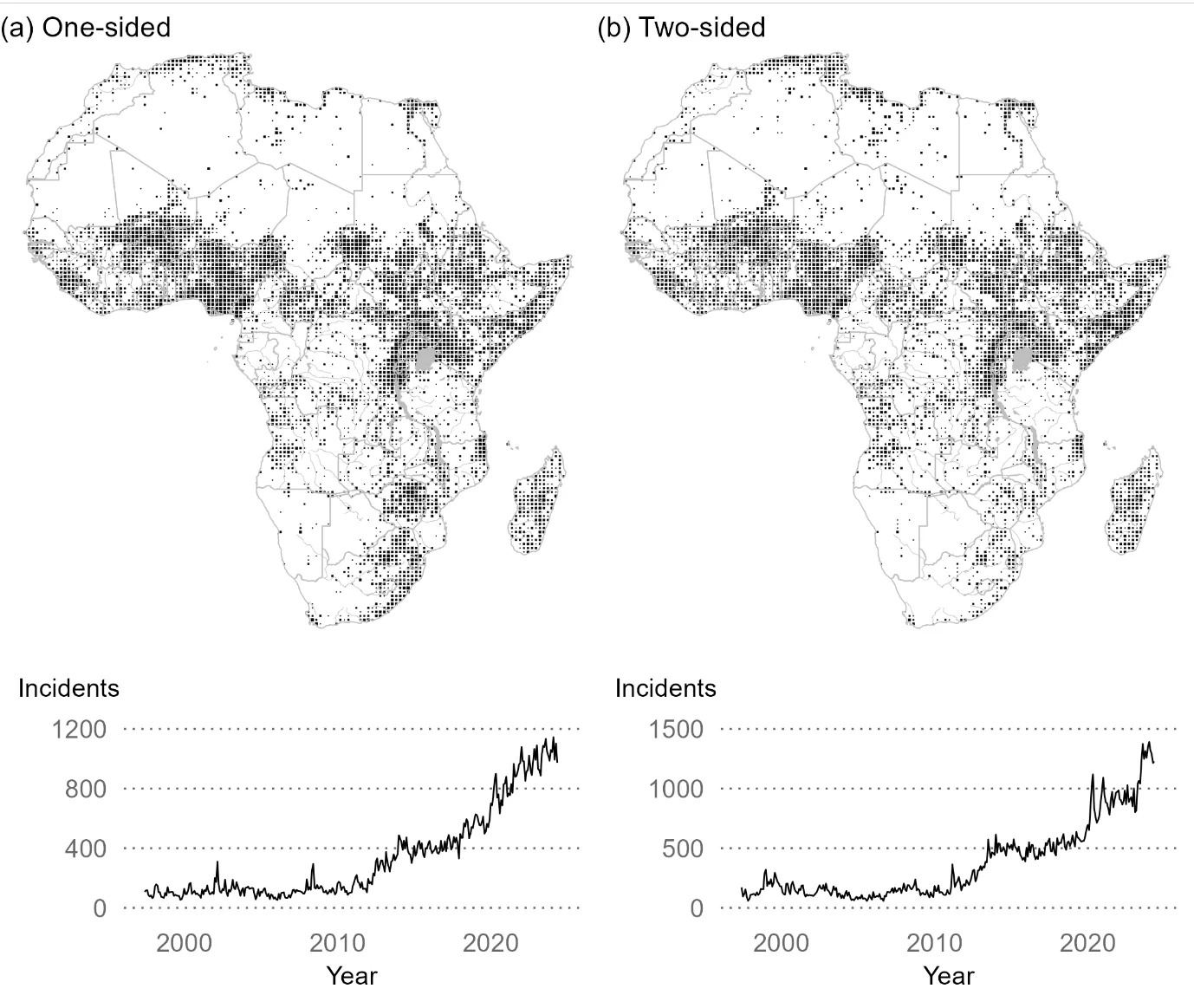
The author used political violence data from the ACLED project from June 1997 to May 2024, dividing Africa into 10,223 grid cells of 0.5° latitude and longitude. For each cell, information was collected on the area planted with the main staple crop and its growing period. The key indicator was teleconnection intensity: the proportion of growing-season months when the ENSO index significantly influenced precipitation or temperature. Then, using regression models with fixed effects, the author estimated how ENSO deviations during the growing season affect the number of conflicts in the first three months after harvest.
Results
A moderate El Niño (a 1°C increase in sea surface temperature) reduces violence against civilians by 3.4% and violence between armed groups by 2.7% on average across teleconnected farming regions during the early post-harvest season. The effect weakens by the end of the agricultural year. During strong El Niño events, such as those in 1997 or 2015, in highly exposed regions like Southern Africa and the Sahel, the reduction can reach 15% for violence against civilians and 10% for intergroup violence. La Niña, conversely, increases conflicts during the same period. Robustness checks confirm the findings, and event analysis shows that the effect begins immediately after harvest and lasts from three to five months.
Implications
This work differs from neighboring studies by linking not just weather but a predictable climate index, ENSO, to conflicts, and by focusing on a short post-harvest window rather than long-term dynamics. Unlike studies where drought or heat increase violence, here it is shown that a poor-harvest El Niño can reduce conflicts because it diminishes the 'loot' available to attackers. This refines our understanding of climate violence: the effect depends on season and conflict type, which is important for climate and security science.
Future development
The topic could evolve toward predicting conflicts based on seasonal climate forecasts of ENSO. Since El Niño is predictable months in advance, early warning systems could be built for humanitarian organizations. Also promising is studying how climate change affects the intensity and geography of teleconnections, which could shift conflict risk zones.
Impact
The results may be useful for humanitarian organizations, peacekeeping missions, and African governments when planning operations during post-harvest periods. They are also relevant for economists studying the climate-violence link and for food security specialists.
Next steps
The next step could be testing the mechanism using data on actual yields and food prices. It is also necessary to adapt the models for other regions, such as South Asia or Latin America.
Key open problems
For the economics of climate and conflict, the causal link between weather shocks and violence remains an open question: it is not always clear which is primary. This work brings us closer to an answer by using the exogenous climate signal of ENSO, but issues of endogeneity related to migration and adaptation remain. Also unresolved is the question of the long-term consequences of repeated climate shocks for institutions and conflicts.
In 1876–78, a strong El Niño caused droughts and famine in India, and a significant portion of the scarce grain harvest was exported to Europe to stabilize markets, exacerbating the suffering of the local population.
In Kim Stanley Robinson's novel 'The Ministry for the Future,' climate disasters, including heat waves linked to climate change, lead to political upheaval. This study resonates with that theme, showing how climate anomalies can influence conflicts even today.
Key numbers
- reduction in violence against civilians under moderate El Niño: 3.4%
- reduction in intergroup violence under moderate El Niño: 2.7%
- average crop area per cell: about 10,000 hectares
- number of cells in the analysis: 10,223
- data period: June 1997 – May 2024