Why El Niño Is Unpredictable: A Maze of Invisible Orbits ✛
The Pacific Ocean works like a giant pendulum. Warm water off the coast of Peru moves westward and returns about six months later. Scientists call this travel time the delay. It makes the climate akin to a maze where each step depends not only on where you are now but also on where you were half a year ago.
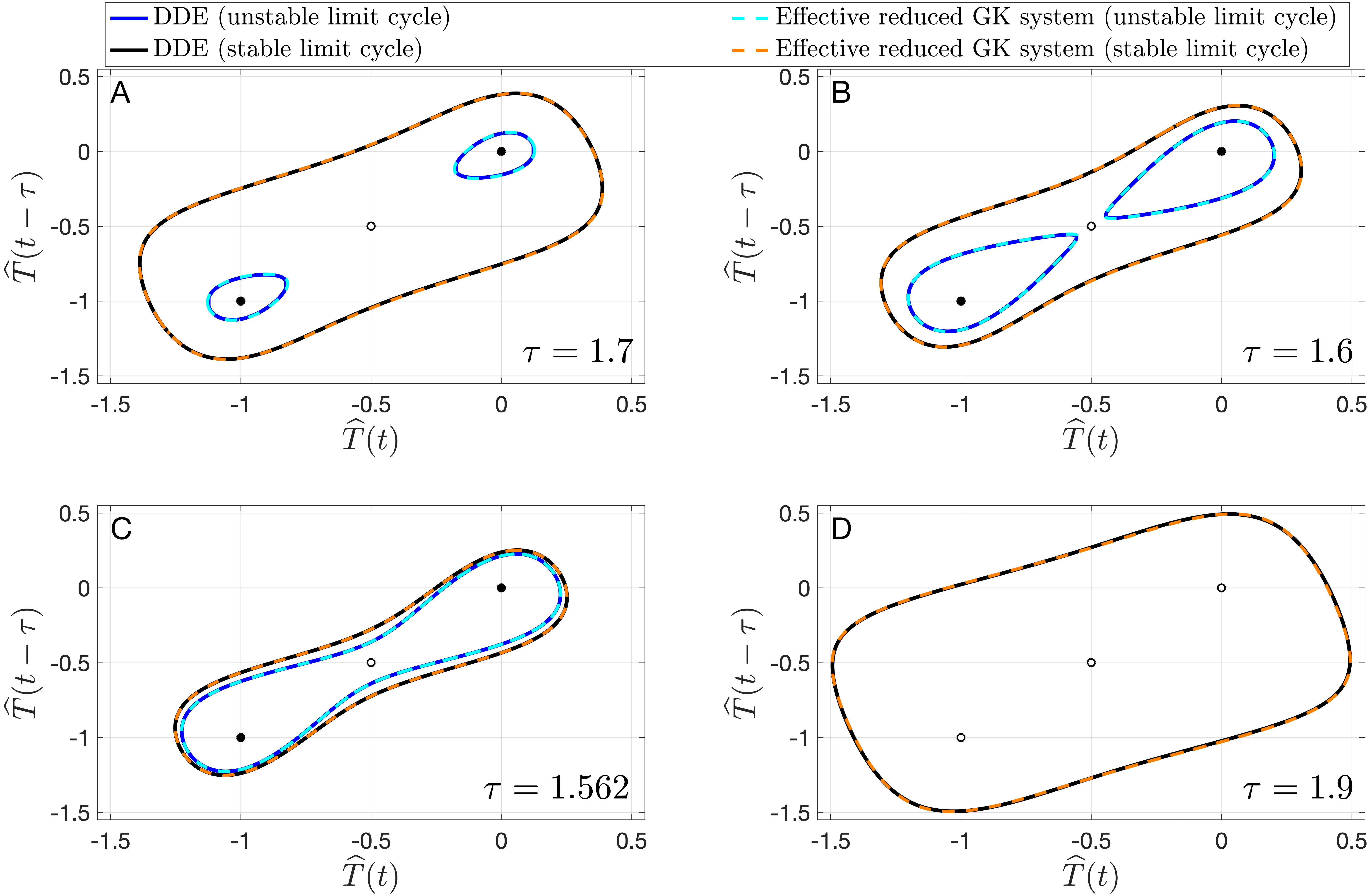
When the delay changes, the maze reshapes itself. At a delay of about 1.74 years, the system starts oscillating, but these oscillations are unstable. Nearby, there are invisible closed paths that repel the system. Random jolts, like gusts of wind, knock it off course, and it wanders for a long time before finding a new path.
The slow drift of the delay, mimicking changes in wave travel time, makes the maze slowly alter its shape. As a result, episodes resembling El Niño and La Niña emerge: a warm phase gives way to a cold one, and this rhythm is irregular. Scientists found two main rhythms: about 5.5 years and about 21 years. The second rhythm is linked to the system occasionally approaching invisible orbits and spending several cycles near them.
This explains why El Niño is so hard to predict. But understanding possible routes helps recognize an approaching point of no return. This could form the basis for early warnings of strong events and for more accurate climate models that account for the ocean's memory.
The Suárez–Schopf model was proposed in 1988 and has since served as a testing ground for studying El Niño. Despite its simplicity, it reproduces key features of the phenomenon, including irregularity and decadal modulations.
The idea that small random perturbations can switch a system between qualitatively different regimes echoes the concept of 'bifurcation points' in science fiction, for instance, in Isaac Asimov's novel 'The End of Eternity', where small changes in the past lead to unpredictable consequences in the future.