A Sieve for El Niño: How an Algorithm Finds the Minimal Model of a Fickle Climate ✛
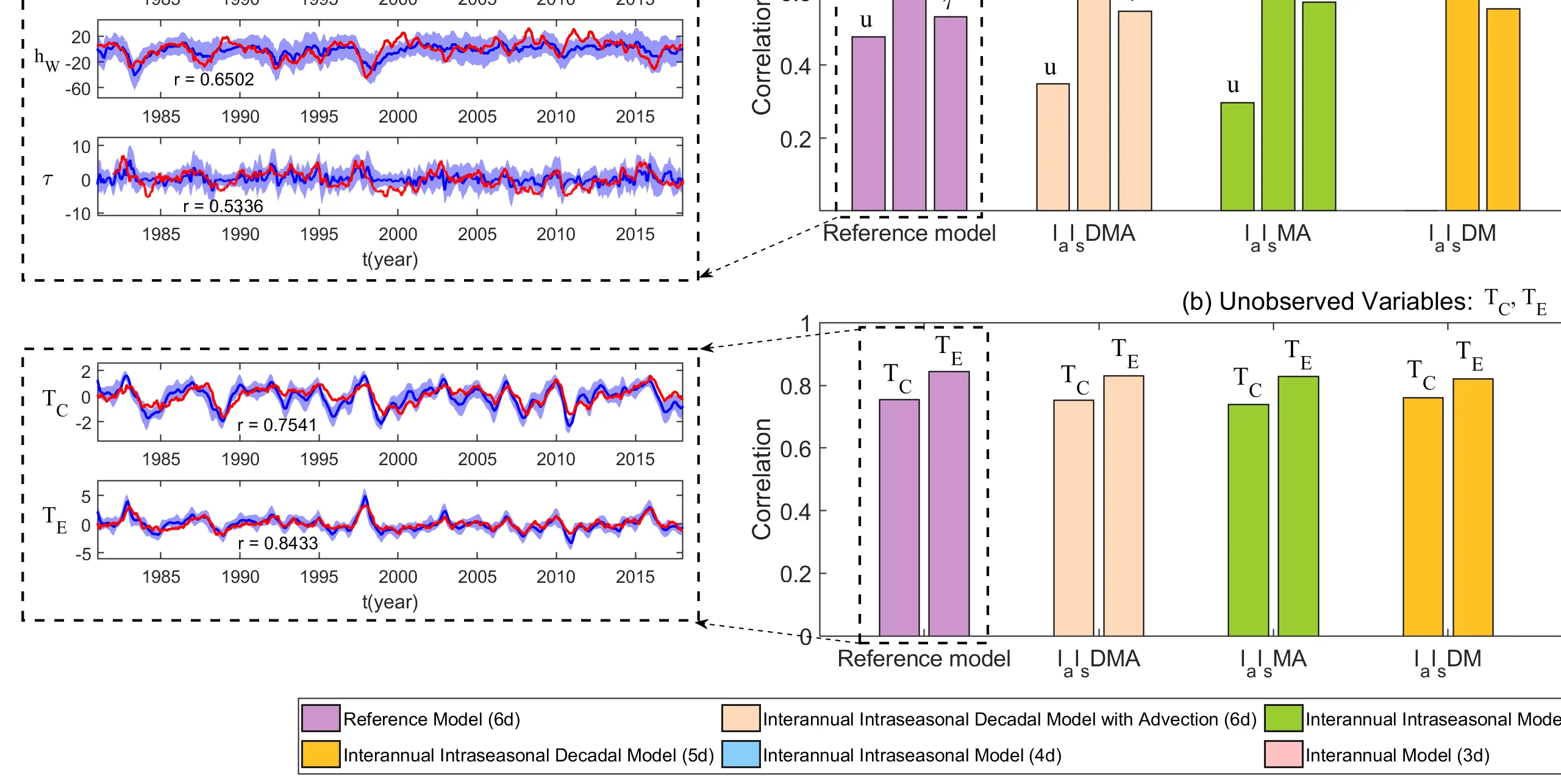
Every few years, a huge pool of warm water in the western Pacific Ocean shifts eastward, like water in a bathtub when you tilt it sharply to one side. That is El Niño. But each tilt is different: sometimes the water sloshes against the shores of Peru, sometimes it stalls in the middle, sometimes it pours out in a powerful surge, and sometimes it barely creeps.
Scientists have long tried to build a simple model that reproduces all these variations. The problem is that equations accumulate many terms, and it is unclear which ones are truly needed and which merely create an illusion of accuracy. The new work offers a sieve: the algorithm sifts through a library of dozens of functions and keeps only those that add information about how the system changes.
Sifting through a six-dimensional reference model in this way, the authors obtained a hierarchy of models with dimensions from three to six. All models except the three-dimensional one reproduced key properties of El Niño diversity: seasonal synchronization, temperature asymmetry, autocorrelations, and frequencies of different event types. The minimal sufficient model turned out to be four-dimensional.
In it, three variables describe slow processes: the depth of the thermocline (the layer of sharp temperature change) in the western Pacific and the surface temperatures in the eastern and central parts. The fourth variable accounts for intraseasonal westerly wind bursts. Without it, the model becomes too regular and underestimates extreme events, when the temperature anomaly exceeds 2.5 °C.
The method not only finds a model but also makes it transparent. Unlike neural networks, which work as black boxes, here every term in the equation has physical meaning. This opens the way to systematically building conceptual models for other geophysical systems where data are abundant but understanding of mechanisms is limited.
The sieve that sifted El Niño equations left scientists with a minimal set of details from which the entire spectrum of behavior of this climate phenomenon is assembled.
The causal entropy used to select model terms is computed via analytical formulas thanks to the Gaussian approximation, making the entire autogeneration process computationally cheap: on a standard computer it takes minutes, not hours.