Physically Informed Autogeneration of Stochastic Models of El Niño Diversity ✛
Context
Understanding El Niño dynamics has advanced considerably over recent decades, yet the diversity of events in terms of spatial pattern, peak intensity, and temporal evolution remains poorly captured by conceptual models. Existing approaches either rely on physical intuition or use standard nonlinear regression, which retains many nonphysical terms with small coefficients. This work sits alongside studies that apply neural network training to extract laws of nature from noise and to build precise maps of physical fields, but it differs by using causal inference based on a library of functions rather than a black box. This allows for the automatic generation of sparse and physically interpretable models.
Methods
The authors developed a physically informed autogeneration scheme that uses causal entropy to determine model structure. First, a state vector is defined, then a library is built from linear, quadratic, and cubic functions of these variables. For each function, the causal entropy is computed, indicating whether it adds information about the derivative given all other functions. The Gaussian approximation yields analytical formulas, making the computations efficient. Parameters are estimated by maximum likelihood. For models with latent variables, an iterative procedure is applied, alternating between Bayesian sampling of trajectories and updating the structure. A six-dimensional stochastic model calibrated to observations served as the reference.
Results
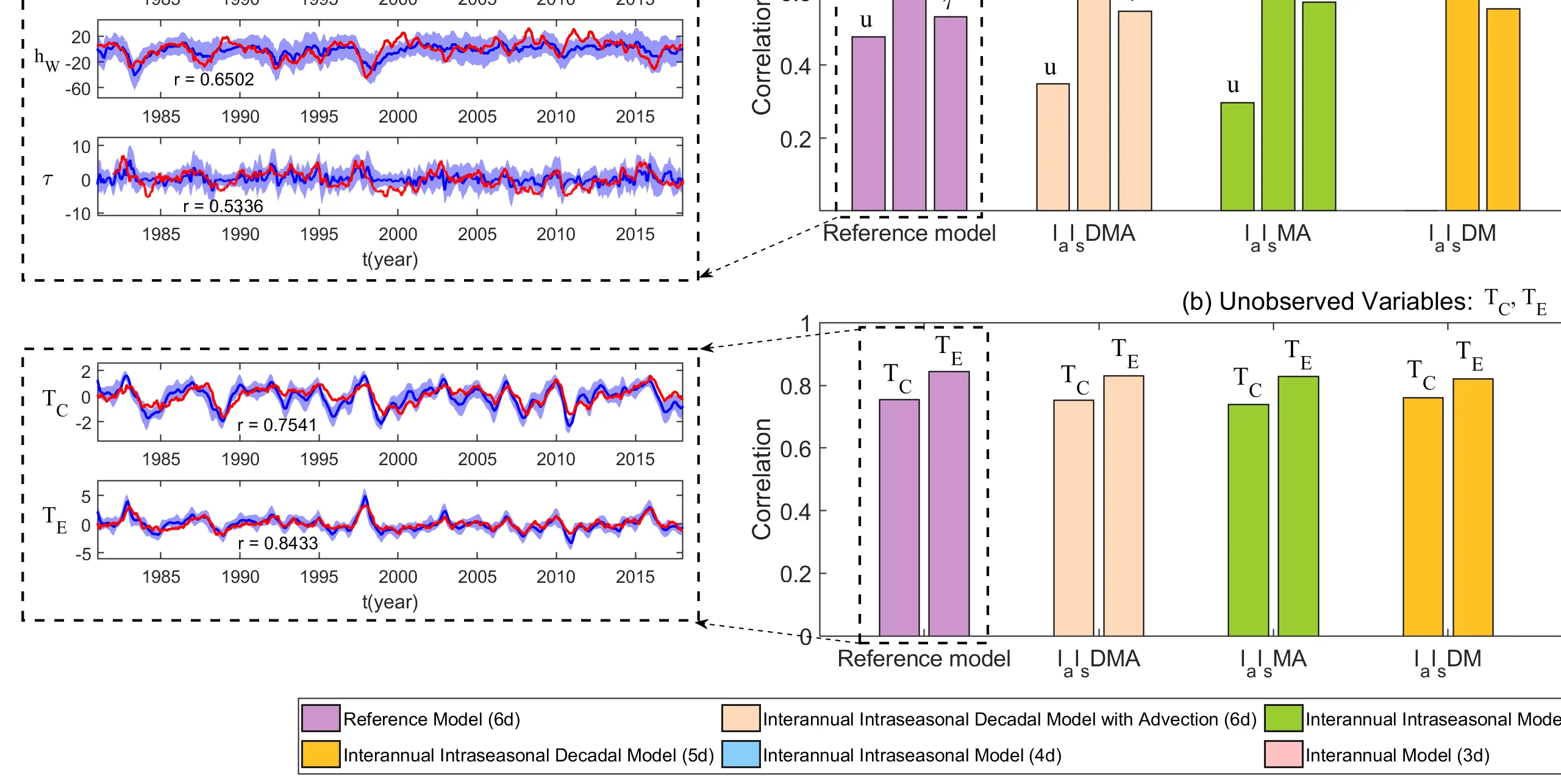
From the reference six-dimensional model, a hierarchy of models with dimensions from three to six is derived. All models except the three-dimensional one successfully reproduce key properties of El Niño diversity: seasonal synchronization, asymmetry of temperature distributions, autocorrelation functions, the bivariate diagram of event location and strength, and the frequencies of different event types. The minimal sufficient model turned out to be four-dimensional, containing three interannual variables (thermocline depth in the western Pacific, surface temperatures in the eastern and central regions) and one intraseasonal variable for westerly wind bursts. The three-dimensional model without this variable underestimates extreme events and produces overly regular oscillations. Adding a latent variable, which after training is identified as a surrogate for atmospheric wind, corrects these deficiencies.
Implications
The work shows that automatic causal inference can find minimal physically meaningful models of complex climate phenomena. Unlike neighboring approaches based on neural networks, here the model structure remains transparent and interpretable. This opens the way to systematically building conceptual models for other geophysical systems where data are abundant but mechanistic understanding is limited.
Future development
The method can be applied to data from CMIP climate models and paleoreconstructions, which provide long time series. This would allow extracting dynamics for different climate epochs and testing how the key mechanisms of El Niño diversity change with the mean state.
Impact
The results could improve El Niño forecasting through more accurate stochastic models suitable for ensemble data assimilation. They also provide guidance for the development of recharge-oscillator models, indicating which variables and nonlinearities are truly necessary.
Next steps
The next step will be to apply autogeneration to climate model data and paleoarchives, as well as to investigate the sensitivity of the models to changes in decadal variability, which may affect the frequency of central and eastern Pacific events.
Key open problems
The work directly addresses an unresolved problem in climatology: what minimal dynamical ingredients are necessary to reproduce the observed diversity of El Niño. It also touches on the role of stochastic forcing at different time scales in shaping extreme events.
The knowledge machine's view
This section is addressed to the author of the paper and their colleagues. Neighbouring works were found by meaning-based search across our archive, not by word overlap. We do not review: we show the field around the work.
What the work does
The authors developed a physically informed scheme for the automatic generation of stochastic models, using causal entropy for feature selection. From a reference six-dimensional model, they derived a hierarchy of models and found that the minimal model reproducing the diversity of El Niño must include three interannual variables and one intraseasonal variable for westerly wind bursts.
Where its strength is
The strength of the work lies in the automatic causal inference, which yields sparse and physically interpretable models without a black box, and in the clear demonstration of the need for an intraseasonal stochastic variable to achieve realistic diversity.
Where it could go next
- It might be interesting to compare the obtained minimal model with models derived by rigorous asymptotic methods from more complete equations, to check how well the automatically selected terms correspond to physically motivated ones.based on: How Order Emerges from Chaos: A Rigorous Derivation of El Niño Models arXiv:2212.14179
- A related approach explains diversity through the interaction of three oscillators in a low-dimensional model; one could examine how your four-dimensional model relates to such an interpretation and whether similar regimes emerge.based on: Three Pendulums on a Shared Spring: How a Simple Model Explains El Niño's Whims arXiv:2206.06649
- Since you emphasize the role of intraseasonal wind bursts, it would be interesting to compare with a model where seasonal wind bursts drive the El Niño oscillator, to clarify how stochastic forcing at different frequencies shapes diversity.based on: El Niño: A Pendulum Rocked by Seasonal Gusts arXiv:2012.09858
Worth trying
- Test whether the minimal dimensionality holds when using a different reference model, for example one derived from observations via a nonparametric method.
- Apply the proposed scheme to other climate phenomena with pronounced diversity, such as the Indian monsoon or the Pacific decadal oscillation.
- Investigate how variable selection changes when the diversity assessment criteria are altered, to understand the robustness of the found minimal model.
Why this may matter
Automatic identification of physically relevant variables could help build more accurate conceptual models for predicting and understanding complex climate phenomena where event diversity is critical.
Nearby works in our archive
- How Order Emerges from Chaos: A Rigorous Derivation of El Niño Modelssimilarity 0.65
- Three Pendulums on a Shared Spring: How a Simple Model Explains El Niño's Whimssimilarity 0.61
- Three Rhythms of El Niño: A Model of Complexitysimilarity 0.59
- El Niño: A Pendulum Rocked by Seasonal Gustssimilarity 0.58
- Twin Winds: How Rotation and Divergence Drive El Niñosimilarity 0.57
- El Niño: Fading Out or Self-Sustaining?similarity 0.57
The closest work in the archive sits at 0.65 by meaning — the usual level for our corpus.
The causal entropy used to select model terms is computed via analytical formulas thanks to the Gaussian approximation, making the entire autogeneration process computationally cheap: on a standard computer it takes minutes, not hours.
Key numbers
- minimal model dimension: 4
- number of interannual variables: 3
- number of intraseasonal variables: 1
- threshold for extreme El Niño: 2.5 °C
- length of model segments for validation: 70 years