Yinling Zhang

5 articles · 6 co-authors · latest: 2025-07-18

We have retold 5 papers by this author. 5 of them with a full read. most often about: el_nino_southern_oscillation, enso_diversity, chaos theory. 6 co-authors across our retellings.

Links in the knowledge graph
How Order Emerges from Chaos: A Rigorous Derivation of El Niño Models
Every few years, warm Pacific waters rise to the surface off the coast of Peru, and the planet's weather goes off its usual schedule. This is El Niño, an irregular phenomenon that recurs every 3–7 years but still eludes precise forecasting.
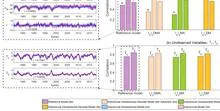
A Sieve for El Niño: How an Algorithm Finds the Minimal Model of a Fickle Climate
Every few years, a huge pool of warm water in the western Pacific Ocean shifts eastward, like water in a bathtub when you tilt it sharply to one side. That is El Niño. But each tilt is different: sometimes the water sloshes against the shores of Peru, sometimes it stalls in the middle, sometimes it pours out in a powerful surge, and sometimes it barely creeps.
The interpreter that learned chaos's dialect
An interpreter at a conference hears the noise of the hall but keeps translating. They don't repeat every word; instead, they find an intermediate language where complex phrases become simple, yet meaning is preserved.
A Bridge Between Ocean and Atmosphere Rhythms
The tropical Pacific breathes in two rhythms. One lasts several years: the water off the coast of Peru warms and cools, which fishermen call El Niño. The second rhythm is fast: every month or two, a giant cloud wave is born over the warm waters of the Indian and Pacific Oceans, creeping eastward at a runner's pace and dying out near South America.
A Bridge Between Typhoon and Current: How El Niño Is Born
The tropical Pacific Ocean lives in two rhythms. The first is fast: a wave of thunderstorms born over the Indian Ocean races eastward and dies out off the coast of the Americas within a month or two. The second is slow: every few years, the ocean surface warms enough to alter weather across the entire planet. That is El Niño. Between these rhythms lies a bridge, and building it took climatologists decades.