Ocean and Atmosphere Learn to Speak the Same Language ✛
Two dancers stand facing each other but cannot see each other's faces. One is the atmosphere, fast and noisy, forgetting its moves after just a couple of weeks. The other is the ocean, slow and heavy, remembering every touch for months. For the dance to work, they need to learn to lead each other while only looking at their partner's hands. That is exactly the pair researchers created with the Ola model: two neural networks that exchange only a few numbers but together reproduce one of the planet's most capricious rhythms, El Niño.
The secret of the dance lies underwater. The upper layer of the ocean, down to 300 meters, stores the memory of past winds and releases it through surface temperature. The atmosphere senses this temperature and changes the wind, which in turn pushes the ocean. In physical models, this coupling is described by equations, but they have accumulated errors in the tropics for decades, such as the cold tongue that spoils forecasts. Ola took a different path: the atmospheric neural network was trained on 36 years of ERA5 reanalysis, the ocean network on 22 years of UFS-replay data, and then they were coupled in a loop. The ocean network sees eight depth levels, from half a meter to 300 meters, and thus distinguishes the thermocline, the layer of sharp temperature change where El Niño's future hides.
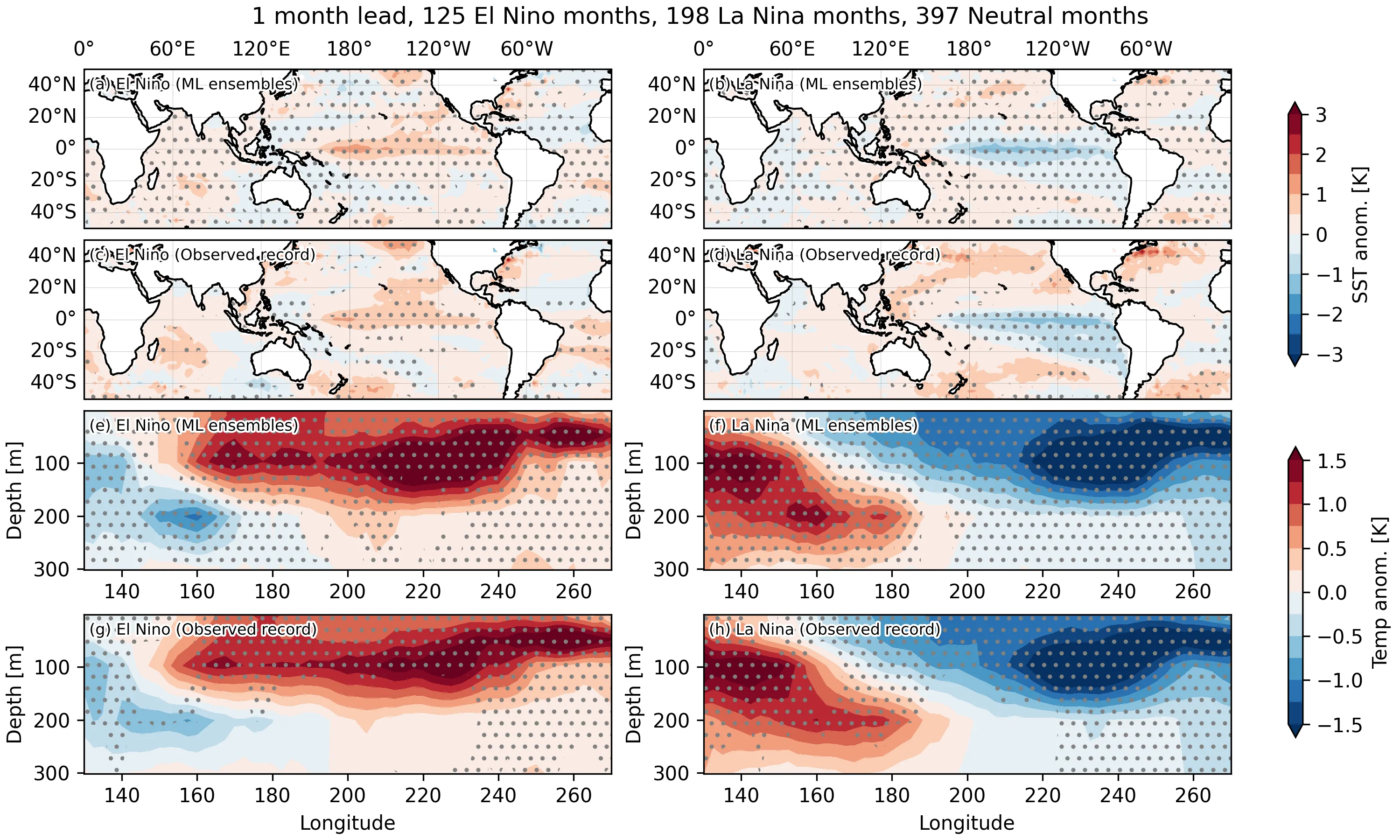
The test lasted five years, from 2017 to 2022. Ola reproduced both El Niño and its cold sister La Niña, with the amplitude of temperature oscillations in the Niño 3.4 region close to observations. Along the equator, the model generated Kelvin waves traveling eastward at about two meters per second and Rossby waves creeping westward at five to ten degrees from the equator. Subsurface temperature anomalies during El Niño shifted eastward at a depth of 50 meters, as in the real ocean. The only notable miss occurred in the winter of 2021–2022, when the model failed to sustain a third consecutive La Niña, but most operational systems also struggled with that.
Previously, it was unclear whether a neural network could learn the coupled ocean–atmosphere dynamics, including subsurface processes that drive El Niño. Ola showed that it can. The difference from related work is fundamental: those either predicted El Niño from statistical indices or used only sea surface temperature, whereas Ola is the first to include the vertical structure of the upper 300 meters in the trainable loop. This is not just another emulator but a test of the hypothesis that a neural network can learn the coupled ocean–atmosphere dynamics, including the waves that transport heat and determine El Niño's phase.
Currently, the model is stable only for six months; beyond that, drifts accumulate at high latitudes. But already today, the prototype can be used for fast ensemble seasonal forecasts for research purposes: Ola produces a six-month forecast in less than a minute on a single A100 GPU, whereas the classical GFDL-SPEAR model needs hours on a cluster for the same calculation. The two dancers who learned only from hands have already taken the stage.
Ola produces a six-month forecast in less than a minute on a single A100 GPU, while the classical GFDL-SPEAR model needs hours on a cluster for the same calculation.