Ocean and Atmosphere Learn to Speak the Same Language ✛
Two dancers stand facing each other but cannot see each other's faces. One is the atmosphere, fast and forgetful. The other is the ocean, slow and with a long memory. For the dance to work, they must lead each other by watching only their partner's hands. This is exactly the pair researchers created when they built the model Ola: two neural networks that exchange only a few numbers but together reproduce one of the planet's most capricious rhythms, El Niño.
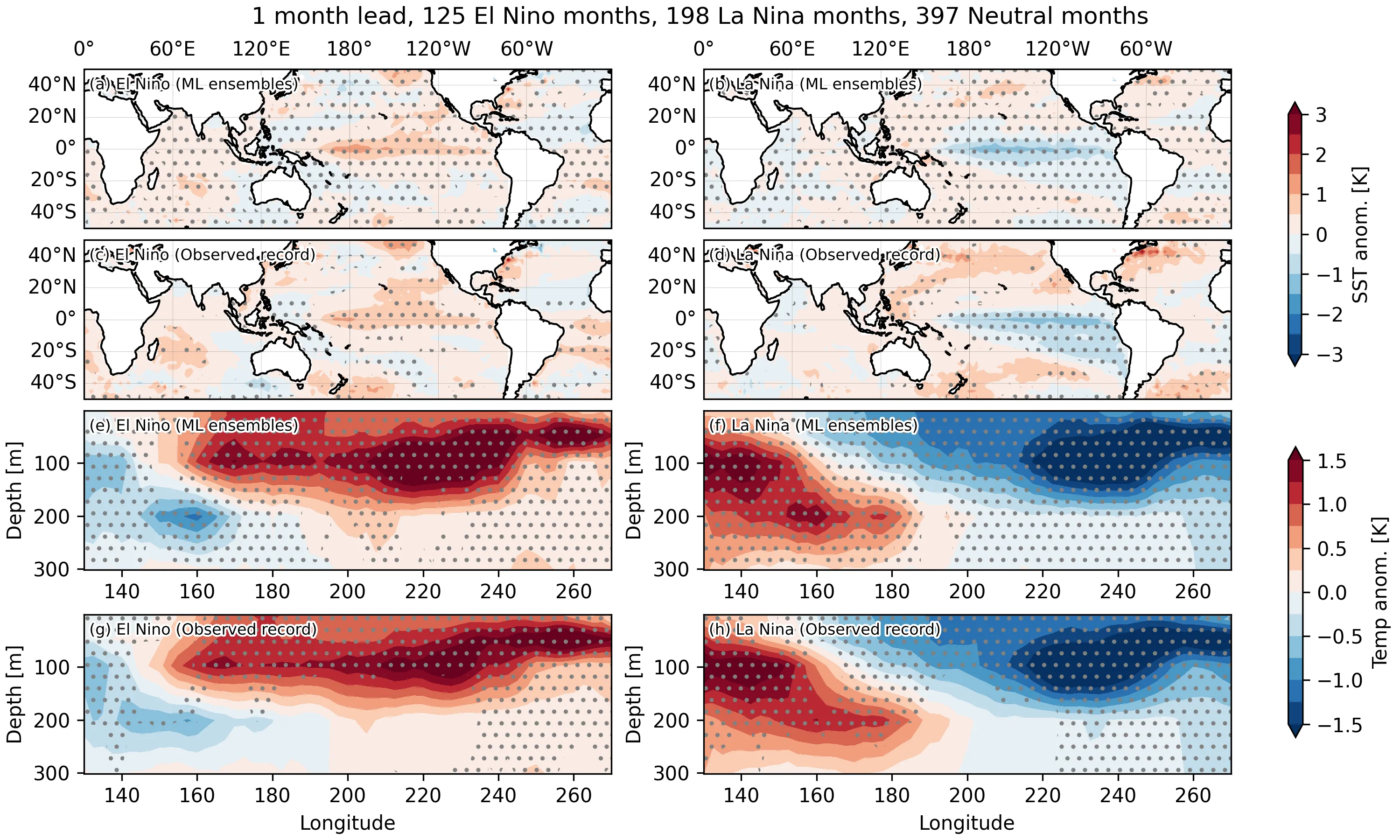
The secret of the dance lies beneath the water. The upper layer of the ocean, down to 300 meters, stores a memory of past winds and releases it through surface temperature. The atmosphere senses this temperature and changes the wind, which in turn pushes the ocean. Previously, scientists described this coupling with equations, but equations accumulated errors. Ola took a different path: the neural network for the atmosphere was trained on 36 years of weather data, the ocean network on 22 years of temperature and current data, and then they were linked in a cycle. The ocean network sees eight depth levels, from half a meter down to 300 meters, and therefore distinguishes the layer of sharp temperature change where the future El Niño hides.
The test lasted five years. Ola reproduced both El Niño and its cold sister La Niña, with sea surface temperatures in the key region close to reality. The model also generated waves that travel along the equator both eastward and westward, just as in the real ocean. The only notable miss occurred in the winter of 2021–2022, when the model failed to sustain a third consecutive La Niña, but most other forecasts also struggled with that.
Previously, it was unclear whether a neural network could learn the coupled dynamics of the ocean and atmosphere. Ola showed that it can. Already now, the prototype can be used for fast seasonal forecasts for research purposes: Ola produces a six-month forecast in less than a minute on a single GPU, whereas an older model needs hours on a supercomputer for the same calculation. The two dancers, who learned only from each other's hands, have already taken the stage.
Ola produces a six-month forecast in less than a minute on a single A100 GPU, while the classical GFDL-SPEAR model needs hours on a cluster for the same calculation.