A Digital Twin of the Atmosphere: How a Neural Network Speeds Up Climate Modeling by 350 Times ✛
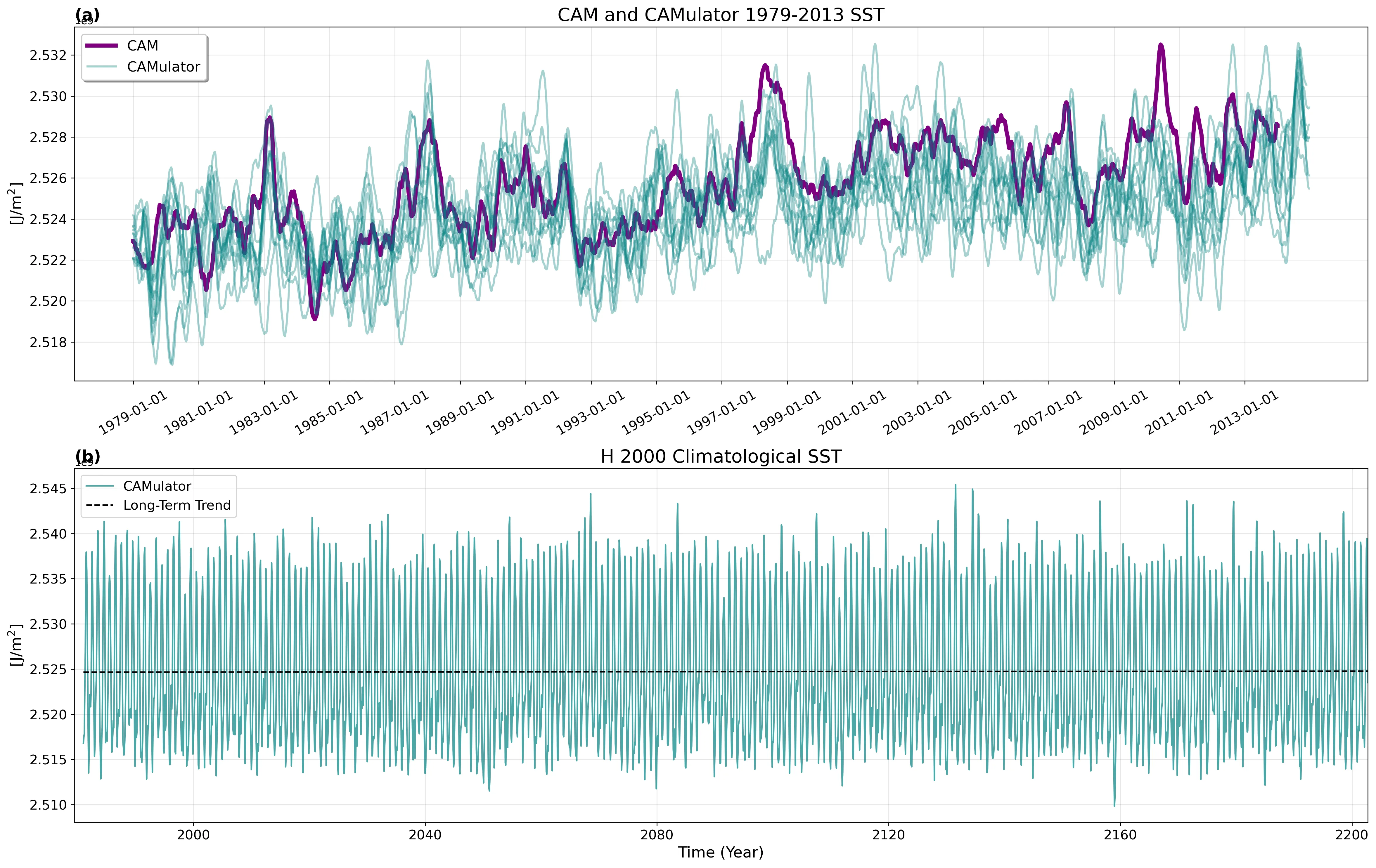
A translator at a high-stakes negotiation doesn't just render words quickly; they make sure the meaning doesn't get lost. CAMulator does the same: it takes the complex climate model CAM6 and translates it into the language of a neural network that runs hundreds of times faster, without losing the physical essence. Earlier such "translators" either simplified the picture or forgot about conservation laws, and their forecasts fell apart over long integrations. CAMulator is the first to keep both full resolution and strict physical rules.
The secret lies in the WXFormer architecture: it first learned to predict weather one step ahead, then it was trained to correct errors so that air mass, moisture, and energy don't drift. It's like a translator who, after each sentence, checks whether they've missed an important detail. Training took only three days on four GPUs, but the model now runs stably for arbitrarily long periods.
Of course, there are flaws. When CAMulator is pushed to look into a future where the ocean is two or four degrees warmer, it paints winters in polar regions that are too cold. The reason is simple: its training didn't include interactive sea ice, so it doesn't know how ice responds to warming. It's like a translator who is fluent in everyday speech but gets lost in technical jargon.
Now that the translator is ready, new possibilities open up. You can quickly generate hundreds of possible future climates, assess uncertainties, and test hypotheses that previously lacked the necessary computing time. And if you couple CAMulator with ocean and ice models, it will stop making mistakes at high latitudes and become even more accurate. In this way, a fast translator helps us understand what awaits the planet in the coming decades.
CAMulator trained for just three days, yet it can simulate 480 years of climate in one day on a single GPU. For comparison, CAM6 on the Derecho supercomputer produces 14 years per day on 10 CPU nodes.