A Digital Twin of the Atmosphere: CAMulator Speeds Up Climate Modeling by 350-Fold ✛
Context
The computational cost of Earth system models limits their use for long-term climate projections and uncertainty analysis. The atmospheric component is the main bottleneck. Machine learning offers a path to acceleration, but previous atmospheric emulators either had reduced spatial resolution or failed to conserve fundamental physical quantities, hindering their integration with other components. CAMulator fills this gap by retaining CAM6's full resolution and imposing hard conservation constraints. This work stands apart from neighboring studies: most either focus on short-term weather forecasting or on machine-learned climate models without strict conservation laws. CAMulator combines full resolution, physical constraints, and climate-scale integration.
Methods
CAMulator is built on the WXFormer architecture, which uses the CrossFormer transformer backbone for multi-scale feature processing and hierarchical transposed convolutional layers to restore spatial resolution. The model contains approximately 751 million trainable parameters. Training proceeded in two stages: first, 113 epochs of one-step forecasting at 6 hours without conservation blocks, then 77 epochs of two-step forecasting at 12 hours with conservation blocks enabled. The loss function is latitude-weighted mean squared error, optimizer AdamW, batch size 32. Training took three days on four NVIDIA A100 GPUs. After the output layer, four sequential correction blocks are applied: non-negativity, conservation of global dry air mass, global moisture budget, and global atmospheric energy. Corrections are applied via multiplicative factors to surface pressure, precipitation, and temperature.
Results
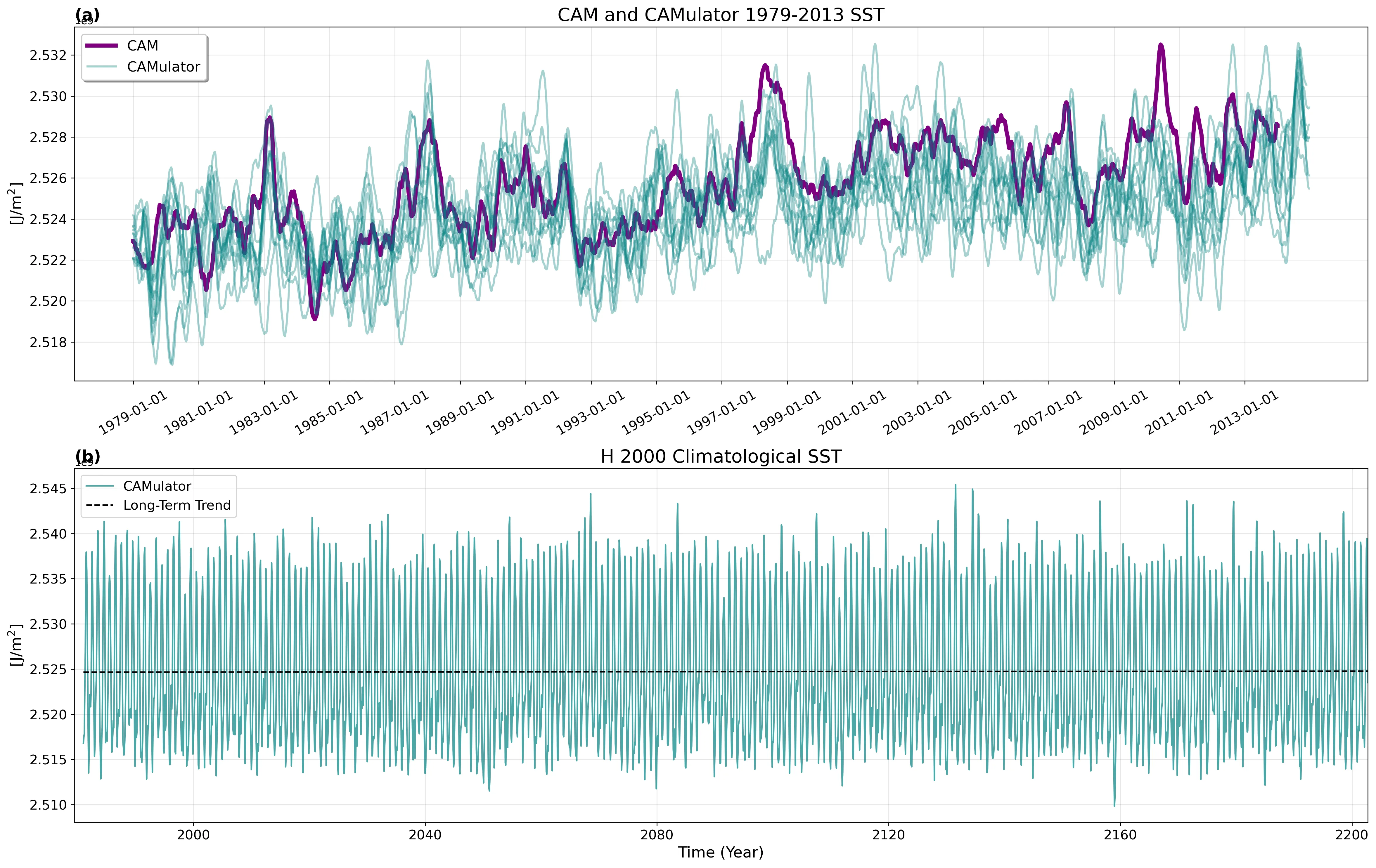
CAMulator reproduces CAM6's annual climatology with spatial root-mean-square errors: precipitation 0.58 mm/day, surface temperature 0.31 K, 10-meter wind speed 0.31 m/s. The model captures the long-term warming trend in atmospheric heat content under observed ocean temperatures. Key modes of variability—PNA, NAO, and ENSO—are reproduced with a correlation of 0.935 for the precipitation response to El Niño, but with somewhat reduced amplitude. Under forcing with ocean temperatures +2K and +4K, beyond the training range, the model shows a systematic cold bias in high latitudes, especially in winter, due to the lack of interactive sea ice. CAMulator runs 350 times faster than CAM6: 480 model years per day on a single GPU versus 14 years per day on 10 CPU nodes.
Implications
CAMulator demonstrates that a machine-learned atmospheric emulator can conserve physical laws while being orders of magnitude faster than a traditional model. Unlike neighboring works that often sacrifice resolution or physical consistency, CAMulator retains CAM6's full resolution and explicitly enforces conservation constraints. This opens the way to hybrid Earth system models where the atmospheric component is replaced by a fast emulator, while ocean, ice, and land remain physical or are also replaced by machine learning. The 350-fold speedup makes it feasible to generate large ensembles for climate projection uncertainty assessment, which was previously computationally prohibitive.
Future development
Near-term improvements include coupling CAMulator to interactive ocean, sea ice, and land models to eliminate the cold bias in polar regions. Adding stochastic parameterizations, such as a kinetic energy backscatter scheme, could enhance variability and improve the representation of ENSO and NAO. Exploring supermodeling, where multiple emulators interact with a dynamical model, promises more accurate climate change projections. Also promising is leveraging CAMulator's differentiability for inverse modeling and parameter estimation.
Impact
Climate modeling, weather forecasting, extreme event analysis, uncertainty assessment, policy development.
Next steps
Integration with interactive ocean, ice, and land models; addition of stochastic parameterizations; testing within a supermodeling framework.
Key open problems
Connection to unresolved problems in climate modeling: accurate reproduction of El Niño and North Atlantic Oscillation variability, adequate response to external forcing beyond the training distribution, and representation of cryospheric feedbacks. CAMulator reveals that physical conservation constraints help reduce the systematic drizzling precipitation bias inherent to CAM6, but do not solve the problem of extrapolation to a warmer climate.
The knowledge machine's view
This section is addressed to the author of the paper and their colleagues. Neighbouring works were found by meaning-based search across our archive, not by word overlap. We do not review: we show the field around the work.
What the work does
CAMulator is an autoregressive emulator of the CAM6 atmospheric model built on the WXFormer architecture (751 million parameters), trained in two stages on one- and two-step forecasting. The model explicitly conserves global dry air mass, moisture, and energy, which ensures stability in long simulations. It reproduces the annual climatology and key modes of variability (ENSO, NAO, PNA) with a 350-fold speedup, but when forced beyond its training distribution, it exhibits a cold bias in high latitudes due to the absence of interactive sea ice.
Where its strength is
Its strength lies in combining the full resolution of CAM6, strict conservation constraints, and the ability to integrate over climate timescales. This makes the emulator suitable for generating large ensembles and for potential coupling with other Earth system components.
Where it could go next
- It might be interesting to look at approaches to weather forecasting on a single GPU: they tackled a similar problem of accelerating atmospheric computations, and perhaps some techniques could further reduce the computational cost of CAMulator.based on: Weather forecast on a single GPU arXiv:2603.21284
- Closely related is work on the 'fourth climate spring'—it may discuss feedbacks that could be incorporated into the emulator to improve its behavior under external forcings, especially in high latitudes.based on: The Fourth Spring of Climate arXiv:2602.10369
Worth trying
- Try incorporating a simplified interactive ice scheme (e.g., a statistical sea ice model) and test whether it removes the cold bias in high latitudes under +2K/+4K scenarios.
- Investigate whether the 'cloud speckles' technique can be applied to improve the representation of clouds and precipitation in the emulator.
- Assess whether methods from 'weather forecasting on a single GPU' offer gains in reducing parameter count or accelerating inference.
Why this may matter
Successfully eliminating systematic biases and achieving further speedups would make CAMulator a practical tool for rapid climate assessments, uncertainty analyses, and possibly operational forecasts within coupled models.
Nearby works in our archive
- Cloud Spices: How a Neural Network Improves Climatesimilarity 0.52
- A neural network tastes the atmospheres of distant planetssimilarity 0.51
- Neural Network Teaches Gravity Not to Hidesimilarity 0.51
- Martian Weather, Earthly Playbooksimilarity 0.51
- The Cosmic Web on a Neural Leashsimilarity 0.49
- The Fourth Spring of Climatesimilarity 0.48
- Weather forecast on a single GPUsimilarity 0.48
The archive is sparse around this work: the closest review is only 0.52, against a usual 0.64. It looks like few have drilled nearby.
CAMulator trained for just three days, yet it can simulate 480 years of climate in one day on a single GPU. For comparison, CAM6 on the Derecho supercomputer produces 14 years per day on 10 CPU nodes.
Key numbers
- speedup over CAM6: 350 times
- simulation speed: 480 model years per day on one GPU
- model parameters: 751 million
- horizontal resolution: 0.9° × 1.25°
- vertical levels: 32