An analogue forecast is a method of predicting future weather or climate by looking at what happened in similar past situations. The idea is simple: if today's conditions resemble those of a particular year in the past, then the coming weeks or months might unfold similarly. Instead of relying on complex physics equations, this approach uses history as a guide.
History
Analogue forecasting has roots in the early 20th century, but it gained formal traction in the 1970s and 1980s as climate data archives grew and computers made pattern-matching feasible.
How it works
To make an analogue forecast, you start with today's state—say, the current sea-surface temperature pattern. Then you search through decades of past records for years where the same pattern appeared at the same time of year. For each matching 'analogue year,' you note how conditions changed over the following two weeks. By combining those historical changes—often taking an average or building a distribution—you get a range of possible outcomes for the future.
In practice
It is used in seasonal climate outlooks, especially for regions where long-term records are rich but dynamical models are less reliable, such as monsoonforecasts in South Asia.
Fun fact
Analogue forecasts were used by the U.S. military during World War II to plan operations, long before numerical weather prediction became standard.
Picture a wind map over a mountain range. The wind mostly blows downhill, following elevation changes. But if you look closely, in some valleys the air swirls into little eddies that keep the wind from simply flowing down. That is exactly what the mutation field in human DNA looks like.
Two runners start a race on a course with changing incline. One starts earlier, the other later, and the judge measures their speeds without knowing about the staggered starts. So it is with virus variants: data arrive with delays, and if those delays are unequal, estimates of competitive advantage can be badly wrong.
A false vacuum is not just a supercooled liquid, but a quantum hologram, ready to spring to life under the right projection. Its decay is described by the tunneling of a quantum field from a metastable minimum, and the classic calculation via Euclidean instantons is as elegant as a still life under spotlights.
A crowd at a metro station during rush hour. Some hurry toward the escalator, others slow down at the departure board, still others weave around a column. Each step is not merely a reaction to what's right in front of your nose. A person estimates in advance where a neighbor will be a second from now and adjusts their route accordingly. Physicists call this forward-looking behavior anticipatory.
A mosaic of large colored tiles. Each tile is the average precipitation over an entire month for an area the size of a small country. For a general understanding, the picture is fine, but if you need to know whether a downpour hit a specific city yesterday, it's useless.
A melody plays, and the brain doesn't just listen note by note. It works like a conductor who already knows the score: each next note is expected because the previous ones still echo in memory. But how do neurons hold on to that echo?
Black holes are among the most mysterious objects in the universe. Their gravity is so strong that even light cannot escape their vicinity. But studying them directly is extremely difficult: the nearest black hole is thousands of light-years away, and mergers of two black holes take millions of years.
During a course of radiation therapy, the tumor and surrounding tissues can shift or change size. Doctors regularly take images and sometimes adjust the plan to keep the radiation on target. But how do you know how much dose has already been delivered and how much is still to come? Usually, this is estimated using simple rules that don't account for uncertainty.
A solar panel on a roof produces little current in the morning, a lot at noon, and stays silent at night. Wind doesn't blow randomly either: it's often stronger in the morning and evening than during the day. Energy providers need to know in advance how much energy will be available in an hour or three, so they can switch on backup plants or store electricity in batteries in time.
Old Chinese chronicles are full of weather entries: "no rain in the third month," "the river overflowed its banks." But these are words, not numbers. Until now, turning them into precise precipitation data was nearly impossible.
The new approach works like a translator from the language of chronicles to the language of climatology.
Two seemingly incompatible mathematical languages describe a single quantum reality. The first is the language of quantum walks: here, a particle (such as an electron or even a quasiparticle in a condensed medium) takes a stroll on a graph, simultaneously exploring all possible paths — much like a pedestrian in an unfamiliar city instantly finding…
A translator at a high-stakes negotiation doesn't just render words quickly; they make sure the meaning doesn't get lost. CAMulator does the same: it takes the complex climate model CAM6 and translates it into the language of a neural network that runs hundreds of times faster, without losing the physical essence.
Two people are talking at once, and by the loudness of their voices you can't tell who is answering whom. That's how climatologists have for decades searched for a link between warm water off the coast of Peru and droughts in Australia: they compared how synchronously ocean temperature and rainfall change in different parts of the planet.
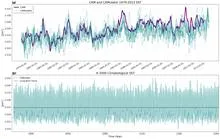
The ocean remembers its weather. Each month, its surface temperature forms a vast map, and if you find a similar map in the past, you can see what happened next. That is exactly how the new method for forecasting El Niño works: the warm current that, every few years, alters the climate of half the planet.
On April 16, 2012, Washington experienced heat no one expected. The thermometer climbed 18 degrees above normal. Sixty days earlier, Bucharest and Kyiv had weather unusual for them. The link between these events was found by an algorithm that scans pairs of cities worldwide, looking for recurring coincidences.
On an old film strip of rainfall, only the brightest frames are visible, and between them lies noise. A meteorologist assessing flood risk long looked only at such frames, that is, at annual rainfall maxima. Everything else, thousands of daily observations, remained off-screen. The new method develops the entire film, and details that were previously invisible come into view.