A Translator That Hears Who Controls Whom ✛
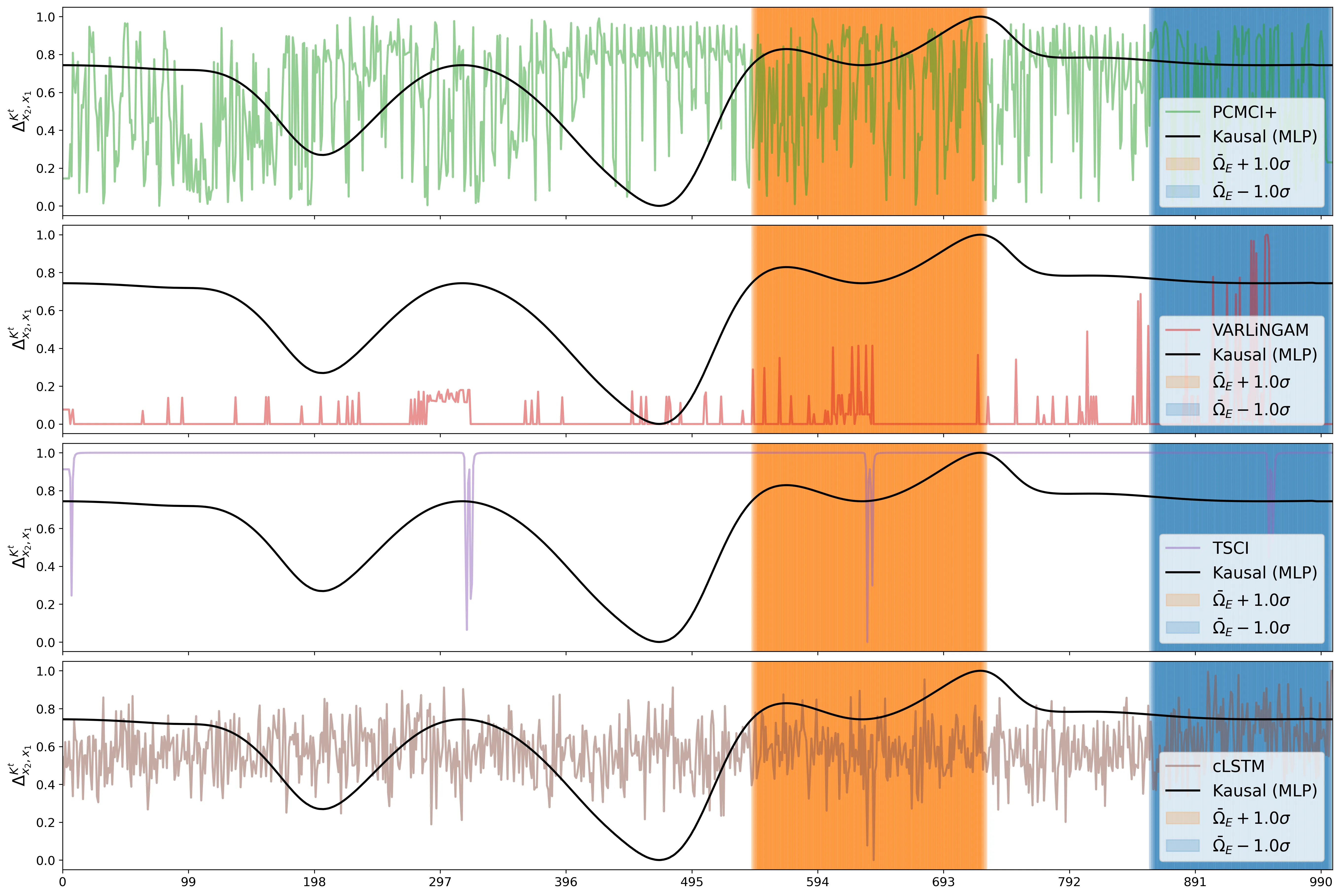
Picture a translator at a meeting where everyone speaks an unfamiliar language. They don't know the words, but they notice: when one person raises their voice, another starts nodding a minute later. At first it seems like coincidence, but over time the translator learns to understand who influences whom. That's roughly how the Kausal algorithm works, searching for causal links in complex systems.
The algorithm builds on the idea of the Koopman operator, proposed back in 1931. This operator turns nonlinear dynamics into linear ones, but to do that you need to pick the right functions of the system's state, the so-called observables. Previously these were chosen by hand; now a neural network finds them on its own, like a translator who picks up the language on the fly.
Kausal then compares two forecasts: one made only from the history of the effect, the other with the suspected cause added. If the second forecast is noticeably more accurate, the cause indeed carries information about the effect. So the difference in errors becomes a measure of causal strength.
Today Kausal can be applied to climate data to understand how ocean temperature affects the atmosphere, or to neuroscience to reveal interactions between brain regions. But the key point is that it doesn't need to know the system's language in advance: it learns it by itself, like a translator who starts with gestures and ends up understanding intonations.
The Koopman operator was proposed in 1931, but only with the advent of deep learning has it become possible to approximate it efficiently for real data.
The idea of lifting a system into a space where the complex becomes simple recalls the 'hyperspace' of science fiction, where ships bypass the constraints of ordinary space. Here, the role of hyperspace is played by an infinite-dimensional function space.