The Kalman filter is an algorithm that produces estimates of a system's true state from a series of measurements that are corrupted by noise. It does this by combining a prediction of where the system should be (based on a physical model) with the actual measurements, weighting each according to their uncertainty. The result is an optimal estimate that minimizes the mean squared error, provided the noise is Gaussian and the system dynamics are linear.
History
Developed by Rudolf E. Kálmán in 1960, building on earlier work by others on Wiener filtering and state-space models.
How it works
The filter operates in two steps: predict and update. In the predict step, it uses the system's dynamics to project the current state forward in time, along with an estimate of the uncertainty (covariance) of that projection. In the update step, it compares the new measurement to the prediction, and computes a weighted average — the Kalman gain — that balances trust in the model versus trust in the sensor. The gain is chosen to minimize the posterior uncertainty, and the process repeats at each time step.
A delicate watermark on wet paper, and a fogged-up glass before your eyes. That's roughly what reading quantum states of light looks like: fragile photon patterns get distorted by losses, and detectors catch only a small fraction of the signal.
A typical tracking program resembles a navigator steering a ship by the stars. But as soon as the sky clouds over, coordinates drift, and entropy (a measure of uncertainty) builds up in the data. The new algorithm gets a ‘co‑pilot’ — a module that monitors how confident the main navigator is.
In a soup pot, you only need two thermometers to gauge the temperature everywhere — if you know heat travels in circles from the bottom. Science works the same way: from a handful of measurements, you want to reconstruct the full heat picture.
The system captures the gist of heat flow, compressing it into a handful of governing numbers.
A sound signal is conveniently represented as a complex number: its modulus (amplitude) reflects loudness, while its argument (phase) indicates the wave's position in time: its instantaneous shift.
A laser beam in a multi-kilometer tunnel trembles as a gravitational wave passes, but the tremor is barely perceptible, on the scale of fractions of a proton's diameter. To hear this cosmic whisper, physicists squeeze every last bit of performance out of light.
A network of tiny magnets seeks the state with the lowest total energy: that's roughly what the quantum Max Cut problem looks like, one of the toughest in physics. Scientists have been hunting for its solution since the days of Werner Heisenberg.
Gravitational-wave observatories are like a keen ear listening for distant rumbles of cosmic catastrophes. To catch the faint whisper of merging black holes, detectors of gravitational waves use specially prepared light — known as squeezed vacuum.
Dip your finger into water once, and from that single sensation, try to guess its temperature. In the quantum world, such one-shot measurements happen all the time, except you have to guess invisible parameters: say, the squeezing strength of a laser beam.
An X-ray tomograph is like a carpenter who examines a log from all sides to see where the void is inside. It takes dozens of flat shadow images, rotating the source and detector around the object. Then a 'reconstruction' program glues these shadows into a 3D model. The quickest reconstructor is the FBP algorithm (filtered back projection).
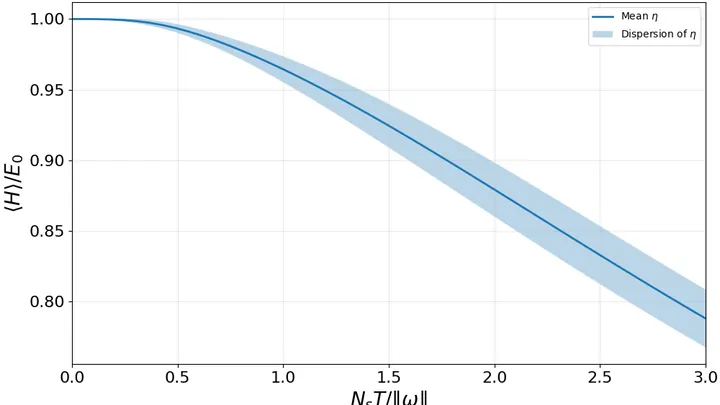
A radio picks up a broadcast through crackle and hiss. That's roughly how modern quantum computers work: the useful signal drowns in noise. The longer the computation runs, the more the interference distorts the result.
In laboratories where atoms are cooled to near absolute zero, even a tiny change in the magnetic field throws off all the settings. Conventional sensors, Hall plates or coils with ferrite cores, sit a few centimeters away from the vacuum chamber because they themselves create interference.
To understand a mechanism, you have to poke it. A child taking apart an alarm clock doesn't just stare at the gears: they turn the wheel and listen to how the ticking changes. Scientists do the same: instead of passive observation, they feed specially chosen signals into the system and watch the response.
A material is like a person: if you stretch it for a long time, it remembers and behaves differently. Engineers have spent years fitting formulas to describe such memory. Now a neural network does it on its own.
The new architecture, iCKAN, takes test data and converts it into equations.
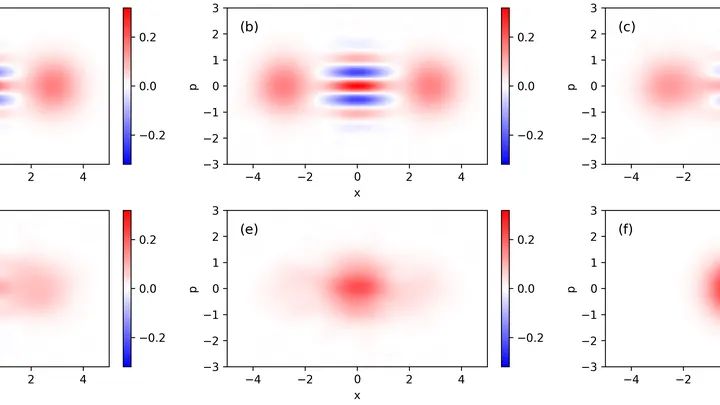
Light can be more than just a stream of particles; it can be a wave with a specific shape over time. Sometimes this shape changes so rapidly that capturing it is like photographing a bullet in flight. Scientists have devised a way to measure such fleeting quantum states of light.
For this, they use a device called a balanced homodyne detector.
A quantum sensor is like a telegraph line transmitting a hypersensitive message. The slightest disturbance distorts the signal. It used to be thought that accurate measurement required an error-free 'telegraphist' — a perfect error-correction system. But in practice, all elements are noisy. The new approach allows for errors at every step: in sending, verification, and reception.
Light passing through a birefringent crystal changes its polarization depending on wavelength. This profile is like a mosaic assembled from rare flashes, where each shard hints at the shape of its neighbors.
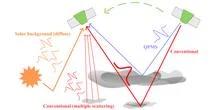
Ice clouds can masquerade as water clouds. A satellite lidar sends a short laser pulse downward and catches the reflection. If flat ice plates hang horizontally in the cloud, they act like tiny mirrors: light bounces back almost without loss. To the instrument, such a flash looks just like a reflection from water droplets.
Picture a translator at a meeting where everyone speaks an unfamiliar language. They don't know the words, but they notice: when one person raises their voice, another starts nodding a minute later. At first it seems like coincidence, but over time the translator learns to understand who influences whom.
A quantum computer is an orchestra where every qubit must come in exactly on cue. But instead of a conductor with a baton, we have an arbitrary waveform generator (AWG) that delivers microwave signals lasting tens of nanoseconds.
An interpreter at a conference hears the noise of the hall but keeps translating. They don't repeat every word; instead, they find an intermediate language where complex phrases become simple, yet meaning is preserved.