Deep Koopman Operators for Causal Discovery in Nonlinear Dynamics ✛
Context
This work sits at the intersection of causal inference and dynamical systems theory. Existing methods in this area either use information flows (such as Granger causality) or lift the system into a higher-dimensional space to simplify analysis. Neighboring papers on the archive also seek hidden structures: some track heat through a single sensor, others predict chaos, and still others build phylogenetic networks. But most approaches assume linearity, stationarity, or prespecified observable functions, which limits their applicability to real-world nonlinear systems such as Earth's climate.
Methods
Kausal uses Koopman theory, which represents nonlinear dynamics as a linear operator acting on a space of functions of the system state. Instead of specifying these functions by hand, the algorithm learns them with neural networks (multilayer perceptrons or convolutional networks). The Koopman operator is then approximated using dynamic mode decomposition (DMD), which solves a least-squares problem. The causal measure is defined as the difference in prediction errors: one model predicts the effect's dynamics using only its own observables, while another adds the cause's observables. If the joint model predicts significantly better, the cause contains information about the effect.
Results
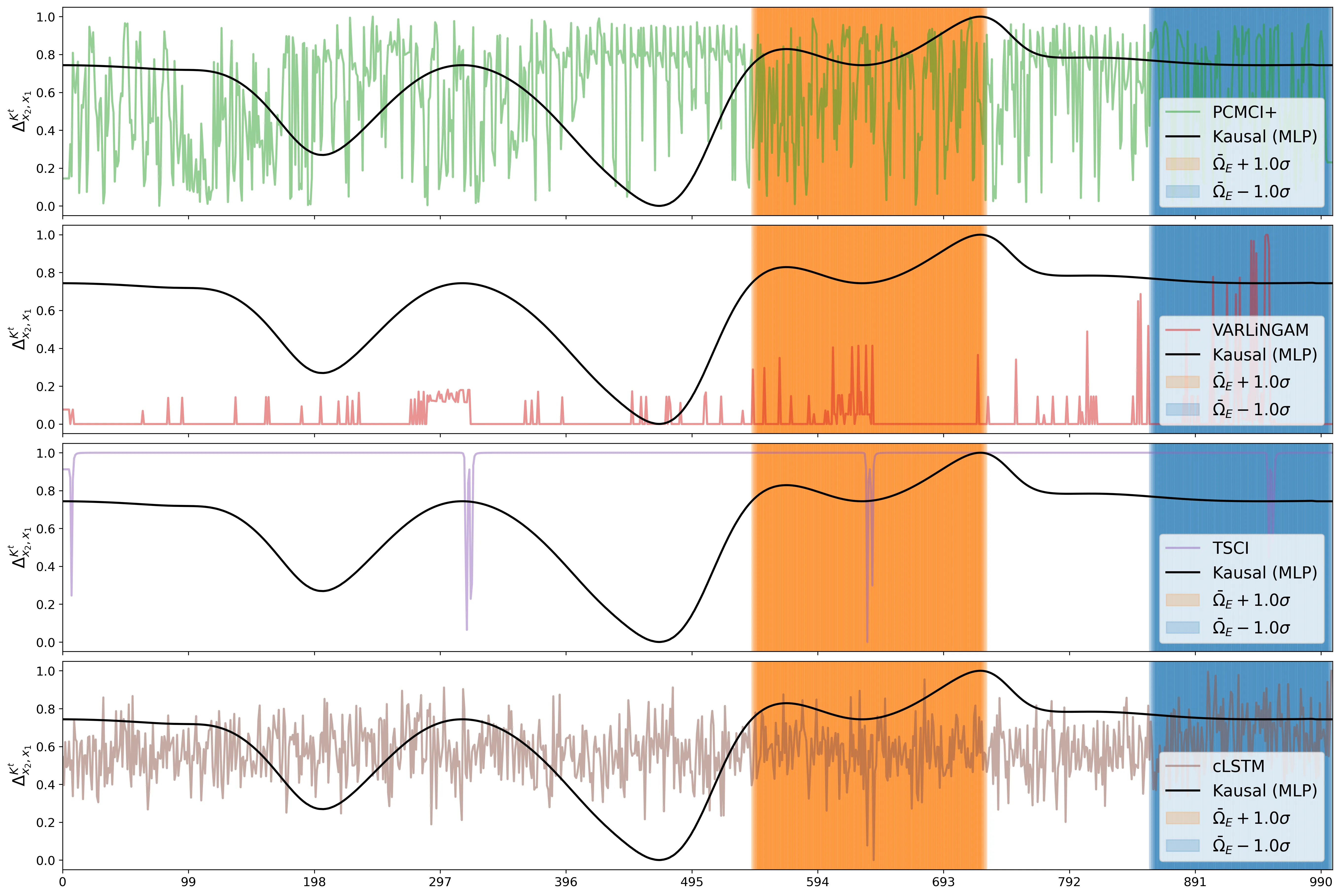
On coupled Rössler oscillators, Kausal with learned observables (a 32-dimensional vector) showed a statistically significant causal signal in the true direction and none in the reverse, unlike PCMCI+ and VARLiNGAM, which either missed the link or produced spurious bidirectional dependencies. For the reaction-diffusion equation (128-dimensional convolutional observables), an ensemble of randomly initialized networks allowed estimating the uncertainty of the causal measure. On the El Niño model, the algorithm correctly reflected changes in causal strength when the coupling parameter and nonlinearity were varied. On real ECMWF reanalysis data, Kausal detected the major El Niño events of 1982–83, 1997–98, and 2014–16, whereas the method with fixed Rademacher kernels missed them. In terms of the AUROC metric, Kausal surpassed all baseline methods.
Implications
This work differs from neighboring approaches in that it does not rely on preselected observable functions but learns them for the specific system. This allows capturing nonlinear and multiscale interactions that elude methods with fixed dictionaries. For the first time, deep learning of observables is combined with an operator-based formulation of causality, opening the way to more accurate and explainable analysis of complex dynamical systems.
Future development
The algorithm can be extended to estimate causal effects, enabling physically grounded forecasts that are robust to distribution shift. Another direction is building a full causal graph via adjacency tests. Plans also include accounting for stochastic and nonautonomous systems, where the flow depends on time and contains internal variability.
Impact
The method is applicable in climatology for analyzing ocean-atmosphere links, in neuroscience for identifying interactions between brain regions, and in epidemiology and economics, where nonlinear feedback loops are important.
Next steps
Immediate next steps include adapting Kausal to stochastic differential equations and developing statistical significance testing procedures for detected causal links in multivariate systems.
Key open problems
For the field of machine learning and causal inference, a key open problem remains identifying causality in nonstationary, high-dimensional systems with feedback. Kausal directly attacks this problem by replacing the linearity assumption with a learned linear representation in observable space.
The knowledge machine's view
This section is addressed to the author of the paper and their colleagues. Neighbouring works were found by meaning-based search across our archive, not by word overlap. We do not review: we show the field around the work.
What the work does
The authors propose the Kausal algorithm, which combines deep learning with Koopman operator theory for causal analysis in nonlinear systems. The neural network learns observables in which the dynamics become linear, and the causal measure is computed as the difference in prediction errors between marginal and joint models. The method is tested on coupled Rössler oscillators, the reaction-diffusion equation, and El Niño data, where it outperforms classical approaches.
Where its strength is
The strength of the work lies in not relying on pre-chosen observable functions but learning them for the specific system, which allows capturing nonlinear and multiscale interactions. This paves the way for more accurate and explainable analysis of complex dynamical systems.
Where it could go next
- It might be interesting to see how ideas from the work on taming chaos with prediction algorithms could be applied to improve the selection of observables in Kausal, especially in highly chaotic systems.based on: Taming Chaos: How Algorithms Predict the Future arXiv:2607.11344
- Closely related is an approach that tracks heat across a room with a single thermometer using hidden states; perhaps a similar technique for recovering hidden variables could extend Kausal to partially observed systems.based on: How to Track Heat Across an Entire Room with Just One Thermometer arXiv:2607.14273
- There is a paper in the archive about invisible links in gene networks, using graph methods to uncover interactions; one could consider adapting these ideas for interpreting learned Koopman operators and building causal graphs.based on: Invisible Connections in the Gene Network arXiv:2607.13994
Worth trying
- Try initializing the observables with autoencoders trained to reconstruct the dynamics, to improve convergence and interpretability.
- Apply the method to data with missing values, using the technique of recovering hidden states from the single-sensor work.
- Explore the use of graph neural networks for observables in systems with known network structure.
Why this may matter
Further development of the method could lead to more accurate causal analysis in climatology, neuroscience, and other fields where systems are nonlinear and contain hidden variables, which is important for understanding and predicting complex phenomena.
Nearby works in our archive
- Taming Chaos: How Algorithms Predict the Futuresimilarity 0.53
- How to Track Heat Across an Entire Room with Just One Thermometersimilarity 0.53
- A Smart Navigator That Doesn’t Trust Itselfsimilarity 0.51
- Polar Flip: How Neural Networks Catch Invisible Clumps of Dark Mattersimilarity 0.50
- Invisible Connections in the Gene Networksimilarity 0.50
The archive is sparse around this work: the closest review is only 0.53, against a usual 0.64. It looks like few have drilled nearby.
The Koopman operator was proposed in 1931, but only with the advent of deep learning has it become possible to approximate it efficiently for real data.
The idea of lifting a system into a space where the complex becomes simple recalls the 'hyperspace' of science fiction, where ships bypass the constraints of ordinary space. Here, the role of hyperspace is played by an infinite-dimensional function space.
Key numbers
- dimension of observables for Rössler oscillators: 32
- dimension of observables for reaction-diffusion equation: 128
- critical value of coupling parameter in El Niño model: 0.67
- number of data pairs for DMD training: D (depends on experiment)