Orchestra Without a Conductor: Quantum Order Beyond Time ✛
In an empty concert hall, two musicians play a single part. First the violin, then the cello, or the other way around. It has always been this way: every note has its place in time, its own "earlier" and "later." But what if an orchestra could play both versions at once, in a quantum superposition of two orders? That is exactly the picture quantum mechanics paints, and now it has experimental support.
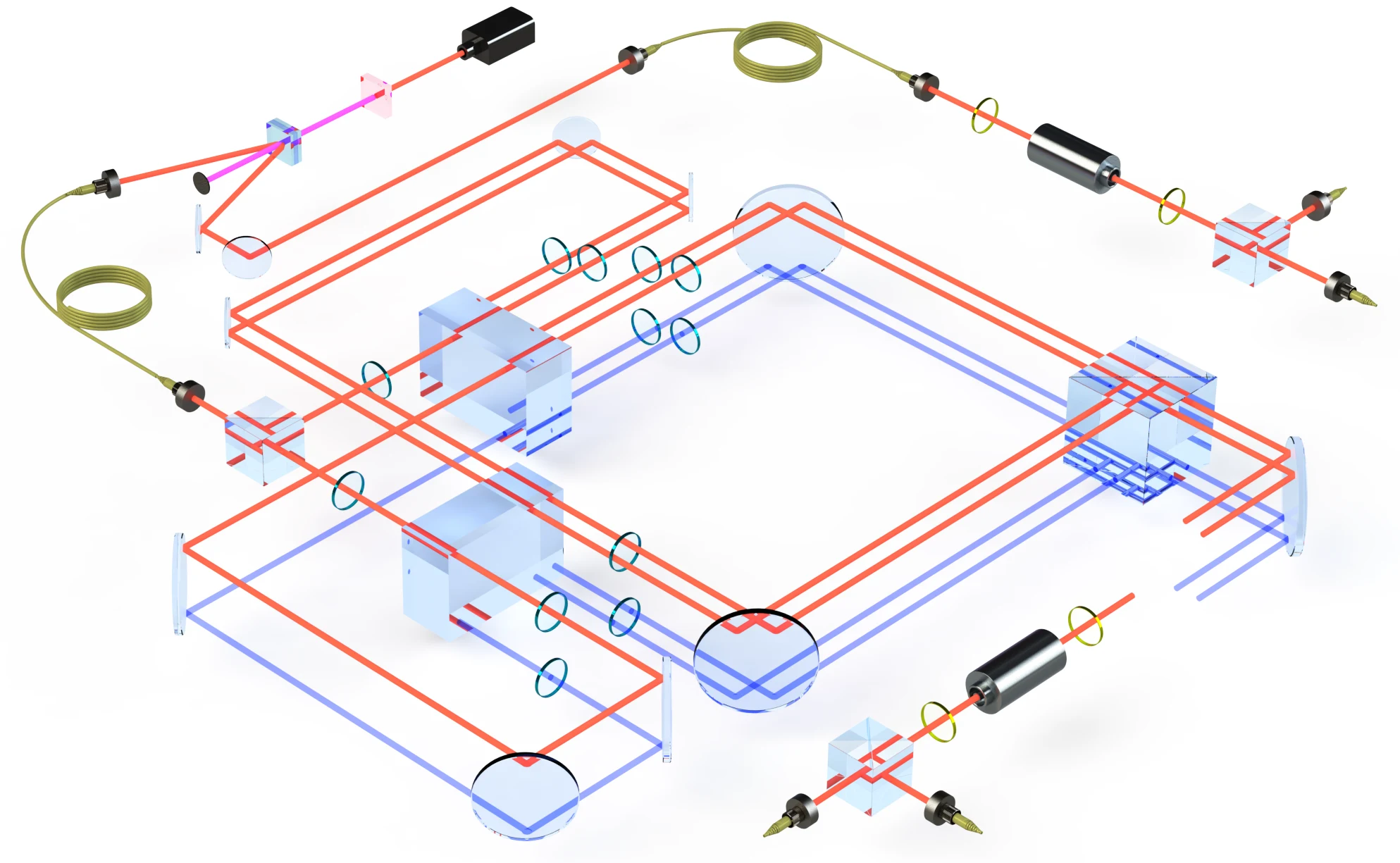
In the experiment conducted in Nanjing, the musicians were played by photons, particles of light. Two entangled photons flew apart along 20-meter optical fibers, and the fate of each was linked to the other. One photon served as the control qubit, while the second was a remote qubit on which operations were performed. The trick was that the order of these operations was not fixed in advance: a quantum switch, a device where the sequence of actions is determined by a quantum state, allowed them to run in a superposition of "A then B" and "B then A" simultaneously. It is as if the violin and cello started playing in different orders, but both versions existed in a single quantum wave.
To rule out any classical explanations, the physicists used a trick familiar from Bell tests. The measurement settings for two distant observers were chosen randomly and so quickly, in just 22.6 nanoseconds, that a light signal could not travel from one to the other. This spacelike separation closed the locality loophole: no hidden connection between the devices could have adjusted the results. The measured correlations across four parties summed to a value of 1.8090 ± 0.0024, whereas the classical bound is 1.75. The theoretical prediction for an ideal quantum switch is 1.8536, and the experiment came very close to it. Such a result cannot be explained by any model with a fixed causal order, even if hidden variables are allowed.
This discovery is not just a beautiful demonstration. Previously, all evidence for indefinite order relied on trusting the description of the devices: researchers assumed their equipment worked as intended. Now, the correlations violate the causal inequality, a numerical condition that holds for any definite order of events, without any assumptions about the internal workings of the apparatus. This is a step toward loophole-free certification of quantum processors that use superpositions of operational orders. In the future, such devices could offer advantages in communication and computation, and today's result strengthens the status of quantum causality as a physical resource, not just a mathematical abstraction.
An orchestra without a conductor, where musicians play their parts in a quantum superposition of two orders, this metaphor now has experimental grounding. Open questions remain: can the remaining fair-sampling and freedom-of-choice loopholes be closed, and how can the protocol be extended to multi-qubit systems? But the first chord has already sounded, and it plays outside the usual time.
The photons in the experiment traveled along 20-meter optical fibers, and choosing the measurement settings took just 22.6 nanoseconds, during which light travels less than seven meters. So no signal could have influenced the distant observer.
The idea of events without a definite order echoes Ted Chiang's novella "Story of Your Life," where an alien language changes the perception of time, and cause and effect lose their usual sequence.