Quantum Order Beyond Time: Photons Violate Causality ✛
Context
Quantum mechanics allows events to occur in a superposition of causal orders: neither 'A before B' nor 'B before A,' but a coherent mixture of both. Such a structure, called a quantum switch, promises advantages in communication, computation, and thermodynamics. However, previous demonstrations relied on assumptions about how the devices work, leaving a loophole for hidden classical explanations. This work stands alongside research on quantum batteries, entanglement, and causality, but differs in that it is the first to test indefinite order in a device-independent manner, with spacelike separation of observers.
Methods
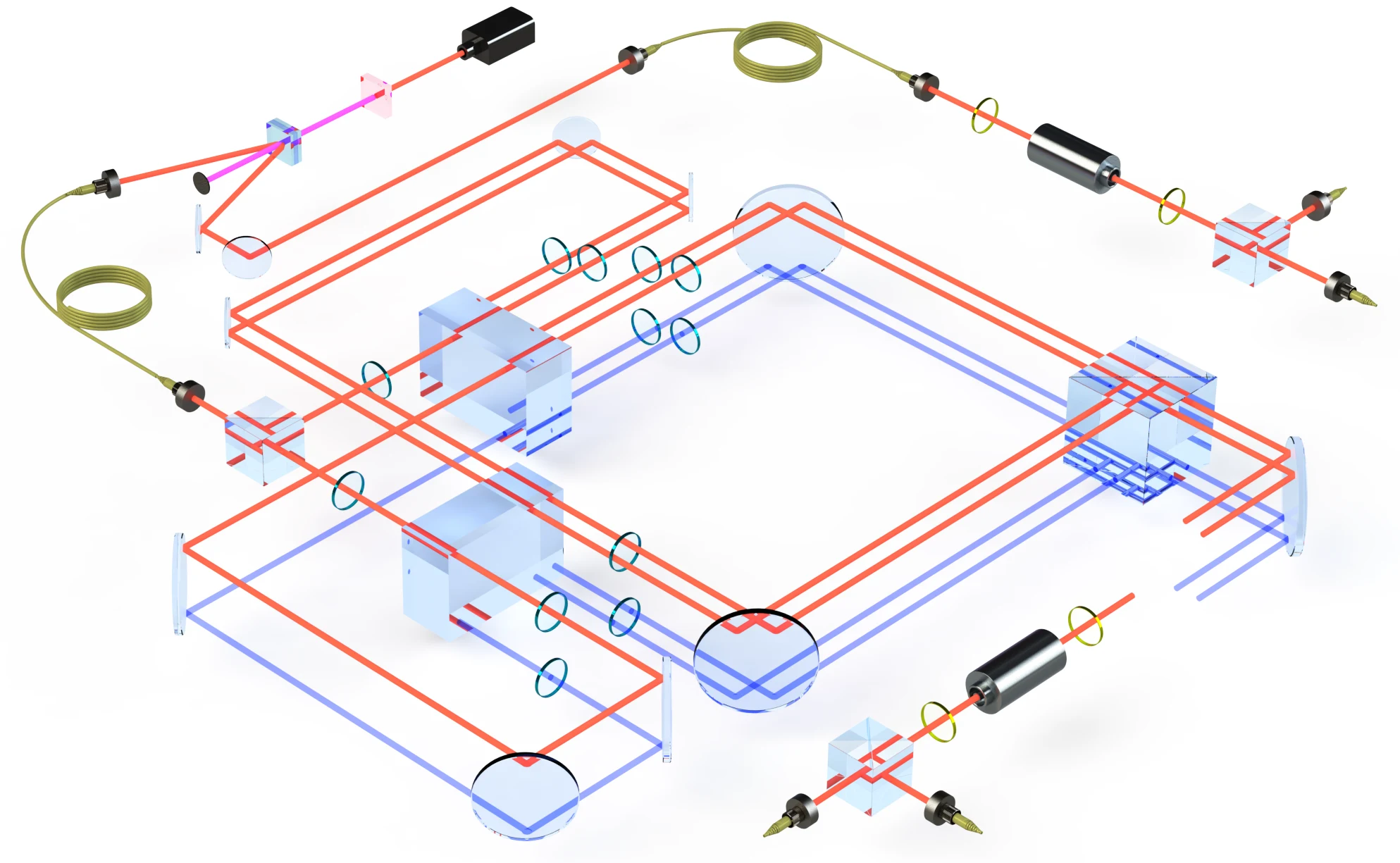
The experiment realized a photonic quantum switch with two spatially separated entangled photons. One photon served as the control qubit, and the second as a remote qubit at Bob's location. The control photon passed through an interferometer, where two 'Alices' performed measurement and re-preparation of the target qubit in a superposition of orders. Fast electro-optic modulators and random generators selected measurement settings for Bob and Charlie in a time shorter than the light signal between them, closing the locality loophole. Coincidences were recorded by avalanche photodiodes, and statistics were accumulated for all 16 combinations of inputs and outputs.
Results
The three measured terms of the Van der Lugt–Barrett–Kyrillidis inequality were 0.4846 ± 0.0022, 0.4895 ± 0.0022, and 0.8348 ± 0.0023, summing to 1.8090 ± 0.0024. This exceeds the classical bound of 1.75 by 24 standard deviations. The theoretical prediction for an ideal quantum switch is 1.8536. The agreement between experiment and theory is excellent, confirming that the observed correlations cannot be explained by any model with a fixed causal order, even with hidden variables.
Implications
Unlike neighboring works that study quantum batteries or entanglement in ordinary causal structures, here a causal inequality is experimentally violated for the first time in a scenario with spacelike separation. This provides evidence for indefinite causal order that does not depend on characterizing the devices. The result strengthens the status of quantum causality as a physical resource rather than a mathematical abstraction, and opens the path to loophole-free tests in the spirit of Bell tests.
Future development
The next step will be to close the remaining loopholes: the fair-sampling and freedom-of-choice loopholes. Detectors with efficiency above the threshold and random number generators isolated from the rest of the setup will be required. The protocol can also be extended to multi-qubit systems and networks, where indefinite order may offer advantages in communication complexity. Theoretically, it is important to understand which other inequalities can be violated by the quantum switch with additional observers.
Impact
The result will impact quantum information theory, quantum communication, and the foundations of physics. Device-independent certification of indefinite order could become a standard for future quantum processors that exploit superpositions of operation orders.
Next steps
Immediate experiments should improve detector efficiency and speed up setting selection to close the fair-sampling loophole. It is also worth testing the inequality on other platforms, such as trapped ions or superconducting circuits.
Key open problems
This work is directly related to the problem of quantum causality: how to reconcile indefinite event order with the relativistic structure of spacetime. It also touches on the question of which quantum correlations are possible without a fixed causal structure, an open problem in the foundations of quantum theory.
The knowledge machine's view
This section is addressed to the author of the paper and their colleagues. Neighbouring works were found by meaning-based search across our archive, not by word overlap. We do not review: we show the field around the work.
What the work does
The paper experimentally tests the van der Lugt–Barrett–Kiribella inequality using a photonic quantum switch with spacelike separation. The measured correlations yield a value of 1.8090 ± 0.0024, exceeding the classical bound of 1.75 by 24 standard deviations. This demonstrates indefinite causal order without assumptions about the devices' operation.
Where its strength is
The strength of the work lies in closing the locality loophole for the first time in a test of quantum causal order, using fast modulators and random settings. This makes the evidence for indefinite order device-independent, paving the way for loophole-free tests.
Where it could go next
- It might be interesting to examine the connection with the work on quantum entanglement as geometry, where time is treated as an additional dimension. That work offers an alternative perspective on causality, which could provide a new interpretation for the observed correlations.based on: Quantum Entanglement as Geometry: Extra Time Instead of Instantaneous Communication arXiv:2606.12457
- Closely related is the work on quantum events without a predefined scenario, which may offer a formalism for describing more general causal structures beyond the quantum switch. This could aid in the search for new inequalities.based on: Quantum Events Without a Script arXiv:2605.08351
- It would be interesting to compare with the experiment on the quantum telegraph through a hidden time tunnel, which also uses superposition of orders but in a different context. Their characterization methods might help improve robustness against losses.based on: A Telegraph Through a Hidden Tunnel in Time arXiv:2311.17070
Worth trying
- Explore using the quantum switch for communication tasks, akin to the quantum telegraph, where superposition of orders enhances channel capacity.
- Investigate whether the impact of losses can be mitigated using ideas from the work on the birth of order in the presence of losses, thereby increasing the observed inequality value.
- Consider employing quantum clocks to synchronize measurements at spacelike-separated nodes, which could improve the closure of the locality loophole.
Why this may matter
The result reinforces the status of quantum causal order as a physical resource and opens the path to its application in quantum communication and computation, where indefinite order can provide an advantage.
Nearby works in our archive
- Quantum Events Without a Scriptsimilarity 0.58
- A Telegraph Through a Hidden Tunnel in Timesimilarity 0.54
- Clocks That Tick Quantumlysimilarity 0.54
- Loss Creates Order: The Quantum Dance of Photonssimilarity 0.53
- Quantum Entanglement as Geometry: Extra Time Instead of Instantaneous Communicationsimilarity 0.53
- Entanglement in the Crosshairssimilarity 0.52
The archive is sparse around this work: the closest review is only 0.58, against a usual 0.64. It looks like few have drilled nearby.
The photons in the experiment traveled along 20-meter optical fibers, and the choice of measurement settings took only 22.6 nanoseconds, during which light travels less than seven meters. Therefore, no signal could influence the distant observer in time.
The idea of events without a definite order resonates with Ted Chiang's novella 'Story of Your Life,' where an alien language changes the perception of time, and cause and effect lose their familiar sequence.
Key numbers
- violation of inequality: 24 standard deviations
- measured value: 1.8090 ± 0.0024
- classical bound: 1.75
- theoretical prediction: 1.8536
- setting selection time: 22.6 ns