Switchable Ion Crystals ✛
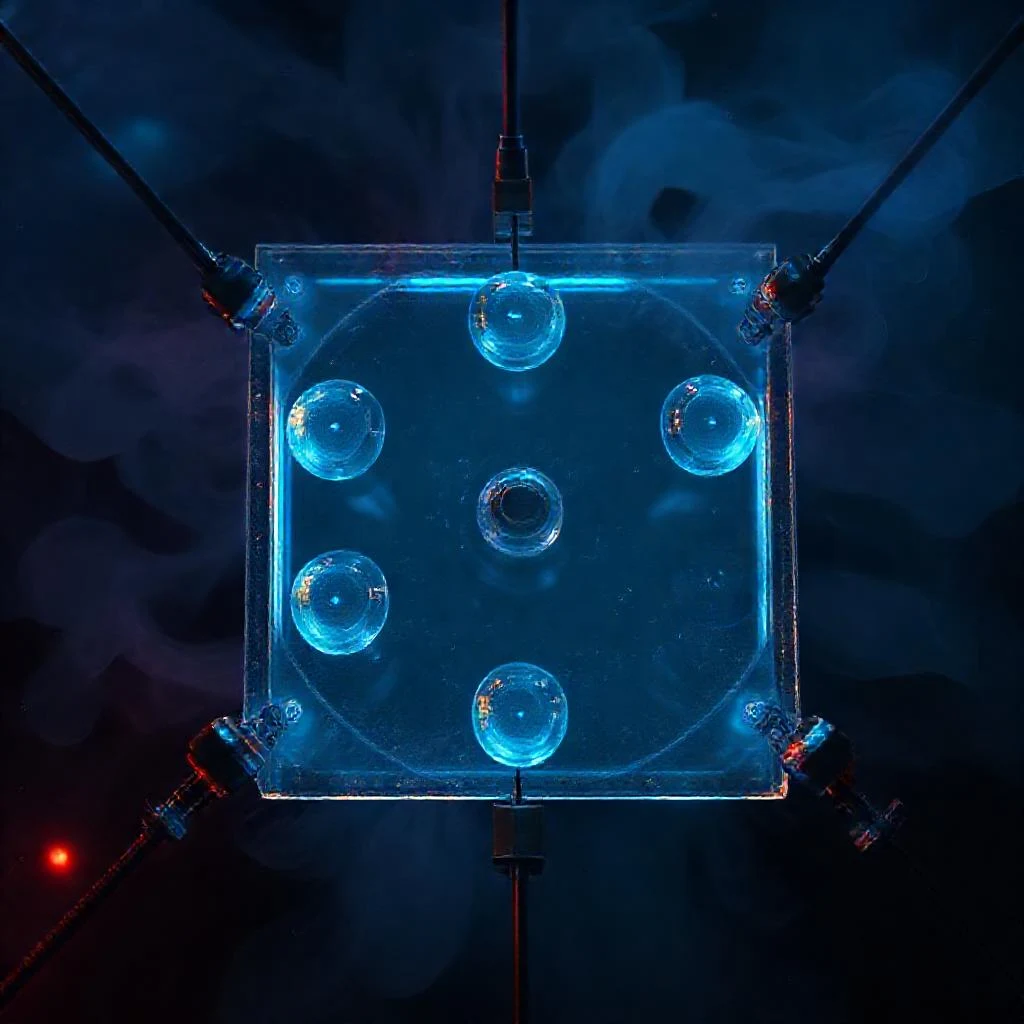
A tiny crystal of six charged barium atoms behaves like a snap bracelet: it can freeze into one of two shapes. Scientists, watching the glow of the ions (photometry), knew exactly which shape the crystal had taken. By smoothly deforming the trap — as if squeezing or straightening a bracelet — they switched the ions between states. At a critical point, both shapes coexist, and the switches become random, like a spring trembling. Counting the jump frequency, the researchers measured the temperature: the hotter the ions, the faster they ‘snap’, because the disorder grows. The climax: rapid cooling of the trap, freezing the ions right at the moment of transition. For the first time, they caught the intermediate state and watched how the crystal relaxed. This trick gives scientists switchable ‘ion molecules’ for quantum simulations.
The quality of gasoline depends on the shape of molecules: of the 18 isomers of octane, some burn smoothly, others cause knocking. The engine literally feels the difference between atomic rearrangements.