Crystal property modification is the deliberate alteration of a crystal's physical characteristics — such as hardness, optical transparency, electrical conductivity, or magnetic behavior — by changing its chemical composition or atomic arrangement. This is the foundation of materials science: by tweaking the recipe or the growth conditions, scientists can create materials with precisely tuned properties for specific applications. The field spans from ancient metallurgy (adding tin to copper to make bronze) to modern semiconductor doping that powers all electronics.
History
Humans have modified crystal properties since the Bronze Age (around 3000 BCE), but the scientific understanding began with the development of crystallography in the early 20th century. The invention of the transistor in 1947 by Bardeen, Brattain, and Shockley relied on precise doping of silicon crystals, launching the modern era of engineered crystals.
How it works
Crystals are periodic arrangements of atoms, and their macroscopic properties emerge from this atomic-scale order. Modification works by introducing 'defects' — either intentional impurities (doping) or structural changes like vacancies or dislocations. A single foreign atom in a crystal lattice can alter its electronic band structure, changing its color, conductivity, or magnetic response. Alternatively, changing the growth conditions (temperature, pressure, cooling rate) can create different crystal phases or grain sizes, which dramatically affect mechanical properties like hardness or flexibility.
In practice
Used everywhere: from the silicon chips in computers (doped with phosphorus or boron) to the sapphire glass in smartphone screens (doped with iron and titanium for strength), and in laser crystals like ruby or Nd:YAG.
Fun fact
Adding just one atom of chromium to every million atoms of aluminum oxide transforms a colorless, hard mineral into a deep red ruby — the same crystal, but with completely different optical properties.
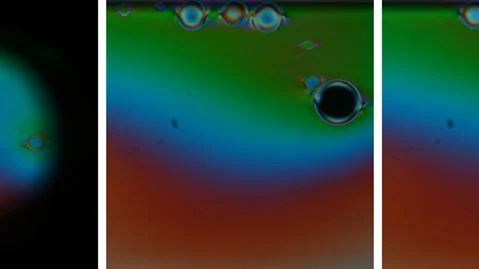
In a thin layer of liquid crystal, molecules usually lie like matches in a box — aligned in one direction but randomly oriented: some point up, others down. To make all the matches point the same way, you need a special molecular architecture. Scientists have found a chemical trick that does this almost automatically.
A drop of saltwater dries on a table. The salt doesn't settle just anywhere: crystals first appear at the rim, forming a ring, like coffee grounds at the bottom of a cup. Everyone who has seen the stain left by a dried droplet knows this behavior. But what if the droplet contains swimming bacteria?
On the screen is the result of a complex simulation: two planets collided, a shockwave ripples outward. A couple of clicks in an editor, and harsh shadows soften, noise smooths out, the background darkens. This kind of digital retouching (image editing to enhance appearance) has long been part of the scientist’s toolkit.
A big sticky ball thrown onto a dusty shelf bounces off and kicks up a cloud of dust, but if you roll it slowly, it picks up every bit. Rydberg excitons behave just like that — they're giant 'atoms' inside a crystal, named after Johannes Rydberg.
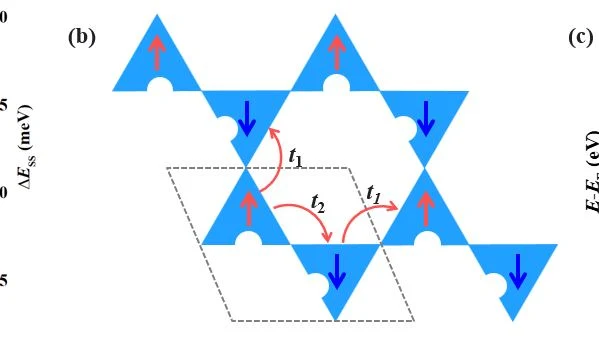
Honeycombs are built from identical cells, but tweak the shape of just one, and the whole structure gains new properties. Researchers did something similar to create a magnet without a single metal atom. They took flat carbon molecules shaped like triangles, triangulenes, and arranged them in a hexagonal lattice, just as bees build honeycombs.
In a molecule resembling chlorophyll and built from carbon, a metal atom at the center acts as a toggle. Shifting it by fractions of a nanometer can make the molecule glow, quench, or boost its brightness a hundredfold.
A gold particle a few nanometers across looks like a tiny faceted diamond, but with five faces instead of the usual ones. Inside it hides a defect, like a crack in glass that can either heal or shatter the whole object. Scientists set out to discover what makes this defect move and disappear.
Molecules in a solution behave like a crowd in a square: they can jostle randomly or line up in neat rows. An aqueous solution of disodium cromoglycate is a well-known model for chromonic liquid crystals, where such 'rows' form spontaneously. But if you shine ultraviolet light on the solution, order collapses: molecules start breaking apart.
A crystal of calcium ions in a trap, illuminated by a laser, is a tiny model of the matter inside a white dwarf. There, in the depths of a dying star, atomic nuclei arrange into a rigid lattice as the temperature drops.
Six barium ions lined up in a flat hexagon inside a Paul trap, a device that holds charged particles with oscillating electric fields. But a slight change in the shape of the trapping potential made the crystal rearrange: one ion moved to the center, and the other five formed a ring around it.