A Radio Beacon at the Edge of the Ecliptic: How Our Signals Give Us Away to the Universe ✛
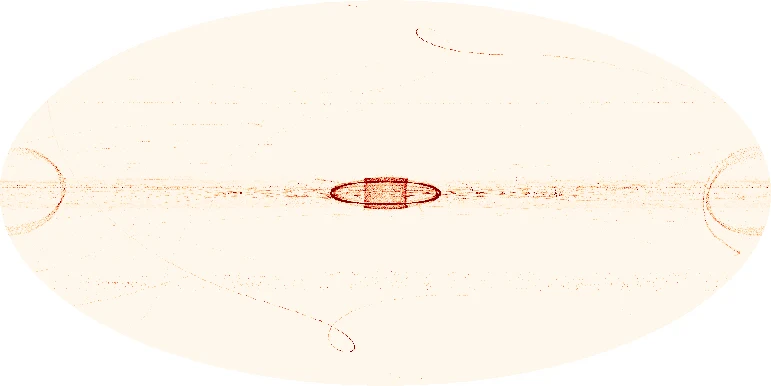
Every few hours, narrow beams of radio waves leave the Mojave Desert, near Madrid, and near Canberra, heading into the sky. This is NASA's Deep Space Network: three antenna complexes that keep in touch with spacecraft across the solar system. Over two decades, they have accumulated 92.5 antenna-years of continuous transmissions. If a single antenna were broadcasting nonstop, it would need nearly a century.
This dataset is not just a technical log. It is a map of what the "radio handwriting" of a civilization just beginning to explore interplanetary space looks like. Astronomers took public transmission logs from 2005 to 2024, matched each entry with the spacecraft's position, and reconstructed the exact beam direction. Then they divided the sky into pixels of 0.85 arcminutes and calculated the duty cycle for each: the fraction of time when at least one beam was pointed there. The result is a map showing where humanity "shines" most often.
The brightest peak on this map is the direction toward Mars. Within 2 arcminutes of the planet, the duty cycle reached 77%, which is 9.4 months per year. That is 400,000 times the sky average. For comparison, if a distant observer looked at the solar system during an Earth-Mars conjunction, their chance of catching a transmission would be 77%, versus 0.0002% at a random moment. Inside the Earth transit zone, the narrow strip from which our planet's passage across the Sun's disk is visible, the duty cycle was 13 minutes per year, 20 times the average over all latitudes.
Before this work, strategies for searching for extraterrestrial intelligence often relied on intuition: look for signals during planetary conjunctions, focus on systems with transiting planets. Now that intuition has become measurable priorities. Observing a system with an edge-on planet at the moment of its planetary conjunction is not just a sensible idea but a statistically justified choice. If humanity continues to explore the solar system, especially with permanent bases on Mars, the concentration of powerful transmissions in the ecliptic plane will only increase. For the search for extraterrestrial analogs, this means: we should deliberately observe stars within 5° of our ecliptic, where our signals have gone and from where an answer might come.
A beacon that shines not in all directions but in a narrow beam along a busy shipping lane: that is our civilization in the radio band. And now we have a precise map of that beam. The question remains whether there are other beacons in the harbor.
Over 20 years, DSN spent 92.5 antenna-years on transmissions, which is like a single antenna broadcasting continuously for nearly a century. At the same time, 79% of the time the beam went into a narrow band around the ecliptic, only 10° wide.
In Carl Sagan's novel 'Contact', the signal from an extraterrestrial civilization arrives as a powerful radio pulse that Earth's antennas pick up by chance. This work shows that if aliens were looking for us, they would do well to watch our ecliptic during planetary conjunctions, when the chance of catching our 'radio shadow' would be maximal.