Eavesdropping on Earth: How to Find a Civilization Like Ours ✛
Context
The search for extraterrestrial intelligence has for decades relied on the assumption that we are looking for signals like ours. Alongside this work in the archive lie studies that search for alien probes by Earth's shadow, eavesdrop on the radio hum of distant civilizations, or hunt for traces of ancient technologies in cosmic dust. All of them in one way or another try to guess how a technological civilization might manifest itself. This article does not guess but measures: it takes real transmission logs from our own deep-space communication network and turns them into a map of what the 'radio handwriting' of a civilization just beginning to explore interplanetary space looks like.
Methods
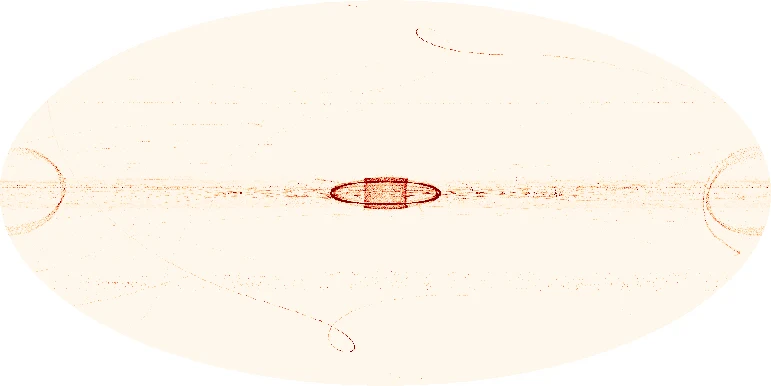
The authors collected public transmission logs from NASA's Deep Space Network for 2005–2024, totaling 92.5 antenna-years of observations. Each transmission was matched with spacecraft ephemerides to reconstruct the exact beam direction. The sky was then divided into pixels of 0.85 arcminutes (HEALPix), and for each pixel they computed the duty cycle, the fraction of time during which at least one beam was pointed there. They also accounted for the light-travel time correction to see how the transmission would appear to a distant observer.
Results
DSN transmissions covered only 15% of the celestial sphere, but the distribution is extremely uneven. 79% of all transmission time went into a band ±5° from the ecliptic plane. Within the Earth transit zone (a band 0.27° wide), the duty cycle was 13 minutes per year, 20 times higher than the average over all latitudes. The brightest feature is the direction toward Mars: within 2 arcminutes of the planet, the duty cycle reached 77%, or 9.4 months per year. This is 400,000 times higher than the sky average. For comparison, if an observer looked at the Solar System at the moment of Earth–Mars conjunction, their chance of catching a transmission would be 77%, versus 0.0002% for a random moment.
Implications
This work stands out among its neighbors because it does not model hypothetical signals but measures real ones. Other studies have suggested searching for signals during conjunctions or from systems with transiting planets, but here for the first time a quantitative estimate of the gain is given: 20 times for the Earth transit zone and up to 400,000 times for the direction toward Mars. This turns intuitive SETI strategies into measurable priorities. Now it is clear that observing a system with an edge-on planet at the moment of its planetary conjunction is not just a reasonable idea but a statistically justified choice.
Future development
If humanity continues to explore the Solar System, especially with the establishment of permanent bases on Mars, the concentration of powerful transmissions in the ecliptic plane will only increase. For the search for extraterrestrial analogs, this means that we should deliberately observe stars within 5° of our ecliptic, where our signals have gone and from where an answer might come. Furthermore, as deep-space optical communication develops, similar patterns may appear in the laser range, although the beams there are much narrower.
Impact
The results directly affect the planning of SETI surveys: target selection, observation timing, and interpretation of signal absence. They are also useful for assessing our own detectability by other civilizations.
Next steps
The immediate next step is to obtain transmission logs from other space agencies, such as the Chinese deep-space network, to build a complete picture of humanity's radio signature. It is also worth modeling the contribution of transmissions to low Earth orbit and geosynchronous satellites.
Key open problems
In the field of SETI, the question remains open as to how typical our civilization is in its use of directed transmissions. This work shows that even 'ordinary' planetary exploration activity creates bright, predictable beacons. The next unresolved problem is how to distinguish such a technosignature from natural radio sources and from random coincidences.
The knowledge machine's view
This section is addressed to the author of the paper and their colleagues. Neighbouring works were found by meaning-based search across our archive, not by word overlap. We do not review: we show the field around the work.
What the work does
The authors compiled public NASA Deep Space Network transmission schedules for 2005–2024, matched each transmission to spacecraft ephemerides, and built a map of the network's duty cycle across the sky. They showed that 79% of transmission time is directed within 5° of the ecliptic plane, and the direction toward Mars has a duty cycle of 77%, which is 400,000 times higher than the sky average.
Where its strength is
This work turns intuitive SETI strategies into quantitatively measurable priorities, grounded in real data about our own radio signature rather than hypothetical models.
Where it could go next
- It might be interesting to compare the resulting radio signature map with the hypothesis that technological progress may make civilizations quieter in radio, not brighter: in our archive, there is an analysis of the 'phantom note' work discussing how technological development could hide civilizations from observers.based on: Phantom Note: Why Technological Progress Hides Extraterrestrial Civilizations arXiv:2607.07413
- Nearby, there is a paper proposing to search for alien probes by their shadow during transits against a star; perhaps these two approaches could be combined to assess which types of technosignatures are worth looking for in systems where planets are seen edge-on.based on: Earth's Shadow Hunts for Alien Probes arXiv:2510.17907
- It might also be useful to look at work on neural network cleaning of stellar noise: once priority observation directions are identified, it is important to be able to extract weak artificial signals against natural interference.based on: Neural Network Cleans Stellar Noise from the Search for Distant Worlds arXiv:2602.17760
Worth trying
- Test how the DSN duty cycle varies with spacecraft distance: perhaps distant missions produce narrower and rarer beams, which affects detectability.
- Apply the 'transit zone' method to other planetary systems, computing the expected duty cycle of our network as seen from an edge-on perspective.
- Combine the duty cycle map with a catalog of nearby stars to identify specific targets for observations during conjunctions.
Nearby works in our archive
- The Alien Radio Hum: How to Eavesdrop on Distant Civilizations' Technospheressimilarity 0.56
- Hunting Ancient Civilizations Through Cosmic Dustsimilarity 0.53
- Earth's Shadow Hunts for Alien Probessimilarity 0.53
- Neural Network Cleans Stellar Noise from the Search for Distant Worldssimilarity 0.53
- How to Hear the Cosmos Through the Noisesimilarity 0.52
- Phantom Note: Why Technological Progress Hides Extraterrestrial Civilizationssimilarity 0.52
The archive is sparse around this work: the closest review is only 0.56, against a usual 0.64. It looks like few have drilled nearby.
Over 20 years, DSN spent 92.5 antenna-years on transmissions, which is like a single antenna broadcasting continuously for nearly a century. At the same time, 79% of the time the beam went into a narrow band around the ecliptic, only 10° wide.
In Carl Sagan's novel 'Contact', the signal from an extraterrestrial civilization arrives as a powerful radio pulse that Earth's antennas pick up by chance. This work shows that if aliens were looking for us, they would do well to watch our ecliptic during planetary conjunctions, when the chance of catching our 'radio shadow' would be maximal.
Key numbers
- duty cycle toward Mars: 77% (9.4 months per year)
- excess over sky average for Mars: 400,000 times
- fraction of transmissions within 5° of the ecliptic: 79%
- increase in duty cycle in Earth transit zone: 20 times
- detection range of a typical DSN transmission: 7 parsecs