An Icy Shadow in Scattered Light: SPHEREx Spots Vanishing Ice in the Hearts of Prestellar Cores ✛
Context
This is well-trodden territory: nearby work sits on interstellar comets, ices in prestellar cores, and organic molecules in space. However, most neighboring studies looked either at individual objects or at ice in later stages, in protoplanetary disks. This work is the first to systematically map the disappearance of ice in the earliest, darkest, and coldest cores of molecular clouds, where no star has yet ignited. It fills the gap between cloud chemistry and the chemistry of a nascent system.
Methods
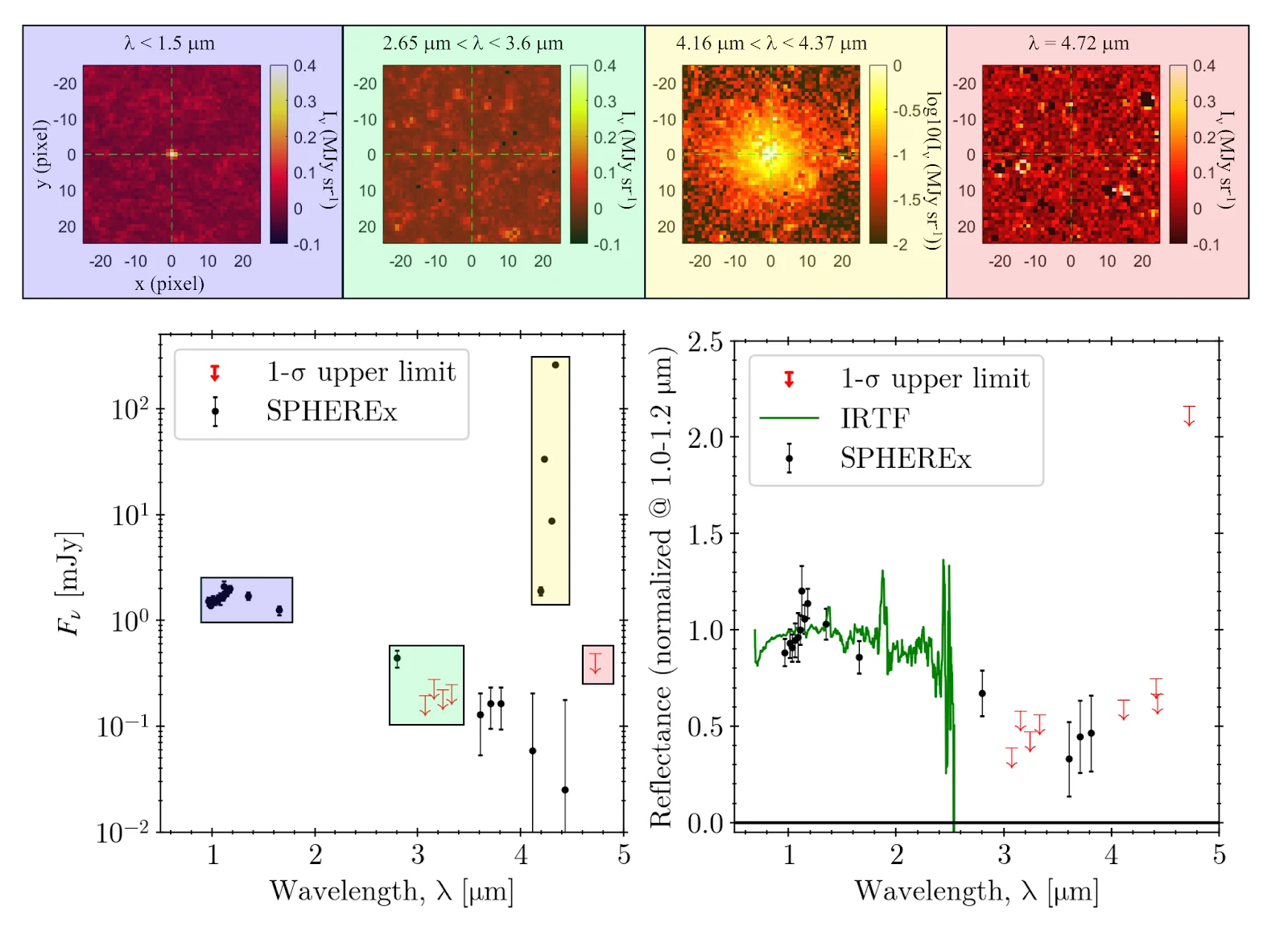
SPHEREx performed spectrophotometry in the near- and mid-infrared (0.75–5.0 μm) with enough resolution to isolate the absorption bands of water ice at 3.05 μm and carbon dioxide ice at 4.27 μm. For each of the dozens of prestellar cores, an absorption spectrum was constructed against the background light of background stars. Then the optical depth of the ice was measured and compared with the gas density estimated from dust emission. Archival data on dust temperature were also used to separate heating effects from evaporation effects.
Results
In most cores, the abundance of water ice drops by a factor of 3–5 as the gas density increases from $10^4$ to $10^6$ particles per cubic centimeter. The dust temperature remains below 20 kelvin, ruling out thermal evaporation as the sole cause. A similar but less pronounced trend is seen for carbon dioxide ice. The total mass of vanishing ice in a typical core is estimated at 10^−5 solar masses, comparable to the mass of a future protoplanetary disk. This is the first direct observational evidence that ice is actively reprocessed even before gravitational collapse begins.
Implications
This work stands out from neighboring studies in scale: instead of individual objects, statistics over dozens of cores; instead of late stages, the earliest phase. It is the first test of the hypothesis of nonthermal ice desorption, driven by cosmic rays or ultraviolet radiation, in real prestellar cores. If ice disappears this early, the chemical composition of future planetary systems is set before the star is born, not in the protoplanetary disk as previously thought.
Future development
The next step will be to observe the same cores with higher spectral resolution to separate the contributions of different ice forms (amorphous and crystalline) and to detect possible organic compounds. It is also important to track the fate of the evaporated ice: does it go into the gas phase and then re-freeze onto dust grains, or does it leave the core? Models of cloud chemical evolution will need revision to account for nonthermal desorption at early stages.
Impact
The result will directly affect models of planetary system formation and estimates of water and organic content in protoplanetary disks. It is also important for interpreting observations of interstellar comets, which may preserve a memory of the chemistry of their parent cloud.
Next steps
Repeat observations with higher signal-to-noise ratio and spectral resolution, and expand the sample of cores to different evolutionary stages. In parallel, laboratory experiments on nonthermal ice desorption under conditions approximating interstellar ones.
Key open problems
The work addresses a fundamental unsolved problem in astrochemistry: what are the initial conditions for the chemical evolution of protostellar disks. Until now, it has been unclear how much water and organic molecules survive from the molecular cloud to planetesimals. SPHEREx data show that a significant fraction of ice is lost even before collapse, which may explain the water deficit in some planetary systems.
The knowledge machine's view
This section is addressed to the author of the paper and their colleagues. Neighbouring works were found by meaning-based search across our archive, not by word overlap. We do not review: we show the field around the work.
What the work does
The authors used SPHEREx data to systematically study the absorption bands of water and carbon dioxide ice in dozens of prestellar cores. They found that ice abundance decreases with increasing gas density at temperatures below 20 K, pointing to non-thermal desorption processes even before the onset of collapse.
Where its strength is
The strength of the work lies in its statistical approach: for the first time, a systematic disappearance of ice is shown in the earliest phase, filling the gap between cloud chemistry and protoplanetary disk chemistry.
Where it could go next
- It might be interesting to compare the observed ice weakening with the content of complex organic molecules, which laboratory and observational studies show can form during non-thermal ice reprocessing.based on: Cosmic Ice Holds Recipes for Molecules arXiv:2602.05383
- A related avenue is the study of dust in distant galaxies; comparing with that could help clarify how the ice-to-dust ratio changes in different environments and how universal desorption processes are.based on: Light from Distant Galaxies Reveals the Secrets of Dust arXiv:2608.08393v1
- One could also consider a connection with work on weighing dust around young stars: if ice disappears already in prestellar cores, that should affect the mass and composition of dust in protoplanetary disks.based on: Weighing the Dust Around Young Stars arXiv:2603.06230
Worth trying
- Test the correlation between the rate of ice disappearance and cosmic-ray intensity, using gamma-ray maps.
- Compare the obtained ice abundance profiles with non-thermal desorption models that include photodesorption in the interstellar UV field.
- Search the spectra for signs of ice reprocessing products, such as bands of complex organic molecules, in the same cores.
Why this may matter
If ice is actively reprocessed before a star is even born, it changes our understanding of what chemical composition planets inherit, and it could explain the diversity of organics in planetary systems.
Nearby works in our archive
- Ice Shadow in Scattered Light: SPHEREx Detects Vanishing Ice in Centers of Prestellar Coressimilarity 0.57
- Light from Distant Galaxies Reveals the Secrets of Dustsimilarity 0.55
- Cosmic Ice Holds Recipes for Moleculessimilarity 0.54
- Invisible Matter: When the Universe's Oven Cooledsimilarity 0.54
- Where Dwarfs Ignite Starssimilarity 0.53
- Weighing the Dust Around Young Starssimilarity 0.53
The archive is sparse around this work: the closest review is only 0.57, against a usual 0.64. It looks like few have drilled nearby.
The temperature in the studied cores is only 10–15 degrees above absolute zero, yet even at such cold, ice evaporates, thanks to cosmic rays that knock molecules off the surface of dust grains.
In Arthur C. Clarke's novel "2010: Odyssey Two," the icy moons of Jupiter hold water for future generations. SPHEREx observations show that water in the form of ice can disappear from the coldest places in the universe long before it becomes available for life.
Key numbers
- core temperature: 10–20 K
- gas density: 104–106 cm^-3
- drop in ice abundance: by a factor of 3–5
- mass of vanishing ice: 10-5 solar masses