Gravitationalcollapse is the process by which a massive body contracts under its own gravity, often leading to extreme states of matter such as neutron stars or black holes. It is a fundamental mechanism in astrophysics, governing the life cycles of stars and the formation of compact objects. The process explains phenomena ranging from supernova explosions to the creation of gravitational waves, and it is central to understanding the most extreme environments in the universe.
History
The concept was first rigorously explored in the 1930s by J. Robert Oppenheimer and Hartland Snyder, who showed that a sufficiently massive star would collapse indefinitely, forming what later became known as a black hole.
How it works
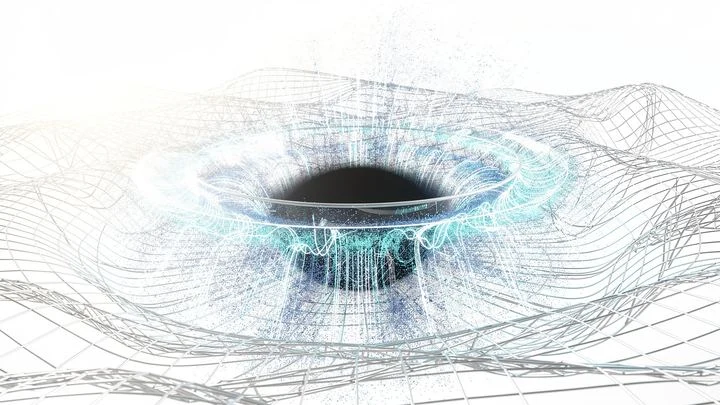
When a star exhausts its nuclear fuel, the outward pressure that once balanced gravity diminishes. Gravity then compresses the stellar material inward. If the core's mass exceeds the Chandrasekhar limit (about 1.4 solar masses), no known force can halt the collapse, and the core continues to shrink until it forms a singularity, a black hole. During this collapse, enormous amounts of gravitational potential energy are released, often triggering supernova explosions and emitting gravitational waves.
During gravitationalcollapse, the infalling matter can reach speeds close to the speed of light, causing time dilation effects that make the collapse appear to freeze from an outside observer's perspective.
A light ray passing near a massive body bends around it, like a runner rounding the corner of a stadium. For a neutron star, this deflection angle is usually assumed to be the same as for a point mass. But if the star is wrapped in an invisible halo of dark matter, the picture changes: light passing through the halo is deflected less than the total mass would predict.
An avalanche in a sandpile starts with a single grain. No one knows exactly where it will slip or how big the slide will be. But if you keep pouring sand, the pile itself reaches a state where avalanches of all sizes, from tiny trickles to massive collapses, follow the same law.
A globular cluster, a dense swarm of hundreds of thousands of stars, plows through a galaxy like a bullet through water. In ordinary dark matter (the invisible mass that holds galaxies together), it should quickly lose speed due to dynamical friction.
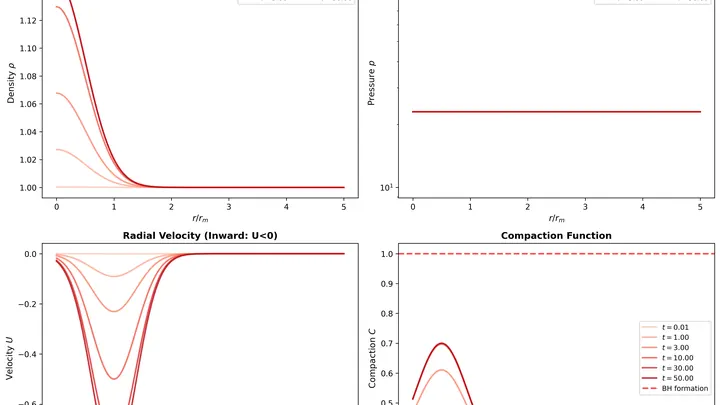
A cloud of waves collapses under its own gravity. While it's loose, everything goes by the book: the field oscillates gently in nearly flat space, and approximate formulas work perfectly. But add just a bit more energy, and the picture changes.
Physicists used a numerical model to catch the moment when simple calculations stop describing reality.
A campfire burns steadily and long. But when the wind blows, the flame flickers out, leaving only embers. A similar story plays out with the gravastar — a hypothetical object that was supposed to replace the black hole.
An ordinary black hole hides a singularity — a point where the laws of physics break down.
In August 2019, the LIGO and Virgo detectors picked up gravitational waves from the merger of two compact objects in a binary star. One weighed 23 solar masses — a standard black hole. The other came in at 2.5–2.67 M⊙.
At the centers of many galaxies, not only supermassive black holes lurk, but also vast clouds of invisible matter. If this matter consists of ultralight particles, it can gather into dense clumps — a kind of 'star' made of dark matter.
The world around us is three-dimensional, but perhaps that's just an illusion. Some theories allow for extra dimensions of space, curled up or stretched in special ways. One such model depicts a five-dimensional universe with a "diluted" dimension (called a linear dilaton).
In the first moments after the Big Bang, the universe was filled with a hot, nearly uniform plasma. But in some places, the density could randomly be slightly higher. If such a clump gained critical mass, it collapsed into a black hole: this is how primordial black holes were born.
Dark matter is the invisible scaffold of the universe. It doesn't shine, but its gravity holds stars in galaxies. In some models, dark matter particles can collide and exchange energy, like molecules in warm air.
In the standard picture, black holes are the undisputed density champions: all their matter is squeezed into a single point. Imagine the entire mass of Mount Everest packed into a grain of salt. But physicists have found a theoretical trick.
Quantum objects live in a world of superpositions — being here and there at the same time, with one spin and another. But as soon as they gain enough mass, this magic fades. Roger Penrose suggested that gravity itself is to blame.
A dying star is not just fading away. In its final moments, the core, starved of fuel, collapses into itself at colossal speed. Classical gravity leaves no choice: if the mass is large enough, a black hole is born — a region from which not even light can escape.
A star that has exhausted its fuel falls into itself. Its outer layers fly apart, while the core compresses to unimaginable densities. It was once thought that this process ends in a point — a singularity where the laws of physics break down. New work shows that just before the very end, something strange happens inside the future black hole.
A magnet with only one pole (north, without a south) is not a fragment but a particle in its own right. Physicists call it a magnetic monopole (a carrier of a single magnetic charge). Such visitors could have been born in the early universe, when the forces were just separating.
A thrown stone arcs along a clean trajectory, but an electron's position in an atom is smeared out like fog. The transition from one to the other is a puzzle. New work shows that the fuzziness disappears not because of an observer, but because of the particle's own gravity.
Light reflecting off the scorching disk around a black hole can reveal more about it than we ever thought. When the disk emits heat, some of that light bounces back onto the disk and scatters, acquiring an unusual energy distribution, as if a new component, resembling a power law, is added to the ordinary glow.
A wormhole is a hypothetical tunnel that shortens the path between distant corners of the universe, like a soap bubble stretched between two points. To keep the bubble's walls from closing, a special film is needed — matter with negative pressure, akin to dark energy. But this support isn't eternal: remove half the film, and the bubble bursts.
In 2019, gravitational-wave detectors caught a signal from the merger of distant objects. One was a black hole of 23 solar masses. The other weighed just 2.5 solar masses — and that's weird.
Usually, neutron stars don't get heavier than two solar masses: beyond that, they collapse into a black hole.
When two black holes merge, the newborn hole should ring like a bell, emitting gravitational waves — ripples in space. Yet before the ring, a silence can fall: the black hole gets caught in a phantom trap, as if an invisible hand grips the bell’s clapper.
In the quantum world, an object can be in several places at once. Yet in everyday life we see things strictly in their places. The reason is gravity. A massive star under its own weight inevitably collapses into a black hole or a neutron star, but it can't be both at the same time.
A homogeneous dust sphere begins to contract under its own gravity. Inside it, like a rescue bubble, a region of negative pressure inflates: the de Sitter bubble. It expands, slows down near the very edge of the fall, and freezes at the Schwarzschild radius.