Water ice is not just frozen water; in astrophysics and planetary science, it is a key tracer of conditions across the cosmos. When light from a star or other source passes through or reflects off ice, certain wavelengths are absorbed by the molecular vibrations of H₂O. This leaves a distinctive fingerprint in the spectrum, allowing scientists to identify the presence of ice in distant interstellar clouds, on planetary surfaces, or in the rings of Saturn. The study of water ice spectra reveals not only where water exists but also its temperature, crystalline structure, and even the presence of other molecules trapped within it.
History
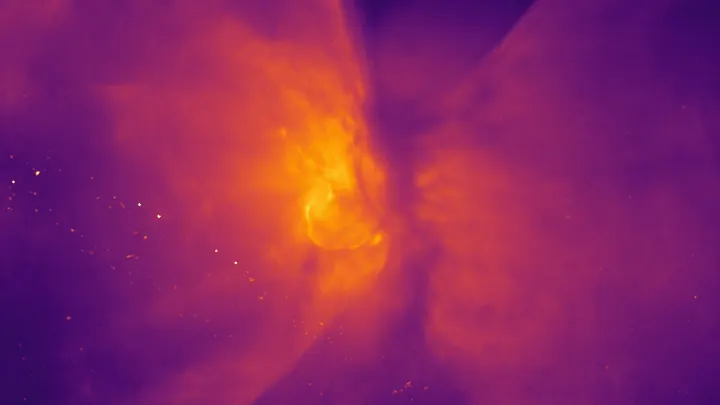
The first identification of water ice in space came in 1969 when astronomers detected its absorption feature in the spectrum of the young star BN in the Orion Nebula, using ground-based infrared observations.
How it works
Water molecules absorb infrared light at specific wavelengths, particularly around 1.5, 2.0, and 3.0 micrometers, due to stretching and bending vibrations of the O-H bonds. In ice, these absorption features shift and broaden depending on whether the ice is amorphous or crystalline, and on its temperature. By comparing observed spectra to laboratory measurements of ice under various conditions, astronomers can infer the physical state of the ice and its environment.
In practice
Spectral analysis of water ice is used to map the distribution of water in the solar system and in star-forming regions, guiding missions like NASA's Europa Clipper to assess the habitability of icy moons.
Fun fact
Water ice in space can be amorphous—lacking a regular crystal structure—when formed at very low temperatures, and it slowly transforms into crystalline ice over millions of years under cosmic radiation.
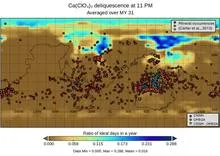
Every Martian night, salt crystals on the planet's surface soak up moisture from the thin air, much like a sponge draws water from a damp cloth. By morning, a microscopic brine accumulates inside them, and during the day, as temperatures rise, that brine finds itself trapped in tiny cavities.
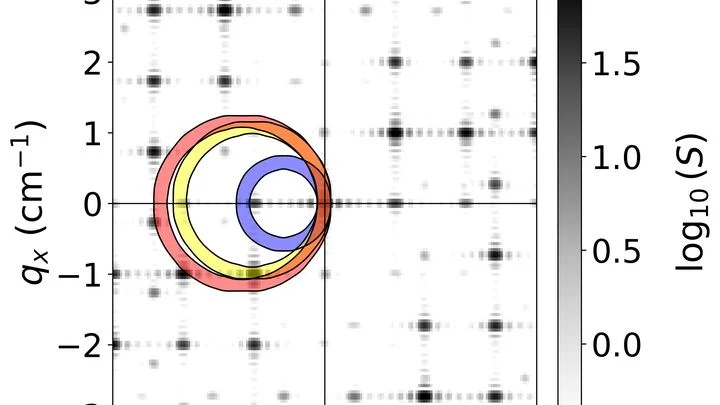
Waves on the water's surface usually break against any obstacle — a rock, a piling, an island. But what if you arrange obstacles so cleverly that the wave barely notices them? In a new study, scientists assembled a pattern of many points on the water, arranged according to special mathematical rules, and sent waves through them.
In the coldest, darkest corners of space, dust grains get covered in ice, like a window on a frosty day. This ice isn't just frozen water: it also contains carbon monoxide and carbon dioxide. From such ice, comets and planets may eventually assemble. But until now, it was unclear how the dust grain itself affects the ice that forms on it.
One hundred forty parsecs, a distance light traverses in four and a half centuries, separate us from the Taurus molecular cloud. Within its depths hide dark condensations: prestellar cores, where gas and dust slowly contract under their own weight.
Water is not just a wet substance. On a picosecond scale, it resembles a dance floor where molecules continuously break and form bonds with each other. Usually, this dance is described by one main movement — collective relaxation, as if the whole crowd simultaneously slows down after the music stops.
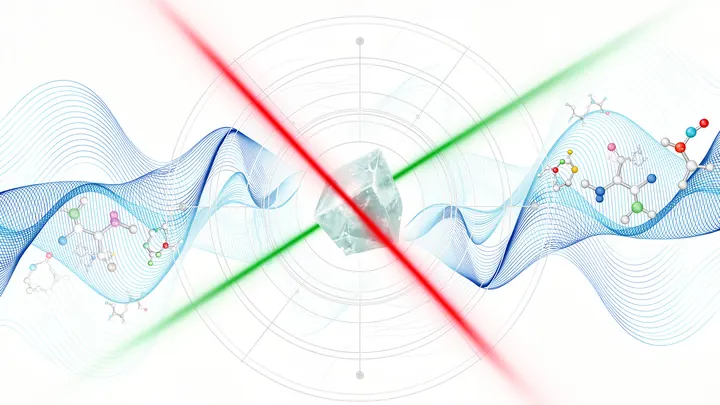
Spectroscopy has always been a way to hear the unheard. Back in the 19th century, Johann Balmer deciphered the elegant lines of hydrogen — a simple numerical harmony that foreshadowed quantum theory.
The atmosphere of Titan, discovered by Christiaan Huygens, is opaque to ordinary telescopes. But spectral analysis finds 'windows' of transparency — narrow regions where the haze parts.
The James Webb Space Telescope peered into a disk of gas and dust around a young star where planets are born, and for the first time spotted ice made of heavy water. This water is not ordinary: in its molecules, regular hydrogen is replaced by deuterium, its heavier sibling.
When astronomers peer at distant worlds, they often don't see crisp lines of water vapor or methane, but a blurry silhouette, as if the planet has thrown on a thick veil. This veil, a haze of organic particles, behaves like a temperamental photographic plate: it darkens under harsh ultraviolet light, revealing hidden chemical patterns.
A stellar river winds around the center of a distant galaxy like a glowing ribbon on an invisible frame. That frame is the dark halo: a vast cloud of invisible dark matter whose gravity holds stars and gas in place. If the halo is squashed like a pumpkin or stretched like a melon, the stellar stream will bend differently.
Strike a bell, and it hums at a single pitch. But if you place a second clapper inside, and they ring without touching each other, the sound becomes more complex. That's roughly how the neutron star from the new study is built. It's not just a hot sphere: inside, two immiscible fluids can flow — for instance, superfluid neutrons and ordinary plasma.
A giant planet hangs in space in complete solitude, separated from its star by a distance 160 times greater than the path from the Sun to Pluto. The light from its parent star arrives so faintly that the surface temperature barely exceeds 200 degrees Celsius — about as warm as a well-heated sauna.
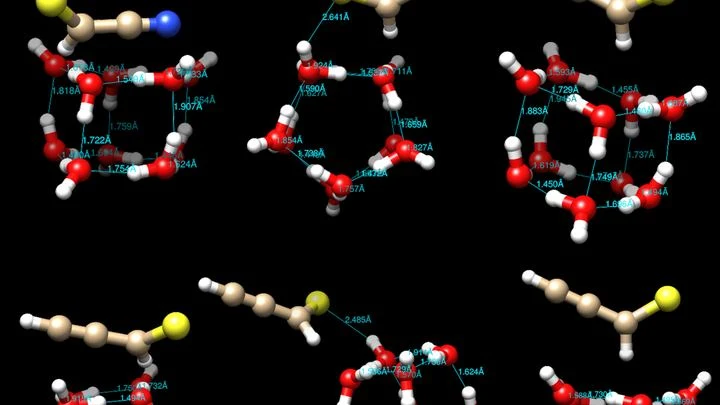
In a cold cloud of gas and dust that astronomers call TMC-1, two sulfur-bearing compounds were recently found: one smells like bitter almonds, the other like rotten eggs. But such a cloud contains less sulfur than it should. Where does it go? It seems to hide in tiny icy pockets on the surface of dust grains.
Space ice is not like a skating rink. It is fluffy, like snow, and full of crevices and hollows.
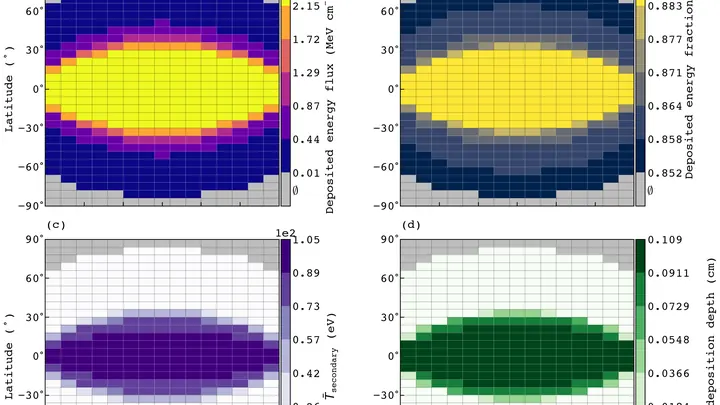
Europa's surface is an icy armor continuously bombarded by charged particles from Jupiter's magnetosphere. Electrons slam into the ice's crystal lattice, lose energy, and kick off chemical reactions. Until now, there was no tool to show how deep such bombardment pierces the ice.
When an exoplanet briefly eclipses its star, starlight passes through its air and absorbs its chemical taste. This technique, the transit method, is the core of how the James Webb telescope works.
In a blazing foundry, any ice cube would vanish instantly. But tucked inside a thick mitten, it survives. Nature pulled a similar trick in the planetary nebula NGC 6302.
In dark, cold clouds where stars are just beginning to form, dust grains put on icy coats. This ice is not just frozen water: it contains dissolved carbon dioxide, methanol, ammonia, and other molecules.
A distant red object usually means one thing: we're seeing a dust veil over a scorching disk falling into a black hole. But when the James Webb split its light into shades, a shadow appeared inside — just like steam from boiling water intercepts rays.
Neutrinos are ghost particles: predicted by the Standard Model, they barely interact with matter. Catching them is like trying to hear a whisper in the roar of a waterfall.
In the dark, cold clouds of space where stars are born, dust grains become coated with a thin layer of ice. This ice is not just frozen water but a mixture of different molecules: carbon monoxide, carbon dioxide, nitrogen, and others. For a long time, astronomers could not find nitrous oxide (N2O) in this ice — the very "laughing gas" used in medicine.
Deep inside a molecular cloud, where temperatures drop to 10–20 kelvin and gas densities reach a million particles per cubic centimeter, a frozen shadow prevails. There, far from starlight, water, carbon dioxide, and other molecules freeze onto dust grains.